Backyard Reflections

Last week was a big one—my eightieth birthday and our fifty-fifth wedding anniversary.

Your New Favorite Writer is now an octogenarian and, presumably, past ordinary cares. 
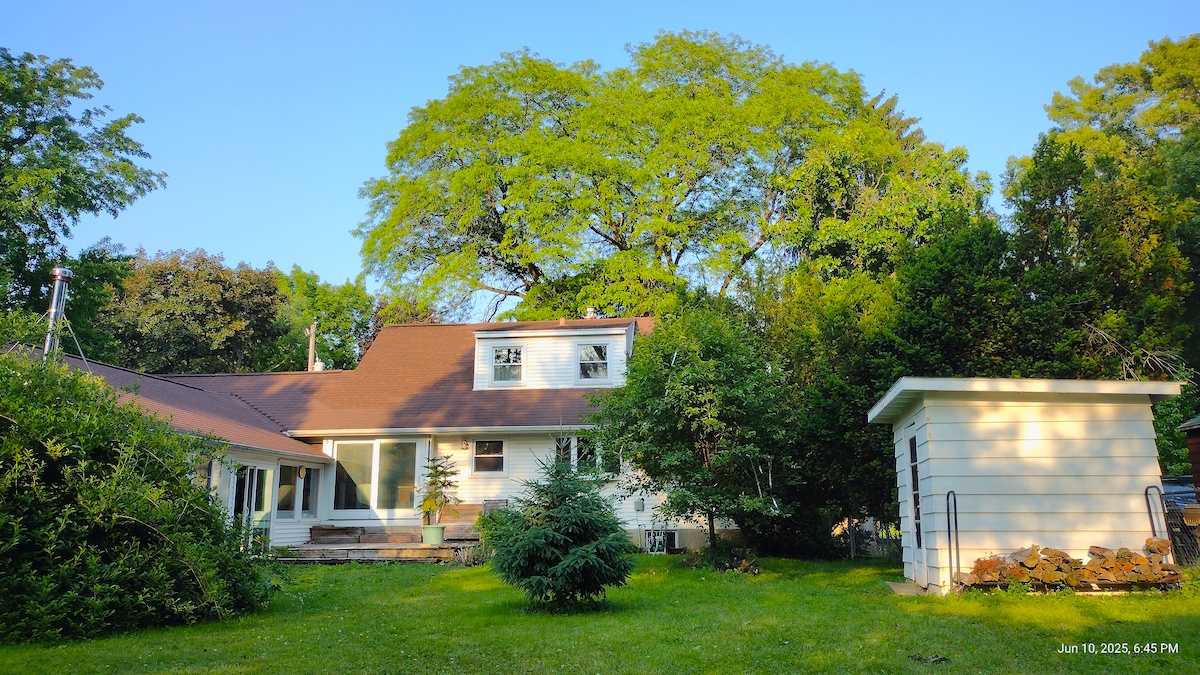
My backyard.

I love to occupy my zero-G chair in the backyard, staring at the black locust tree that arches high above our roofline. I’ve traveled the world and seen its sights. I love Italy and Alaska; I really like Iceland, Austria, Croatia, and Costa Rica. But my favorite place in the whole wide world? Right here, in my backyard. 

Fooboo.

Fooboo and I sit here of evenings and commune with the Great All. This communion is sweeter by a glass of wine—or Benedictine, better yet. I share a bit of sharp Wisconsin cheddar with Fooboo. He gobbles it and, if a morsel drops, chases it among the grass blades. I eat mine on a Wasa rye cracker.

I read a book—a history or biography, or a good novel. I see birds and sometimes frame them in my Nikon 8×30 binoculars. 

But even at eighty, life’s not all about sitting and relaxing. I picked up some firewood logs the other day from a guy who wanted to get them out of his backyard. I’ll give them a new home, split into pieces, in my woodstove next winter. As I was loading the heavy wood into my little car, he said, “You’re a tough old bird, aren’t you?” I think he meant it as a compliment, not an insult, but in any case I’ll take the rap.

LeRoy “Satchel” Paige in 1970. Photo by Bernard Gotfryd. Public domain.

Some people don’t make it to eighty; others are in poor shape when they get there. I’m blessed to be able to continue most of my usual activities—and suppose I’d better do so as long as I can. Satchel Paige said, “Don’t look back. Something might be gaining on you.”

Me and my significant other.

“It takes life to love Life.” That was the advice of Lucinda Matlock in Edgar Lee Masters’s Spoon River Anthology.

What is this I hear of sorrow and weariness, 

Anger, discontent and drooping hopes? 

Degenerate sons and daughters, 

Life is too strong for you — 

It takes life to love Life. 

That’s a more stirring philosophy than I would have come up with on my own, but it approximates my lifemate’s approach to all things, and in fifty-five years I guess I have soaked some of it up.

So I keep on playing tennis, which is just plain fun. And I keep on walking the dog, even when my hips hurt. And I’ll keep mowing the lawn, walking thousands of steps behind the Toro; though I don’t enjoy it all that much, I’m terrified to stop. And I reckon I’ll get all that wood split before winter.

I’m not ready to quit life yet. Tough old bird, you know.

But the best thing about old age—and I’m only starting to grok the fullness of it, Gentle Reader—the best thing is, I get to enjoy and appreciate everything. Things that used to drive me crazy now do nothing but warm my heart. 

The folly, stupidity, and perversity of the human race? Well, what do you expect? It’s only human. We all mean well. We can’t help that we’re limited creatures. But in the living of life, we do throw off occasional gleams of splendor. 

I think my worst birthday was when I was thirty. I had reached three decades of age and felt I had not accomplished anything. I meant I had not written a symphony or the great American novel; I had not made a million dollars; I was not President of the United States. I was a failure.

What I did not know then, but do know now, is that most of us don’t leave a great big mark on history. Most of us leave a whole lot of little marks—and half of them, for better or worse, we don’t even know we’re leaving. 

It can take a lifetime to wise up to the great joy of living.

The poet W. D. Snodgrass, when he was only thirty, wrote: 

While scholars speak authority

And wear their ulcers on their sleeves,   

My eyes in spectacles shall see

These trees procure and spend their leaves.   

There is a value underneath

The gold and silver in my teeth.

Though trees turn bare and girls turn wives,   

We shall afford our costly seasons;

There is a gentleness survives

That will outspeak and has its reasons.   

There is a loveliness exists,

Preserves us, not for specialists.

I’ve tried sometimes, but never quite succeeded, in specializing. Guess I’m just a tough old bird.

Blessings,

Larry F. Sommers

Your New Favorite Writer

I Say–That’s Not Cricket!

Our Indian friend Rushabh took us to see a cricket game—pardon me, I mean a cricket match—at a local park here in Madison. He was kind enough to explain the game to us as we watched, so now I know all about cricket.

Anybody who has ever played baseball can easily grasp the essence of cricket, which was bequeathed to the Indians and others by the Raj. Americans were exempted from the need to play cricket by our timely exercise of the British Empire’s Early Opt-out Clause. 

Look, the game’s simple. I will explain it for you:

A cricket match begins when the umpire drives long stakes called “wickets” into the ground with a ceremonial implement that resembles a cast-iron skillet. Once the wickets are planted, he casts an eye upon them to check their alignment, a process known as “laying the battery.” 

Then two groups of men shouting in a mix of English and Gujarati assemble on the grassy field where three giant concentric circles have been drawn around the two distinct wickets. 

A bunch of guys stand around a big circle. Photo by Nigel Chadwick, licensed under CC-BY-SA-2.0.

Now, here is where the game differs ever so slightly from baseball: A baseball diamond is essentially a quarter of a circle, with the batsman at its apex. A cricket ground is a full circle with the batsman more or less in the middle. 

There can be no foul balls! Anywhere you pop the thing up, even behind you, could be a home run—which is called a “six” because it scores six points.

Arm-waving inflatable man. Photo by Alex Liivet, licensed under CC-BY-2.0.

In all other respects, it’s just like baseball. For example, the pitcher, who is called the “bowler,” throws the ball toward the batter. Only, he’s allowed, maybe even required, to take a running start and fling his arms around like one of those inflatable tube-like advertising dummies you see on used car lots, before delivering his pitch, er, bowl. 

The batsman gets to swing at the ball, after the whirling-dervish bowler lets it go, and his main object is to defend the wicket from the ball, using his bat to deflect it wherever he chooses. There are actually two batsmen, but only one of them gets to defend the wicket. The chief task of the other batsman is to switch places with the first one after the ball is hit. 

If the ball slips by the batter and hits the wicket, the batter is out. Likewise, if he hits the ball away from the wicket but a defender catches it in the air, he is also out, just like in baseball. Or if a defender fields a grounder and throws it to the wicket before the two batsmen can change places, the actual batter is out. 

Defending the wicket from the nasty old ball. Photo by Acabashi, licensed under CC-BY-SA-4.0.

Each team is allowed ten outs per inning, but the inning ends in any case after 120 good bowls, even if ten men have not been retired, which by the way they call “dismissed.” Then the other team gets a chance to exceed the first team’s points in the bottom half of the inning. Either they do or don’t, and then everybody goes home. After one inning. One lo-o-ong inning. 

Unless, of course, it’s a test match—in which case they play for five days or until the lawn needs mowing, whichever comes first. 

Toward the end of an inning the players may become impatient and attack the umpire with their bats, pummeling him to an unconscious heap between the wickets. This is the original British source of our familiar baseball phrase, “struck him out.” 

Once the umpire has been struck out, both teams retire to their respective pubs to toast their victory or nurse their grievance for the next five days or until the grass is cut. 

There you have it, sports fans. Just thought you’d want to know.

Blessings,

Larry F. Sommers

Your New Favorite Writer

Why do I blog?

Dear Reader: A writer friend recently asked, “What are the benefits of having a blog?” One could turn the question around and answer, “One of the benefits of having a writer friend who asks about blogs is that it may prompt the production of a blog post.” Read on.

“In my dotage, I am reduced to bloggery.”—King Lear, Act VII, line 4,926. Painting: King Lear and Cordelia, by Benjamin West (1793) / Folger Shakespeare Library, Wikimedia Commons.

When I was young, I did not know what “blog” meant. It didn’t mean anything, yet. Nobody knew what a blog was, because the word hadn’t been invented. The thing hadn’t been invented.

Aw, shucks—computers were giant machines in huge buildings, fed and monitored by teams of scientists in white lab coats. They were used only for Big Problems, like calculating the complete value of π as it will be revealed on the Day of Judgment. 

I did know I wanted to be a writer, but that’s as far as it went: wanting to. It may strike you as crazy, Dear Reader, but I had not the slightest idea how to be a writer. 

As far as I knew, you would shut yourself up in a room with a typewriter and a ream of paper, and SHAZAM!, something would strike you, and you would write it down, mail it off to Bennett Cerf, and get a million dollars. 

Well, it worked for Melville and Hemingway and Louisa May Alcott—why not for me?  Never mind that Melville could barely support his family, Hemingway killed himself, and Alcott wrote girly stories: the point was, you had to do your writing all alone, and it was a divine gift, not something that could be learned.

I now believe that writers do NOT produce great works in isolation. Homer’s epics were no doubt recited over and over, to many different audiences, giving him an idea what worked and what didn’t. Shakespeare’s plays, like all plays, were molded line by line as actors spoke those lines and played the parts. The great American pantheon of writers—Emerson, Thoreau, Longellow, Holmes, and the rest—all knew one another, read one another’s work, and functioned as a little New England-based Algonquin Roundtable.

I’ll bet even J.D. Salinger learned something from somebody. He was just too much of a jerk to admit it.

When I finally began aspiring to be a writer seriously, after retirement from other gigs, I knew that I needed to seek out those who could teach me. They included actual writing teachers like Christine DeSmet and Laurie Scheer, but they also included a great many fellow writers. Comrades in arms; sufferers from the writing disease. People who, like me, spent their time down in the trenches of storytelling—looking for ways to make our efforts stand out and attract readers. 

I learned that writers like to form little clubs—groups for mutual critique and support. In one of the writers’ groups I joined, Tuesdays With Story, blogs came up in conversation. By this time, blogs had become a thing. 

Blogs may be very specific, devoted to one craft, hobby, or special interest. But on the whole, they tend to range a bit wider. A blog can be a window into a writer’s soul.

It was rumored in our group that if one was writing novels and wanted to get them published and read, it was essential to have a “platform”—a basis for public recognition of one’s work. And a blog was a great way to build a platform.

But, Fair Reader, please be advised Your New Favorite Writer did not just fall off a turnip truck. Oh, no. It was immediately apparent that a blog, if it was to be any good, would be just as much work as any other form of writing. If I wanted to have a blog and have that blog represent my work fairly to the world, I would have to put as much time and effort into it as into my novels and short stories. And what would be the point of that?

“Well,” said my friend Jerry Peterson, then the convener of the Tuesday night group, “you might think of a blog as not just a way to promote your work. It might be your work—or at least a significant part of it. After all, you can write whatever you want, and as owner of the web address, you are in a position to present it to the world, without an intervening gatekeeper.” 

Oh. 

That.

Jerry was suggesting that a blog is essentially a form of self-publishing. In those days, only a few short years ago, self-publishing was not as respected as it is today. Still, it was a way to get my work in front of people. People who might like what I’m doing and hunger for more. Books, for example. 

I could see where this was going. I resolved to plunge in, give it a try. That was over six years ago. What you are reading now is the 317th installment of this blog, titled “Reflections.”

Why this, particular, blog? 

When I started writing it, I did not know what I was doing. But people whose views I respected said, “Your blog should have a theme, a brand. It should be identifiable as something. You should have some idea what you’re trying to do with it.” 

Well, it was to be a means of presenting my writing to the public. Well, that was all to the good. For the first time in my life, I felt like I had something to present to the public. I wasn’t qite sure what, but I was on the trail. 

Did I mention, Gentle Reader, that there was a gap of sixty years or so between when I first knew I wanted to be a writer and when I actually started learning how?

I now recognize that long hiatus as being merely the most obvious symptom of the fact that, when I started out, I didn’t have anything to say. But as we age, we acquire experience and even, we hope, wisdom. 

Now, I do have something to say. It’s just hard to figure out what it is, and how to say it. But not impossible. And the figuring out is best done by actually writing. Somebody said you have to write a million or so words of bad writing before it starts coming out good. So I’m working on that. 

I’ve got something to say. I can say it in writing. It’s just hard. 

By the time I launched this blog, I had already figured out that everything I have to say comes out of my deep attachment to the past—my commitment to re-experience the past, to plumb its depths, and to refashion historical knowledge into historical fiction: writing that says, “within an understandable historical context, here is what life may be, at its best or at its worst, but definitely life as best apprehended in the living of it.” 

If this is what my writing is about, it’s what my blog should address. I knew that, with a weekly deadline, I would wind up rambling a bit and imprinting my own personal take on what it means to dig into the past and relate it to the present. So I decided to call this blog “Reflections”—a very general kind of label—but to further qualify that with the catch-phrase “seeking fresh meanings in our common past.” 

That’s what Your New Favorite Writer has been trying to do every week since then. 

What has surprised me is how ccreativity is like a well. In a good water well, you may have to prime the pump, but once you do, it brings up fresh stuff. The well never runs dry. Almost every Tuesday for the last six years I’ve found something to write about, to the tune of a thousand words or so.

Sometimes I miss Tuesday and post a day late (like this week!). Once in a while I have not had time to do a new post and so have re-run an old one. But not very often. It’s just a matter of tweaking my brain a bit, and out it comes.

Some posts are more consequential than others. Some more literary, some more wry, some more snarky. But all have to do, in one way or another, with the passage of time and what that means in the living of life. 

They are not full novels, like The Price of Passage or Izzy Strikes Gold!, but they’re well-meant installments in a writer’s quotidian encounter with the stuff inside and the stuff outside. I hope you find some merit in the reading.

Until next time,

Blessings,

Larry F. Sommers

Your New Favorite Writer