The Gathering

Visit of the Wise Men, from an 1894 Sunday School lesson, by lithographers Harris, Jones & Co. of Providence. Public Domain.

Tomorrow will be Christmas Eve. On Thursday morning, as Santa’s sleighbells jingle away to the North, the Big Day itself will arrive. 

This will be my eightieth Christmas on Earth. 

The first few of those eighty are lost in the mists of time, permanently and perpetually outside my experience. But I recall clearly the next several after that. I remember times of gathering and feasts of togetherness. 

After the workday—most folks used to put in a whole day on December 24—Mom and Dad piled us into the car and we drove in darkness over the hundred miles from the city of Streator to the little town of Knoxville on the Illinois prairie, to gather with family.

1936 Plymouth, from an old postcard. Fair use.

The car was a 1936 Plymouth or a 1939 Chevrolet—both of them relics from an old-time gangster movie—or, later, our first modern car, a 1954 Plymouth. I sat in the back seat with my sister Cynda. We all four sang Christmas carols all the way down the road. Over the river—both Illinois and Spoon—and near some woods but mostly through plateaus of snow-dusted corn stubble, to Grandmother’s house we went.

It was all about gathering. Being together. 

We gathered together with Grandma and Grandpa, with Uncle Dick and Aunt Jane and Cousin Rick, with Uncle Garrett and Aunt Edith and Cousins Steve and Betsy, with Aunt Jo and Uncle Earl, with Aunt Jean and her boyfriend Richard Henderson, with Aunt Sue and Aunt Linda; with Grandma’s sister Aunt Bertha and her husband Uncle Harry Young; with Dad’s parents, my Grandma and Grandpa Sommers, who had no other children left in the Midwest and so joined the LaFollette mélange; and sometimes we would even see Grandma LaFollette’s brother Uncle Roy Dredge and his wife, Aunt Eva.

Eighteen of us including the unpictured photographer, who is probably Aunt Bertha, plus General George C. Marshall on the cover of Life to prove it’s Christmas 1950. Your New Favorite Writer is the boy at lower left, chin on hands.

That made twenty to twenty-five of us all celebrating Christmas in Grandma’s house. Gathered. Together. And the best part was: we all knew each other. We knew one another very well. We were kin. There’s hardly a better way of understanding love than gathering at Christmas.

“Fear not,” says the prophet Isaiah, “for I am with thee: I will bring thy seed from the east, and gather thee from the west; I will say to the north, Give up; and to the south, Keep not back: bring my sons from far, and my daughters from the ends of the earth; even every one that is called by my name: for I have created him for my glory, I have formed him; yea, I have made him.” 

It’s a grand vision of gathering together, members of one tribe, one kindred. 

That’s what we did on those long-ago Christmases. Our tribe came together, at least those of us who could. We came from east and west and north and south and called one another by name. 

I did not know this fact at the time, but I know it now: It was not the toys that mattered most, nor the turkey and dressing and pie and cake. It was the coming together of the people. The spindly tree, illuminated by strings of gaudy colored lights over which Uncle Dick and Uncle Garrett and Uncle Earl had slaved for hours on the living room floor getting all the bulbs to light up at once, was the totem pole, the magnet that gathered the kin. 

Rice pudding with lingonberries. Fair use.

In my wife’s family it was much the same, only with a Swedish accent, because her mother’s folk were all Swedes, first- and second-generation Swedish Americans. So they had warm glögg with almonds and raisins in the bottoms of the cups; rice pudding with lingonberries; meatballs and gravy; limpa rye bread and dopp-i-gryta, the dipping of bread in fatty broth. But mostly with them, it was the people coming together, even if they were all Swedes except my wife’s father, who was Norsk.

The decades bring forth change. Families are smaller now. Folks tend to be more spread out, east and west, north and south. In our house this Christmas we will have Jo and me, my sister Cynda and her husband Steve, our daughter Katie and her children Elsie and Tristan (teenagers!). Plus Katie’s friend Valerie. Eight, all told. Still, it’s a coming together, a gathering. 

Most of us will attend our church’s Christmas Eve service. It’s a Congregational church, meaning the local congregation governs itself autonomously. Such a church is said to be a gathered church, that is, one formed by a process of kindred souls simply gathering together. And indeed it’s more like a family than like a formal institution. We’ll read the Scriptures and sing the carols and burn up a few candles in the process. But the main thing is, we’ll gather together.

We have within us the seeds of hate and the seeds of love. When we gather together around the Christmas tree or the communion table, we nurture the seeds of love and starve the other ones. 

Two greatly different realities are available to us in this world. I prefer the gathered one.

May you gather this season with whomever you have to gather with. And treasure the time, the place, and the gathering. It’s the best Christmas gift.

Blessings,

Larry F. Sommers

Your New Favorite Writer

The Next Voice You Hear

A church can be the voice of God in our bewildered lives.

Movie poster. Fair use.

In 1950, when Your New Favorite Writer was only five years old, along came The Next Voice You Hear, a film in which God breaks into radio broadcasts, leading people to re-examine their lives. 

Its title came from a standard radio-era trope: A staff announcer’s preparation of the audience for an important message by saying, “The next voice you hear will be . . . .”

In this case, the movie implied, the next voice heard will be God, with a message for the world.

#

The Christian church has always struggled to embody the voice of God for people on Earth. 

In the High Middle Ages, people seemed to accept the notion that what the Holy Roman Catholic Church said, through priests and prelates, was God’s voice. If a pope said, “Go to Jerusalem and conquer it for Christianity,” that’s what people did. It was the voice of God.

Before long, people began to question that equation—mostly because, in the Reformation, “the Church” became two churches, then three. Then a thousand.

With a thousand churches saying different things, how could they all be the voice of God?

#

Today, we have a different problem. Church membership, attendance, and affiliation by any metric you may choose, have all declined—inexorably, year by year, decade over decade. 

In today’s society, it is inevitable that people will say, “Can any church speak for God?”

I am here to affirm, Dear Reader, that it can. See my statement above: “A church can be the voice of God in our bewildered lives.” 

I’m not talking about doctrine. It was once common to suppose that a church could be exactly right—fully orthodox—in its theology. In which case, of course, it spoke with the voice of God.

Few people buy into that kind of thinking anymore. 

Today, Christians are more likely to hew to an old biblical standard: “Ye shall know them by their fruits,” words spoken by Jesus in the Sermon on the Mount.

Permit me to amplify.

#

The church where I worship may serve as an example: Heritage Congregational Church of Madison, Wisconsin. 

Heritage was founded by a group of high-minded civic Christians in 1968. At that time approximately half of all Americans attended church, normally wearing their Sunday best. It was the classic 1950s church. Heritage had about three hundred members soon after it opened its doors. 

Almost immediately, erosion began. Over five and a half decades, our membership dwindled until we are now down to 51 members, theoretically. That translates to an active core group of about two dozen who show up regularly for Sunday morning services and other church events.

Most of us are old. We have three “young” families—mom and dad in their early fifties plus children in their late teens or early twenties. The rest of us are in our seventies and eighties. 

We are not getting any younger. By most reckonings, we ought to be what one old-time member used to call “tired roosters.”

I do not mean we never get tired. We do. 

I do not mean we are whirling dervishes of liturgical and evangelical activism. We are not. 

We are calm. We are patient. We are methodical.

We are full of faith, hope, and love.

#

We were not always that way. We got to be that way. God made us that way. 

Five years ago, we were a dying church. 

We struggled to maintain a huge building far in excess of our needs for worship or any other purpose. Just to keep snow and ice from demolishing the roof was a serious drain on our energies. We always worried about money, mostly money to keep the building going.

Then covid hit. We couldn’t even use this enormous building to gather on a Sunday morning and worship the Lord. We worshiped by Zoom while the building sat empty. That in itself was some kind of revelation, to use a biblical term.

We offered the building for sale. To our amazement, it was snapped up quickly by another congregation at a very fair price. 

Suddenly—SHAZAM!—we were awash in cash. We had no money worries for the first time in anyone’s memory. 

But now we had a different problem. Covid was over. Masks were becoming optional, then rare. Life was back to normal, sort of. And we had no place to meet in person. We deeply yearned to meet again with our loved brothers and sisters face-to-face. 

We rented a storefront in the conveniently-named Heritage Square strip mall. We chose the location because it was central and available. The echo of our church name was just a stroke of good fortune. 

Our storefront worship space.

We thought the storefront would be a temporary location. But you know, we like our new space. We’re in no hurry to move on. For the next few years at least, we can afford the rent. 

Free of the institutional concerns that used to tie us in knots, we have begun to relax. 

We concentrate now on simply holding good, restorative worship services in our new space. Our music director, Robert Eversman, has even built a small pipe organ into our little storefront, making it seem kind of churchy, if you know what I mean. He gets a good sound out of it, too.

There is a small kitchenette, adequate for staging our weekly after-worship coffee and refreshments—a key hallmark of our fellowship.

And some wonderful things have happened: 

The Madison Theater Guild, always hungry for rehearsal space, discovered us. We have hosted their rehearsals for three plays in the last year or so, and they’ll be rehearsing Arsenic and Old Lace at Heritage on weekday evenings early in 2025. We don’t charge any rent or facility use fee. We’re just glad there is something nice we can do for the community.

Some folks who enjoy line dancing use our space on Tuesday afternoons. There is a mah-jong club on Wednesday afternoons. A women’s bridge club may start using our space as well. It’s nice these groups can enjoy a cozy and comfortable space for the things they like to do.

Has all this activity increased our membership? No. But that’s no longer what we’re about.

The church is becoming relevant to our community. 

We collect items for a nearby food pantry, and one of our pastors delivers them there on a frequent basis. Some members volunteer there. It’s something we can do for our neighbors.

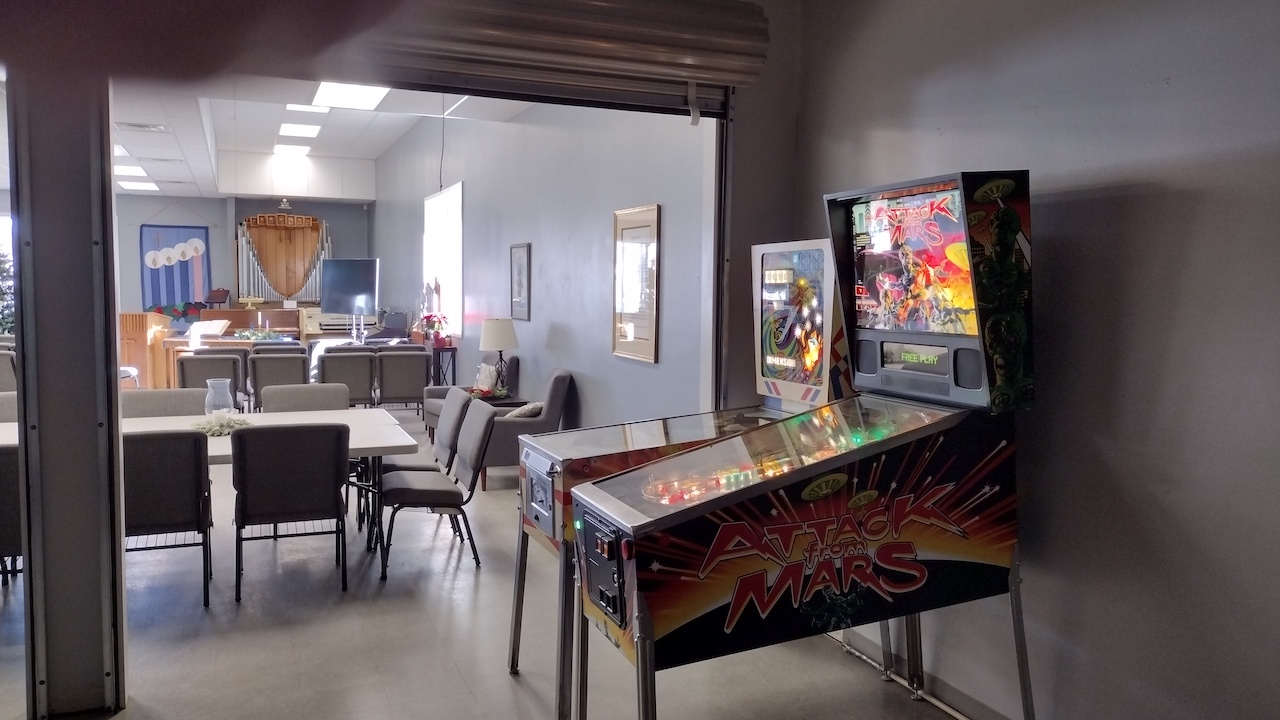
Pinball machines in the back room.

One of our members enjoys rebuilding or reconditioning old pinball machines. He places them in commercial spaces where they generate a bit of revenue. It’s a side gig for him, outside of his regular job. He was running out of space in his basement to store machines, so we said, “Sean, why don’t you put a couple of machines here?” So he did. We don’t know what we’re going to do with them, but there they are. What will God do with them?

Who knows what comes next? We’re in an experimental frame of mind. 

We do not need to hammer our church into a success story. God might plan for our church to die. If so, he hasn’t told us. 

Food supply is one way we have been entrusted to feed his sheep. Play rehearsals, line dancing, mah-jong, bridge, and pinballs might also be ways to feed His sheep.

We don’t know and we don’t need to know. 

We are calm. We are patient. We are methodical.

We are full of faith, hope, and love.

We’re just doing our thing. 

Could that ever add up to the voice of God in somebody’s busy, distracted, vexed, and bewildered life? 

Is that a prophetic ministry?

Who knows? Who knows?

But it’s not nothing. It’s something.

Blessings,

Larry F. Sommers

Your New Favorite Writer

What’s So Good About It?

We show up for choir rehearsal fifty minutes before the Good Friday evening service, ready to do our time-hallowed chore.

Our pastor, with a smile, points out something new. In the entry hall, on exactly the corner of wall where your eye would naturally expect it: 

It is astounding. Our Strategic Planning Team has installed signs to assist first-time visitors. They give just the information that visitors have  been needing ever since the church opened its doors!

This sudden case of our old congregation Doing Something Right For a Change, and with only six months’ prior discussion, lifts a corner of my spirits, unexpectedly. Our church has been shrinking for at least thirty years; I have lost hope for its survival beyond the next crisis. But now, this new lettering stands against my creeping despair, stuck boldly on the wall, staking a claim on the Kingdom yet to come. 

When the shock of it subsides, we go ahead and rehearse our music. 

At seven o’clock the service begins. We are thirty-one souls, counting the pastor, the music director, the guest musician, the ten choir members, and two small children. The twenty-nine adults are mostly grayhairs, but there are also a few middle-aged stalwarts and even a college student home for the weekend.

Good Friday Worship

Good Friday is the most somber day in the Christian year. We’ve been remembering the death of Jesus on the cross for two thousand years. There is nothing light or hopeful in it. But we mull it over with God in worship once a year. It’s always pretty much the same.

Albrecht Dürer, Praying Hands.

Our church’s usual Good Friday evening service is a modified “Tenebrae” service. Candles will be extinguished, one by one, amid scripture readings and music. When all the light has been snuffed out, we will go our ways in silence, to wait for Resurrection morning.

This year’s Good Friday music includes five hymns for all to sing: “When I Survey the Wondrous Cross,” “Beneath the Cross of Jesus,” “What Wondrous Love Is This?”, “Ah, Holy Jesus,” and “Were You There When They Crucified My Lord?”  There are two piano solos from our music director, Robert Eversman; and oboe and English horn solos by Claire Workinger.

About the middle of the service, we regulars in the choir sing “Worthy Is the Lamb.” Accompanied expertly by Robert on piano and Claire on oboe, our anthem reaches a solemn grandeur two steps above the potential of our imperfect voices. 

Church members stand in the pulpit and read scripture—familiar words from Matthew, Luke, Isaiah, and John, telling of Jesus’ sacrifice for our sake. The pitches, the tempoes, the accents and articulations of their voices are all different, but their seriousness of purpose is all the same. Terry’s old voice wavers and weaves its way through the text, suggesting more truth and light yet to break forth from ancient verses; Becky’s young voice is clear and declarative, grounded in the present, looking forward. 

When Jesus has once again been crucified and prepared for burial, we turn out the remaining lights and go home. 

Visible Saints

From my seat in the choir I have watched and listened to my friends in faith. Most are people I have known for years or decades, in holy covenant with the Lord. Two or three are more recent friends, but as a general thing I have many years’ accumulated exposure to the diverse outlooks of our members. 

Their approaches to religion—the private religion deep in one’s heart—are quite varied. Some are conventionally pious, all the way through (yes, that really is who they are). Some are imbued with a secular outlook that largely conceals the “religion” or “spirituality” living in their souls. There are many blends of the sacred and the profane. Some members may be just confused; others, awestruck observers of life. 

What strikes me tonight is their steadiness in attending to the task of worship. Liturgy is said to be “the work of the people” in worshiping God. And so it has been on this night. Each member of this tired, dwindling, cranky, much-loved church—from the freshest/tenderest to the oldest/most battle-hardened—came here to voice a shared agenda of ancient worship, right smack in the midst of all the uncertainty and mayhem of life. Just to do what we have always done, because that’s what we do  . . . because God matters to us.

Thank you, Lord, I hear myself pray—thank you for these people, my friends, who come at your call to worship even in the darkest times. 

However few in number, however poor in spirit, there is something real, authentic, and perpetual—not duplicated elsewhere in our lives—when we gather for worship.

World without end, Amen.

Blessings,

Larry F. Sommers

Your New Favorite Writer