
A church can be the voice of God in our bewildered lives.

In 1950, when Your New Favorite Writer was only five years old, along came The Next Voice You Hear, a film in which God breaks into radio broadcasts, leading people to re-examine their lives.
Its title came from a standard radio-era trope: A staff announcer’s preparation of the audience for an important message by saying, “The next voice you hear will be . . . .”
In this case, the movie implied, the next voice heard will be God, with a message for the world.
#
The Christian church has always struggled to embody the voice of God for people on Earth.
In the High Middle Ages, people seemed to accept the notion that what the Holy Roman Catholic Church said, through priests and prelates, was God’s voice. If a pope said, “Go to Jerusalem and conquer it for Christianity,” that’s what people did. It was the voice of God.
Before long, people began to question that equation—mostly because, in the Reformation, “the Church” became two churches, then three. Then a thousand.
With a thousand churches saying different things, how could they all be the voice of God?
#
Today, we have a different problem. Church membership, attendance, and affiliation by any metric you may choose, have all declined—inexorably, year by year, decade over decade.
In today’s society, it is inevitable that people will say, “Can any church speak for God?”
I am here to affirm, Dear Reader, that it can. See my statement above: “A church can be the voice of God in our bewildered lives.”
I’m not talking about doctrine. It was once common to suppose that a church could be exactly right—fully orthodox—in its theology. In which case, of course, it spoke with the voice of God.
Few people buy into that kind of thinking anymore.
Today, Christians are more likely to hew to an old biblical standard: “Ye shall know them by their fruits,” words spoken by Jesus in the Sermon on the Mount.
Permit me to amplify.
#
The church where I worship may serve as an example: Heritage Congregational Church of Madison, Wisconsin.
Heritage was founded by a group of high-minded civic Christians in 1968. At that time approximately half of all Americans attended church, normally wearing their Sunday best. It was the classic 1950s church. Heritage had about three hundred members soon after it opened its doors.
Almost immediately, erosion began. Over five and a half decades, our membership dwindled until we are now down to 51 members, theoretically. That translates to an active core group of about two dozen who show up regularly for Sunday morning services and other church events.
Most of us are old. We have three “young” families—mom and dad in their early fifties plus children in their late teens or early twenties. The rest of us are in our seventies and eighties.
We are not getting any younger. By most reckonings, we ought to be what one old-time member used to call “tired roosters.”
Surprise: We are not.
I do not mean we never get tired. We do.
I do not mean we are whirling dervishes of liturgical and evangelical activism. We are not.
We are calm. We are patient. We are methodical.
We are full of faith, hope, and love.
#
We were not always that way. We got to be that way. God made us that way.
Five years ago, we were a dying church.
We struggled to maintain a huge building far in excess of our needs for worship or any other purpose. Just to keep snow and ice from demolishing the roof was a serious drain on our energies. We always worried about money, mostly money to keep the building going.
Then covid hit. We couldn’t even use this enormous building to gather on a Sunday morning and worship the Lord. We worshiped by Zoom while the building sat empty. That in itself was some kind of revelation, to use a biblical term.
We offered the building for sale. To our amazement, it was snapped up quickly by another congregation at a very fair price.
Suddenly—SHAZAM!—we were awash in cash. We had no money worries for the first time in anyone’s memory.
But now we had a different problem. Covid was over. Masks were becoming optional, then rare. Life was back to normal, sort of. And we had no place to meet in person. We deeply yearned to meet again with our loved brothers and sisters face-to-face.
We rented a storefront in the conveniently-named Heritage Square strip mall. We chose the location because it was central and available. The echo of our church name was just a stroke of good fortune.

We thought the storefront would be a temporary location. But you know, we like our new space. We’re in no hurry to move on. For the next few years at least, we can afford the rent.
Free of the institutional concerns that used to tie us in knots, we have begun to relax.
We concentrate now on simply holding good, restorative worship services in our new space. Our music director, Robert Eversman, has even built a small pipe organ into our little storefront, making it seem kind of churchy, if you know what I mean. He gets a good sound out of it, too.
There is a small kitchenette, adequate for staging our weekly after-worship coffee and refreshments—a key hallmark of our fellowship.
And some wonderful things have happened:
The Madison Theater Guild, always hungry for rehearsal space, discovered us. We have hosted their rehearsals for three plays in the last year or so, and they’ll be rehearsing Arsenic and Old Lace at Heritage on weekday evenings early in 2025. We don’t charge any rent or facility use fee. We’re just glad there is something nice we can do for the community.
Some folks who enjoy line dancing use our space on Tuesday afternoons. There is a mah-jong club on Wednesday afternoons. A women’s bridge club may start using our space as well. It’s nice these groups can enjoy a cozy and comfortable space for the things they like to do.
Has all this activity increased our membership? No. But that’s no longer what we’re about.
The church is becoming relevant to our community.
We collect items for a nearby food pantry, and one of our pastors delivers them there on a frequent basis. Some members volunteer there. It’s something we can do for our neighbors.
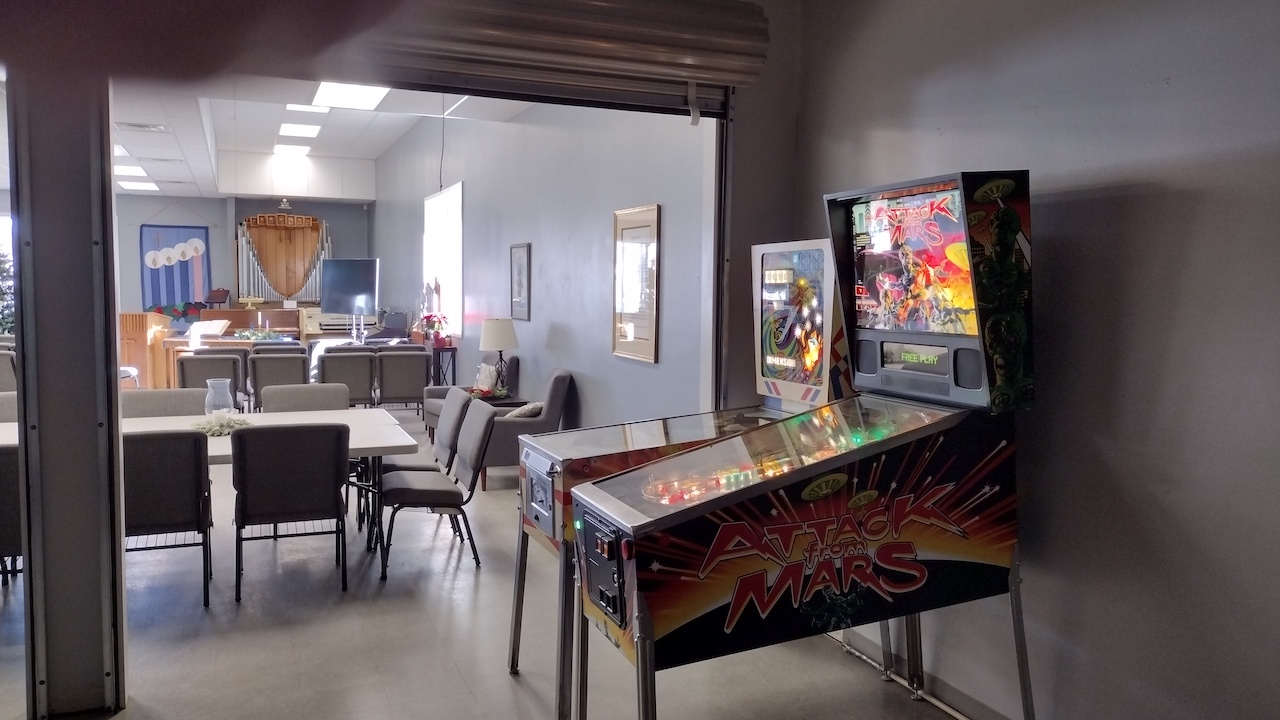
One of our members enjoys rebuilding or reconditioning old pinball machines. He places them in commercial spaces where they generate a bit of revenue. It’s a side gig for him, outside of his regular job. He was running out of space in his basement to store machines, so we said, “Sean, why don’t you put a couple of machines here?” So he did. We don’t know what we’re going to do with them, but there they are. What will God do with them?
Who knows what comes next? We’re in an experimental frame of mind.
We do not need to hammer our church into a success story. God might plan for our church to die. If so, he hasn’t told us.
Food supply is one way we have been entrusted to feed his sheep. Play rehearsals, line dancing, mah-jong, bridge, and pinballs might also be ways to feed His sheep.
We don’t know and we don’t need to know.
We are calm. We are patient. We are methodical.
We are full of faith, hope, and love.
We’re just doing our thing.
Could that ever add up to the voice of God in somebody’s busy, distracted, vexed, and bewildered life?
Is that a prophetic ministry?
Who knows? Who knows?
But it’s not nothing. It’s something.
Blessings,
Larry F. Sommers
Your New Favorite Writer


