Space Cadets

Last week, NASA revealed the four astronauts who will fly on Artemis II, the first crewed moon mission since Apollo flights ended fifty years ago. 

NASA group photo of the Artemis Four. Public Domain.

U.S. astronauts Reid Wiseman, Victor Glover, and Christina Hammock Koch, and Canadian astronaut Jeremy Hansen, posed in their spiffy orange spacesuits, offering visual proof they are diverse as well as handsome. Their resumés show that three of the four also come densely packed with traditional test pilot skills.

Exciting as this news is, I had to stifle a yawn. 

We have stood on this threshold before. The first astronauts, the Mercury Seven, were Scott Carpenter, Gordon Cooper, John Glenn, Gus Grissom, Wally Schirra, Alan Shepard, and Deke Slayton. When they were introduced in a Washington, D.C., press conference on April 9, 1959—sixty-four years ago—America stood enthralled.

I was thirteen. It was an electrifying moment. These seven would be the world’s first spacemen. They would transform science fiction into history. 

The Pre-Space Era

Commando Cody title frame grab, 1952. Public Domain.

I can’t say how the moment seemed to adults. For us kids, the Mercury space-flight program was both exciting and satisfying. It was the due fulfillment of a long-held dream. We had been reared and nurtured on science fiction. 

Frankie Thomas as Tom Corbett, Space Cadet. Radio-TV Mirror 1951, public domain.

On radio and TV, we had ventured into space with Commander Buzz Corry and his sidekick, Cadet Happy, on Space Patrol; with Tom Corbett, Space Cadet; with Captain Video, Commando Cody, and Flash Gordon. These shows had wildly fluctuating production values, but some of their writers would appear in the enduring pantheon of the science fiction genre—Damon Knight, James Blish, Jack Vance, Arthur C. Clarke, Isaac Asimov, and Cyril M. Kornbluth, among others.

Meanwhile, at the Streator Public Library, we checked out books like Step to the Stars and Mission to the Moon, by Lester Del Rey; Rocket Ship Galileo and Citizen of the Galaxy, by Robert A. Heinlein; Islands in the Sky and Childhood’s End, by Arthur C. Clarke; and I, Robot and Foundation, by Isaac Asimov. These writers and others informed us of scientific facts and expanded our horizons beyond comic-strip space operas. 

Yeager in front of the Bell X-1 rocket plane. USAF photo, public domain.

While all this fiction intoxicated us, we were well aware of the real-life space heroes who were making science fiction come true. Men like Robert GoddardWernher von BraunColonel John Stapp, and Chuck Yeager. How could we not know about key developments when they were chronicled by such hardy publicists as Willy Ley

Galaxy magazine cover featuring space station article by Willy Ley. Public Domain.

The Leap Into Space

A significant subtext of all these books, stories, and articles was the blithe assumption that Americans—who else?—would pave the way to the stars. Which is why, on October 5, 1957, we kids were so well-prepared to be keenly disappointed by the news that Russia, not the United States, had launched the first man-made satellite, a healthy 184-pound baby named Sputnik.

It shocked us to learn that the much-maligned Soviet Union had the physical and intellectual wherewithal to beat the United States into space. Our whole nation had egg on its face. 

Yuri Gagarin in Finland, 1961. Finnish Museum of Photography. Public Domain.

There ensued a furious campaign to raise up more scientists and engineers, on the quick. By the time rocketry had been developed to the point where humans could ride on the front ends of the darned things, we had almost caught up.

Alan Shepard in 1961. NASA photo, public domain.

Cosmonaut Yuri Gagarin rode into space on a Soviet rocket less than a month before American astronaut Alan Shepard did the same. Still, the Russians were ahead.

Later that spring, on May 25, 1961, our new president, John F. Kennedy, laid down a marker he thought America stood a good chance of redeeming: Set foot on the moon, and return safely, before the end of the decade—and, incidentally, before the Russians. 

JFK addresses a joint session of Congress May 25, 1961, and proposes the goal of a moon landing. In background, Vice President Lyndon B. Johnson and House Speaker Sam Rayburn listen. NASA photo, public domain.

The Mercury and Gemini manned space programs laid the groundwork for this achievement, and the Apollo program did it, with months to spare, by landing Neil Armstrong and Buzz Aldrin on the moon July 20, 1969. 

The Big Letdown

Once science fiction had become fact, the wind went out of NASA’s sails. 

Five subsequent Apollo missions landed people on the moon, for a total of twelve men. Further programs like Skylab, the Space Shuttle program, and the International Space Station have kept us in space almost continuously. But these programs have the feel of a turning inward. Since reaching the moon, we have not ventured beyond.

This has come as a bit of a surprise to us children of the Fifties. Most of the science fiction we read plotted space flight as a continuous progression from the moon to Mars, and from Mars on to interstellar space. Certainly latter-day science fiction vehicles like Star Trek and Star Wars have taken that long line of development as a given.

Human affairs, however, are always a start-and-stop thing. There are wars. There are recessions. There are hesitancies and second thoughts. Funding is re-allocated. Things happen.

Now, NASA has its sights set on Mars. Establishing a permanent continuous presence on the moon will be a big first step. The Artemis Four will have their work cut out for them.

Time will tell.

Blessings,

Larry F. Sommers

Your New Favorite Writer

Emerson Ebert

Sheet music. Photo by Marius Masalar on Unsplash.

He was an ordinary-looking man, of average height, with a hairline which had already receded to the top of his head. The hair on the sides and back was just long enough, and wavy enough, to make you think of some old poet with ruffles at his collar.

Mister Emerson Ebert was not a poet. He did not wear ruffles at his collar, or down his shirt front or at his cuffs for that matter. He wore a plain two-piece suit and tie—a standard uniform in those days.

Because he was about my parents’ age, I thought him old. Actually, he and they were only in their thirties.

Music

He was a musician. I don’t mean he played in the New York Philharmonic, or in Guy Lombardo’s Royal Canadians. He did not, as far as I know, write symphonies or even commercial jingles. But he was a musician nonetheless.

Here are some of the music things he did.

Middle school band marching. Photo by Jessie Pearl, cropped. Licensed under CC BY 2.0.

He directed the intermediate and concert bands that combined the instrumentalists of half a dozen public grade schools, and two junior highs, in Streator, Illinois (pop. 17,500). Although the junior high band was called “The Concert Band,” both organizations were in fact marching units. So in addition to conducting us musically, he taught us how to march; and not only how to march, but how to play instruments while marching. 

If you have not done that yourself, Dear Reader, I suggest you give it a try some time. It’s not as easy as it looks from the Goodyear Blimp.

Teaching


The Music Lesson (1668) 
 Gerard ter Borch (Dutch, 1617-1681). Public Domain.

To have instrumentalists filling the intermediate and concert bands, Mister Ebert first had to teach scores of young savages how to play instruments. One does not teach beginners to play instruments in general, but rather to play specific instruments—all the various woodwind, brass, and percussion instruments. 

For example, Mister Ebert taught me, and several of my classmates, how to play the clarinet. But he taught Johnny Stevens and Jack Spencer and several others how to play the slide trombone. Still other classmates he taught to play the flute, the saxophone, the trumpet, the cornet, the tuba, and all the different kinds of drums. Yes, French horns, too. And oboes.

You may inquire, “How does one man teach all those different instruments?” That’s a very good question. I don’t know the answer, but Emerson Ebert did. 

I’m not sure you must totally master a particular instrument to teach it to beginning students. At least you need to know which end of the horn to blow into.

Professor Harold Hill’s Think System won’t do the trick.

You must teach the fingerings that go with each particular instrument. You must know a good tone from a bad tone, and how to achieve the former and avoid the latter. In other words, you have to know what you’re doing.

Single-Handed

Did I mention that half dozen or so grade schools contributed musicians to the intermediate and concert bands? 

But there was only the one Mister Ebert. 

Streator was a smallish town. The high school may have had more than one band teacher, but all the grade schools had to share Mister Ebert.

Each week he went to each grade school and gave small group lessons to beginning students. A group lesson for the clarinets; another for the saxophones; another for the flutes, and so forth. A guy could use up quite a bit of time that way. But how else are you going to raise up instrumentalists to play in the band?

Endurance

Apart from the question of technical expertise, there is the question of endurance. An aspiring musician must play a few hundred thousand bad notes before he or she consistently makes good notes. Our parents had to hear those bad notes when we practiced at home, which most of us did not do as much as we were supposed to. 

Mister Emerson Ebert heard the rest of those bad notes at school.

I can testify that when you first pick up the clarinet, you must learn to produce a sound through a wooden reed affixed to a mouthpiece. It is a little like blowing on a duck call, but not nearly so mellifluous. 

Mister Ebert got to hear all that. And imagine! He even got paid for it. What a lucky guy.

Composure

For all that, he was a surprisingly even-tempered man. I do remember one afternoon, however, when we clarinets were tootling away under his instruction in the practice room at Garfield School. 

A rumor had gone round that Mister Ebert’s wife was due to deliver a baby at any moment. 

He sat in a chair near us, using a wooden drumstick as a baton to beat a little rhythm for whatever song it was we were practicing. It was a hot, sticky day in early fall or late spring—and in those days schools were not air-conditioned.

One of us—it could have been me, I really don’t remember—hit a really sour note. 

Mister Ebert’s hand flashed like Bob Feller’s pitching arm as he flung the drumstick across the room, where it crashed against the chalk rail at the bottom of the blackboard 

That focused our attention. 

He got up, walked across the room, and picked up the drumstick from the floor. Astoundingly, neither it nor the chalk rail nor the blackboard had suffered any damage. He walked back to his chair, sat down, and lifted the drumstick again into conducting position. He cleared his throat.

“Continue,” he said, and waved the baton.

The baby was born later that day.

The Grand Parade

Eventually, we entered junior high and became members of the Concert Band. We were given dashing blue uniforms with gold braid at the shoulders and gold stripes down the pants. The first time we wore these was for the annual Pumpkin Festival Parade in Eureka, Illinois, the Pumpkin Capital of the Free World. 

“Now,” Mister Ebert said, “there are several units of horses marching ahead of us. So watch where you step. If you have to break formation to march around something, keep on playing and just get right back in line.” 

#

I regale you with all this, Dear Reader, not in order to toot my own horn. 

This post is not about me, but about Emerson Ebert. 

But I must confess that, when we moved away from Streator when I was in eighth grade, I ditched the clarinet. I never became Benny Goodman. I never became any kind of a musician. 

Oh, I sing in our church choir these days. That much I do. And I listen to music now and then. I like most kinds of music. But I seldom go to concerts. 

Well, I do attend several school concerts each year, because our grandchildren perform. Elsie sings in the school choir and plays trombone in the band. Tristan is taking up viola.

Tristan’s concert. Photo by author. Students in green shirts, teachers in pink.

At Tristan’s strings concert the other day, I couldn’t help noticing a few harried-looking adults in the ranks of youthful musicians, helping them tune up, waving hands and batons to lead them through their numbers—all the while enduring every note which come forth: the just right, the almost, and the nowhere near. With smiles on their faces. 

That’s what brought Emerson Ebert to mind. 

You see, without ever becoming a musician, I did learn a bit of music. I learned to like different kinds of music. I learned how to keep a beat. When I joined the Air Force and went to basic training, I already knew how to march. 

I knew that you should watch where you step—always an important thing.

I can say I have experienced the exaltation that comes when sitting in the middle of a large ensemble of horn blowers and drum bangers all playing the same Sousa march at more or less the same time. 

Thousands, hundreds of thousands, even millions of young people have received that experience because Emerson Ebert, or his counterparts across the land, have given it to them. 

Occasionally we hear news of some school system making a budgetary decision to eliminate music programs—in other words, to fire music teachers.

Wrong move. Cut out almost anything else if you must, but let the Emerson Eberts of the world do what they do. We can’t be human without music.

By a happy coincidence, March is Music in Our Schools Month.

Blessings,

Larry F. Sommers

Your New Favorite Writer

Author of Price of Passage—A Tale of Immigration and Liberation.

Price of Passage

Norwegian Farmers and Fugitive Slaves in Pre-Civil War Illinois

(History is not what you thought.)

Jack’s Big Show

Jack Benny, 1964 publicity shot. Public Domain.

The new thing called television was run by the same networks that ran the old thing called radio. 

Popular radio programs, from The Lone Ranger to Art Linkletter’s House Party, were carried over to TV and brought their loyal audiences with them. 

A great radio show was The Jack Benny Program, a weekly half-hour of hilarity and running gags that ruled the air from from 1932 to 1955. Benny, like many others, made the jump from radio to TV, appearing on CBS television from 1950 to 1964 and on NBC for one year after that. For five years, he and his ensemble pulled off the frenetic trick of appearing regularly in both media.

An Overnight Success

Benny Kubelsky with violin, early 1900s. Public Domain.

He was Benjamin Kubelsky, a violin player from Waukegan, Illinois. After achieving great mediocrity in school and business, the dreamy 18-year-old took his fiddle to the vaudeville stage in 1912. 

Audiences yawned. 

Famed violinist Jan Kubelik hinted at legal action because of the similarity of names. Kubelsky, adding jokes to his routine, changed his billing to “Ben K. Benny: Fiddle Funology.” 

Ben Bernie, a well-known “patter-and-fiddle” star, was not amused. The new kid’s name was too similar.

Kubelsky—having meanwhile served in the U.S. Navy for World War I—adopted the name Jack, common parlance for a sailor (“Jack Tar”). 

After two decades of scratching out a living, first as a vaudevillian, then as a movie novice at MGM, Jack Benny auditioned for NBC Radio and became an overnight success.

Show Within a Show

Jack Benny, newly-minted radio star, in a 1933 NBC publicity shot. Public Domain.

For NBC, Benny—billed as “the star of stage, screen, and radio”—exercised his dramatic skills by portraying a radio comic named Jack Benny. 

This fellow Benny lived a sedate bachelor life in Beverly Hills. He employed the gravel-voiced Rochester, a butler-valet-chauffeur played by black actor Eddie Anderson. Benny’s girlfriend Mary Livingstone (in real life his wife, Sadie Marks) dropped by often, as did people from the cast of his radio show: bandleader Phil Harris, boyish tenor Dennis Day, the closely harmonious Sportsmen Quartet, and rotund announcer Don Wilson.

Mary Livingstone, 1940 publicity photo. Public Domain.

Add a rotating cast of quirky character actors including multi-voiced Mel Blanc, supercilious Frank Nelson (with his famous baritone “Ye-e-e-s-s-s?”), and race track tout Sheldon Leonard (“Psst! Hey, Bud!”), and you had the basic ingredients. 

Dennis Day. ABC publicity photo, 1960. Public Domain.

A show’s plot would focus on some minor incident in the life of stage-screen-radio star Jack Benny. One week he, Mary, and Dennis would go to the race track to play the ponies. Another week Rochester would drive him to the train station for a trip to Palm Springs. Another week, Benny went Christmas shopping or stewed about an impending meeting with his show’s sponsors. Odd things happened to Benny in these commonplace situations, with disparaging commentary by the screwball characters in his cast. 

A comedian playing a comedian in a show about nothing. Are you listening, Jerry Seinfeld?

Pay No Attention to That Man at Center Stage

With kooks on every hand, Jack Benny himself seemed like the normal person in the show. But not exactly . . .

Each episode revolved around Benny. He was center stage. The shady characters, uppity store clerks, band members in a constant state of carousal, wry Mexican villagers, and most of all Benny’s long-suffering household intimates—Mary, Don, Dennis and especially Rochester—all served to call attention to Benny’s eccentricities.

He was vain and vainglorious. Blue-eyed and never ageing beyond 39, he admitted freely to being a violin virtuoso and a comic genius, with leading-man looks thrown in. 

He was indecisive, sometimes making a store clerk wrap, unwrap, and rewrap a purchased gift half a dozen times so that he could change the sentiments expressed on the card inside.

Most of all, he was cheap as only the rich can be. He had fabulous wealth, which he kept in an impregnable basement vault, while pathologically resisting any effort to part him with a dime. This miser image was displayed in every show and developed in almost every joke, until no American could have been unaware that Benny was a skinflint. 

His stinginess was the tacit explanation for his car, a 1908 Maxwell roadster, always on the verge of death. When Rochester, as chauffeur, would suggest Jack acquire a new car, he always insisted on coaxing a few more miles out of the Maxwell. The car’s throes of anguish in its brave attempts to start were given voice by the great Mel Blanc.

Jack Benny and Eddie Anderson as Rochester from the television version of The Jack Benny Show, with Jack’s 1908 Maxwell—one of the rare times an actual car was shown. CBS Television, 1951. Public Domain.

When Benny encountered a hoodlum demanding cash, the studio audience and every fan at home could see the punchline coming.

Jack was a master of the long pause. Comics to this day rave about Benny’s comic timing.

Fred Allen 1940 publicity photo. Public Domain.

Audiences, who may not have understood such subtleties, roared.

To boost ratings, Benny and rival comic Fred Allen concocted a feud, which played out on both shows over a period of almost twenty years, until Allen’s sudden death at 61 in 1956. A typical exchange:

Allen: Jack, you couldn’t ad lib a belch after a plate of Hungarian goulash.

Benny: You wouldn’t say that if my writers were here.

But Benny’s writers were there, every Sunday night. And when he moved from radio to television, “audiences learned that his verbal talent was matched by his controlled repertory of dead-pan facial expressions and gesture” (Wikipedia).

A Smooth Transition

Except for that discovery, the transition was seamless. Of all shows that went from radio to TV, Benny’s had the least noticeable format change. The Jack Benny Program on television was exactly what we radio listeners had always seen in our mind’s eye.

Benny trouped on for another fifteen years on television and continued making stage and TV appearances until shortly before his death in 1974. 

Audiences gradually learned that Jack’s on-air persona was a carefully constructed myth. In person he was warm and generous. And his devotion to music was real, even if his musical talent was less than stellar.

He donated a Stradivarius violin purchased in 1957 to the Los Angeles Philharmonic Orchestra. At the time of the gift, Benny said, “If it isn’t a $30,000 Strad, I’m out $120.”

If you’re interested in a more complete account of the Jack Benny Program, try  https://www.wikiwand.com/en/The_Jack_Benny_Program.

Next week: Something completely different. Tune in.

Blessings,

Larry F. Sommers

Your New Favorite Writer

Author of Price of Passage—A Tale of Immigration and Liberation.

Price of Passage

Norwegian Farmers and Fugitive Slaves in Pre-Civil War Illinois

(History is not what you thought.)

Add Pictures and Stir

Guglielmo Marconi, in 1896, figured out how to send Morse’s telegraphic code through the air, over great distances, without wires. 

Guglielmo Marconi. Photographer unknown. Public Domain.

Microphones, also invented in the late 19th century by a series of audio pioneers, were added to the radio signal, and by the 1930s commercial radio had become an established medium. Popular programs included The Lone Ranger, Amos ’n’ Andy, and the National Barn Dance.

Antique radio, photographed by Doug Coldwell, licensed under CC BY-SA 4.0. 

After supper, American families now sat around large wooden boxes warmed by the orange glow of vacuum tubes to hear concerts, dramas, comedies, mysteries, westerns, news, and quiz shows. Your New Favorite Writer remembers it, Dear Reader. When I was a boy, in the Fifties, “old-time radio” was still going strong. 

But the seeds of its destruction had been sown. Somebody—a group of somebodies, actually—figured out how to transmit motion pictures using radio waves. 

At the end of World War II in 1945, almost nobody owned a television set. By 1955—only ten years later—almost nobody did not own a television set. 

Continuity is a recurring theme in human affairs. The first automobiles resembled horse-drawn buggies or carriages, with a combustion engine taking the place of the horse. 

Early TV set, an RCA Model 630-TS, sold in 1946-47. Photo by Fletcher6, licensed under CC BY-SA 3.0

Likewise, the first TV sets were built like radios: lovely mahogany furniture filled with vacuum tubes, with the addition of a luminous picture tube, the front surface of which served as a screen. That one extra tube brought moving pictures of the world to us in glorious black-and-white. 

Continuity of design ruled content as well. The early television shows were often just radio programs with pictures added.

Cowboys and Indians

Moore and Silverheels as the Lone Ranger and Tonto. ABC photo, Public Domain.

The Lone Ranger and his “faithful Indian companion” Tonto galloped across our living room three nights a week on ABC Radio. When TV came along, they became movie stars, their cinematic exploits piped into our homes once a week on Saturday mornings. 

George W. Trendle produced both the radio and television series, but other personnel changed. On radio, Brace Beemer played the Lone Ranger and John Todd played Tonto. But Beemer was only marginally photogenic, so Clayton Moore was hired to wear a mask and ride the great horse Silver, while authentic Native American Jay Silverheels took over the Tonto role. He looked the part.

Gunsmoke was another western that began on radio and switched to TV. Manly-voiced radio actor William Conrad played U.S. Marshal Matt Dillon. But Conrad was inescapably rotund, so he was replaced in the TV series by tall, lanky James Arness.

William Conrad. CBS Radio photo, Public Domain.
James Arness. CBS Television photo, Public Domain.

What’s a Question Worth?

The radio quiz show show Take It or Leave It premiered in 1940 and rapidly became popular. Wikipedia describes its format perfectly: “Contestants selected from the audience were asked questions. After answering a question correctly, the contestant had the choice to ‘take’ the prize for that question or ‘leave it’ in favor of a chance at the next question. The first question was worth $1, and the value doubled for each successive question, up to the seventh and final question worth $64.”

Because of the show’s popularity, “That’s the sixty-four dollar question” became a widely-used catchphrase applied to any especially difficult conundrum. 

When something you have created becomes a household word, use it. Take It or Leave It changed its title in 1950 to The $64 Question. The program went off the air two years later.

But in 1955, CBS revived The $64 Question as a television show, hosted by actor Hal March. The producers added three zeroes and called it The $64,000 Question. It was the first big-money game show. For that kind of dough, they made the questions hard.

IBM card sorter, 1955. Photo by Atomic Taco, licensed under CC-BY-SA-2.0.

For TV, they added visual gimmicks to the program. When a contestant chose the category to compete in, a lovely young lady pushed the start button on an IBM card sorter—at that time the most decorative aspect of computer technology. The machine whirred and shuffled. The lovely assistant scooped up a deck of IBM cards from the end of the sorter and delivered the deck to Hal March. 

It seemed that an all-knowing machine, the computer, had spun out a graduated series of questions on the spur of the moment. A modern marvel!

There was another gimmick: Once a contestant reached the $8,000 level, he or she was sequestered in an “isolation booth,” able to hear only the quizmaster. It was show biz, folks.

Dr. Joyce Brothers in 1957. World Telegram photo by Phyllis Twacht. Public Domain.

The show spawned imitators: The $64,000 Challenge, Twenty-One, The Big Surprise, Dotto, and Tic-Tac-Dough—all quiz shows with tough questions and high stakes. We TV watchers could not get enough of shows like that. They made instant heroes of brainy people nobody had heard of before. People like eleven-year-old science wizard Rob Strom; polymath Teddy Nadler, a St. Louis stock clerk who made $264,000 answering questions across a broad range of categories; and everybody’s favorite, psychologist Joyce Brothers, a demure young blonde with an uncanny knowledge of boxing. All us regular folks out in TV-land were deeply impressed.

What’s an Answer Worth?

Then, in August 1958, CBS cancelled Dotto without explanation. A federal probe revealed a contestant had been given answers in advance. The G-men expanded their inquiries and found hanky-panky going on in several shows. The bloom was off the rose for big-money game shows. They all went off the air that fall and did not return until forty years later (Who Wants To Be a Millionaire?, 1998).

Soon after, in 1959, the U.S. Congress launched grim hearings exposing “payola.” The Congressmen were shocked, shocked!, to learn that record companies were paying radio disc jockeys to plug their records, manufacturing smash hits by the simple expedient of playing them more often than other records. This actually might have been legal had the source of funding been disclosed; but it was not.

The quiz show scandals, followed soon by the payola scandals, were a one-two punch to the solar plexis and jaw of Middle America. Perhaps not since the Black Sox scandal of 1919 has the American public been so let down. (“Say it ain’t so, Joe!”)

It was hard to know exactly how we’d been cheated. The quiz shows, after all, were entertainment. Seeing all these smart people answer tough questions was engrossing and entertaining, even it it was rigged. After all, for years we’d been watching professional wrestling, which everybody knew was rigged. We liked it anyway.

Likewise, the smash hits produced by the payola system were great songs. We still play them on the oldies stations today. Did anybody really care how they made their way onto the air? 

Still, there was something unsettling about unseen people manipulating contests we had no reason to think were not on the square. Our stubborn innocence was under attack.

I’m not sure it has ever recovered. 

A Ray of Hope

Fortunately for all of us, Jack Benny remained steadfastly on the air, first on radio, then TV.

Benny and cast members, 1946. Public Domain.

Be sure to tune in next week.

Blessings,

Larry F. Sommers

Your New Favorite Writer

Author of Price of Passage—A Tale of Immigration and Liberation.

Price of Passage

Norwegian Farmers and Fugitive Slaves in Pre-Civil War Illinois

(History is not what you thought!)

Train Ride

One bright morning in 1952 I boarded the Santa Fe Chief in Streator, Illinois, and rode to Galesburg, a hundred miles away. 

The Santa Fe Chief pulls out of Chicago in 1957. Kansas Historical Society.

All by myself. 

I was seven years old.

Mom had given a small tip, probably a dollar or two—equal to ten or twenty of today’s dollars—to the porter, a smiling man in a white coat and brown skin, for the extra trouble of looking after me. It was a commonplace transaction.

But for me, a train ride was an adventure. 

You could take a train from almost anywhere to almost anywhere. This was near twenty years before the railroads gave up on passenger service and turned it over to a tax-funded company called Amtrak.

It was more than twenty years before computerized ticketing and reservations. To ride the train, you spoke to an agent through the metal grille of a ticket window. In small towns the ticket agent might also be the station agent and telegrapher (although by the time I was riding the train, manual telegraphy had been replaced by teletype machines). 

You told the man—it was always a man—where you wanted to go, and he gave you a rectangle of pasteboard which conveyed that information to the conductor of the train. If you were going on a long trip that required changing trains, or even changing railroad lines—starting on the Milwaukee Road and ending your journey on the C.B.&Q., for example—your ticket might be a long, multipart form with two or more sections stapled together. 

The conductor punches a ticket. Photo by Donnie Nunley, licensed under Creative Commons Attribution 3.0

The conductor—a white man in a dark blue uniform—came through the car soon after the train left the station and asked for your ticket. He punched it with a hand punch to show it had been used. He kept the ticket and placed a slim paper tab in a clip above your seat. The tab was color-coded and marked to show your destination. 

I wore my best clothes—of course one did that for such an important thing as a rail journey—and carried a small cardboard suitcase and my best friend, Teddy. The stuffed bear rode in the seat beside me, at no extra charge. If a grown-up sat there, Teddy could ride in my lap.

A great panoply of the Heartland blurred by the large train window at sixty miles per hour. We sped past the clotheslines, tenements, and scrapyards of Moon, Ancona, Leeds, Caton, Toluca, LaRose, Wilburn, Atlas, Holton; crossed the Illinois River and stopped for several minutes at the important town of Chillicothe; then clackety-clacked through the stockpens, car lots, and water towers of North Hampton, Edelstein, Princeville, Monica, Laura, and Williamsfield; jumped the Spoon River at Dahinda, and rolled on through the quaint backyards and byways of Appleton, Knoxville, and East Galesburg, to stop at Galesburg, where I got off and was met by Grandma Sommers, with her big old Hudson sedan. 

(Confession time, Dear Reader. My brain does not contain the full litany of railside towns after seventy years. I cheated by looking at an old railroad map.) 

The smiling porter, who had checked my well-being from time to time during the two-hour trip, handed me down the passenger coach steps onto the platform, where Grandma waited. She and I  walked through the station—or, as we called it, the depot—on the west side of North Broad at Water Street.

Santa Fe depot interior, 1950s. Kansas Historical Society. Between the bulletin board, left, and the ticket window, center, stands the shiny metal Chiclets dispenser.

Where you left the passenger waiting room there stood a gum machine. You could put in two of Grandma’s pennies and choose among four flavors of Chiclets. Down a little chute they slid, two pieces of hard-shell chewing gum in a bright-colored cellophane packet. Tutti-frutti was the best flavor, and its packet was peach-colored, not unlike Tennessee Avenue on a Monopoly board.

That color, halfway between orange and pink, marks in my mind not only tutti-frutti Chiclets and Tennessee Avenue, but also Tuesday, my favorite day of the week. For no reason I can think of, Tuesday is peachy in color. 

That may be peculiar to me. If you don’t like it, Fair Reader, you’re free to paint your Tuesdays a different color. Go ahead, I dare you.

The grand exploit of soloing by rail into the wilds of western Illinois, like most of my youthful pleasures, is denied to young people now. Today, minors under twelve may not ride unaccompanied on Amtrak, and those of twelve years and older may do so only subject to numerous regulations

In the safe world of my childhood, we did not think strangers were likely to be perverts. It was unspoken and universal that adults would protect children. Adults trusted other adults to safeguard their children; and we who were children believed that adults—even the legions of grouchy ones—would watch over us if need be.

Others may remember things differently. Perhaps my memory wears rose-colored glasses. But those growing old along with me can testify that in those days, though we were often fussy and formal, sometimes about trivial things, we were at the same time more relaxed and confident in the major departments of life. 

Thomas Wolfe said you can’t go home again. Galesburg, however, is still served by Amtrak. But Amtrak rides the old Burlington main line, now owned by the mega-railroad company called Burlington Northern Santa Fe (BNSF).

That means you can go home again, but you get off the train at a different station. The old Santa Fe main line tracks still run just north of Water Street, owned and operated by that same Burrlington Northern Santa Fe. But that line is traveled only by freight trains. The old depot that had the Chiclets machine is long since demolished.

Santa Fe depot at Broad and Water, about 1962. Kansas Historial Society.

That stately old depot, and the way of life it embodied, are now gone with the wind, as Margaret Mitchell might say. They are with the snows of yesteryear, per François Villon. 

The old depot site at Broad and Water, as it is today. Google Earth screenshot.

No matter. Those trains and stations and clackety-clack journeys still exist in memory . . . for a few years yet.

Blessings,

Larry F. Sommers

Your New Favorite Writer

Author of Price of Passage—A Tale of Immigration and Liberation.

Price of Passage

Norwegian Farmers and Fugitive Slaves in Pre-Civil War Illinois

(History is not what you thought!)

Windward and Leeward

After our escape from Devil’s Island, we sailed north, bound for the Windwards.

If you’re already confused, Dear Reader, allow me to set you straight. 

Mandatory Geography Lesson

The islands in this part of the world are called, for no good reason, “antilles.” If you will consult your map—or your globe, should you own such a princely object—you will see a line of giant antilles running east-west. They are named, from left, Cuba, Jamaica, Hispaniola, and Puerto Rico. These are the Greater Antilles. They form a ridge that walls off the Atlantic Ocean, to the north, from the Caribbean Sea, to the south.

Now, look to the right side (east) of Puerto Rico and there, hanging down like the tail of a large west-facing chameleon, you will note a north-south string of teensy antilles with names like Antigua, Martinique, Saint Lucia, and so forth. These would be your Lesser Antilles. They do not wall off, but do demarcate, the South Atlantic, to the east, from the Caribbean, to the west.

So now you know.

The Greater Antilles, across the top; and the Lesser Antilles, down the right side. From Google Earth.

None of this, Kind Reader, applies to the Dry Tortugas, so get that out of your mind right away. But let me ask you, in all candor—what good is a wet tortuga?

Getting back to the Antilles, I regret to inform you of one further development: Some of the lesser ones are known as Windward Islands, whereas others are called Leeward Islands, on account of the lamentable tendency of sailors to chalk everything up to the wind. Because the Trade Winds, in those latitudes, blow from east to west, therefore the southern islands of the Lesser Antilles are windward and the northern ones are leeward. 

There you go. Don’t ask me. It is what it is.

Now, Back to Our Story

Two long, rolling, sea days after not landing at Devil’s Island, we came to Bridgetown, the principal city of Barbados—which may be a Windward Island or may not, depending which way the wind is blowing. Barbados is technically in the Atlantic Ocean, yet it seems Caribbean, for what that’s worth.

Not yellow, but our submarine nonetheless. Jo Sommers photo.

Barbados is the birthplace of rum, and it still makes some of the best. English is the main language spoken there, along with a local patois that is also part English. After centuries as a British colony, Barbados gained independence in 1966 and is still a member of the British Commonwealth. 

We visited a pineapple farm and later saw the coral beds of Barbados from the viewports of a real submarine!

Our next port of call was Castries, the main port city of Saint Lucia, which is for sure one of the Windward Islands. Between 1660 and 1814, France and Britain fought fourteen times for control of the island. Seven times it came out French and seven times British. Finally the French, exhausted after the energetic reign of Napoleon, gave up. Saint Lucia, like Barbados, is now an independent state in the British Commonwealth.

Saint Lucia’s caldera–the low spot between the lumpy mountain on the left and the two craggy pitons on the right–looms over the fishing town of Soufrière.

I found Saint Lucia lovely and appealing. It is volcanic. The southwest shore of the island features two great stone spires, called Petit Piton and Gros Piton, and a caldera or basin formed by a gigantic blow-out more than thirty thousand years ago. Hot steam still oozes skyward from the unhealed wound in the earth. 

Thirty years ago, after Gabriel, a tour guide, was burned by steam, the government built a safe viewing platform that overlooks the steam vents. The platform is safe, that is, until the next eruption. But geologists hope the Earth will give warning before that happens. I hope so too. 

The steam vents.

For the present, I can only report that I am happy to have escaped alive.

On we went, ending our voyage in San Juan, Puerto Rico. As a young man, I had paid a brief visit to San Juan. A fellow passenger on our ship asked me how long ago that was. “Oh,” I replied, “it was about thirty years ago. No, wait . . . forty . . . uh, no—make that fifty years ago.” 

Time sure sneaks up on one, does it not? 

San Juan astounded me. Gleaming white buildings stretched along the shore as far as I could see. Old San Juan, the place marked by a pair of famous old Spanish fortresses, is still there. But the city now spreads out over the countryside. Those gleaming white buildings are hotels, apartments, and condos with price tags up to and beyond a million dollars apiece. 

Puerto Rico’s residents are exempt from U.S. income tax, and the island recently passed legislation cutting its own corporate tax rates. As a result, a lot of folks from the U.S. mainland are moving to Puerto Rico, establishing residency, and bringing their businesses with them. No doubt there are still many poor Puerto Ricans, but the new prosperity is not to be sneezed at. 

We had only a little time on Puerto Rico, for our airplane home was waiting. And it was great to get back to good old Madison. Who doesn’t love zero degree weather and foot-deep snow? 

It beats a wet tortuga any day.

Blessings,

Larry F. Sommers

Your New Favorite Writer

Author of Price of Passage—A Tale of Immigration and Liberation.

Price of Passage

Norwegian Farmers and Fugitive Slaves in Pre-Civil War Illinois

(History is not what you thought!)

Brazil

One pleasure of retirement is getting away in midwinter to a warmer scene. For us this is counterbalanced, in a perfectly Emersonian way, by returning home to Madison, Wisconsin, at a moment when the temperature is near zero and a foot of new snow burdens the land.

Workers repair tile in the Manaus town square. The city’s majestic opera house is in the background. Larry F. Sommers photo.

We experienced both of these contrasting joys recently. Far be it from me, Dear Reader, to assault your sensibilities with arctic narratives à la Jack London. But perhaps you’d like to hear about the sunny Tropics.

We flew to Manaus, a city of more than two million people in Brazil’s northwest. It lies on the Amazon River. When I say “Amazon,” you may see dense jungle dripping with rain, bromeliads perched on every tree and bone-nosed cannibals behind every bush. The truth is less romantic.

To trek the Amazon Rain Forest is one thing; riding the Amazon River is quite another. The two are separated by miles of water.

The Amazon is either the longest or the second-longest river in the world, but it is without doubt the largest. In total volume of water carried down to the sea, no other river on Earth comes close. Thus, the Amazon can be navigated for a thousand miles, all the way to Manaus, by oceanic vessels. 

Manaus is Brazil’s seventh largest city. Unlike any other city of its size, Manaus cannot be reached by road. Since air service is both expensive and sparse, most long-distance travel is by boat. People of the region measure inter-city travel in days, not hours. They take small river steamers and sleep in hammocks slung between decks.

Our steed, the Viking Sea.

Not we. The vessel we boarded for the trip downriver was the Viking Sea, a smallish ocean-going liner carrying nine hundred passengers plus about half that number in crew and staff. We cast off on January 19 and took four days to reach the Atlantic Ocean.

I had imagined a saga like that of Humphrey Bogart and Katharine Hepburn piercing the jungle on the African Queen. But from Manaus onward, the Amazon averages six miles wide. So it was more like traversing a very long lake. We could see shore on both sides, but that’s about it. 

We did glimpse life ashore at various stops along the way. In Manaus we visited the colonial-era town square and also the zoo, where actual denizens of the rainforest are on display. 

Boi Bumbá troupe and befuddled spectators. Larry F. Sommers photo.
Santarém worker fills a long tube with tapioca pulp. Larry F. Sommers photo.

At the small town of Parintins we were treated to an indoor performance of Boi Bumbá, a folkloric singing and dancing festival much enhanced by complimentary glasses of “a delicious caipirinha cocktail made of cachaça (fermented sugarcane juice), sugar and lime.” I am no judge of such noisy spectacles, but as used to say in the Fifties, it had a beat, and you could dance to it. (You, Fair Reader; not me.) 

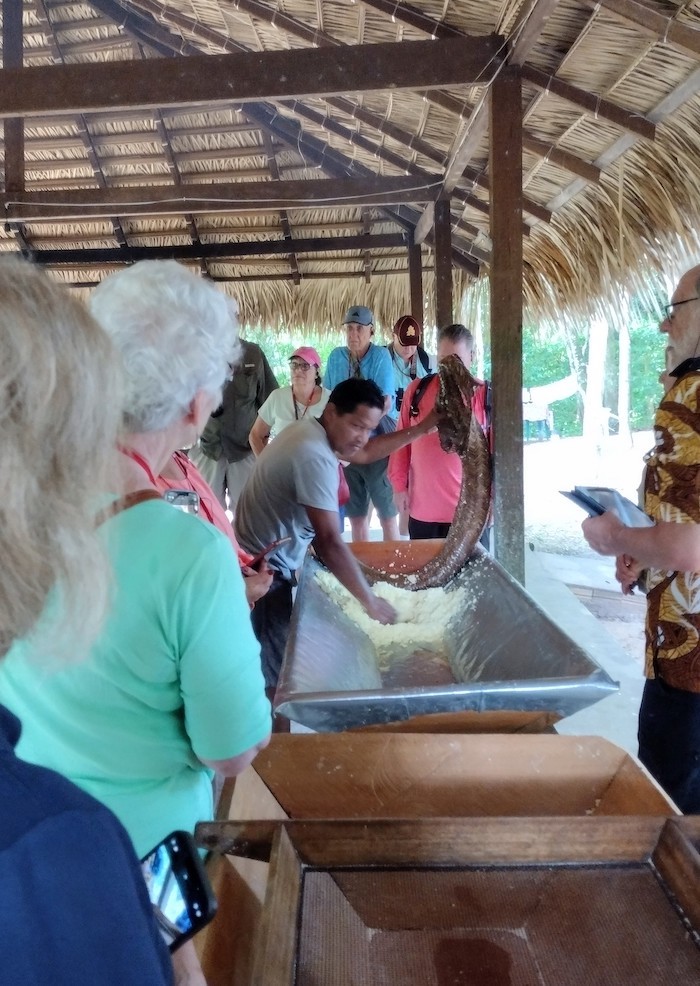
The highlight of the Amazon voyage was Santarém. We visited a cassava mill, where workers dig up wild-growing manioc or cassava tubers—they look like sweet potatoes—and extract their starch, which is tapioca. The tapioca is a staple of local cooking and also processed for export. The sap of the cassava is boiled until no longer poisonous and used as the base for a pepper-spiced sauce.  

Victorious angler holds piranha for photos while others continue to fish. Larry F. Sommers photo.

Then we went piranha-fishing on Maica Lake. In a small boat we motored up the Rio Tapajós, a tributary of the Amazon. We passed small farmhouses elevated on stilts and a bit of actual Amazon rainforest, the treetops populated by sloths—which are hard to spot, but we did see some. Those passengers intent on angling for the razor-toothed piranha hung out over the gunwales with baited lines and bated breath. Eventually a few of the little devils—the fish, that is—were caught, photographed, and thrown back in to lurk in waiting for the next boatload of turistas

Calm yourself, Gentle Reader. Your New Favorite Writer escaped with all fingers, toes, and other parts intact.

Another day of cruising the ever-widening Amazon, and we were off for the Caribbean. But that’s another story, to be recounted next week. So stay tuned. 

Blessings,

Larry F. Sommers

Your New Favorite Writer

Author of Price of Passage: A Tale of Immigration and Liberation

Price of Passage

Norwegian Farmers and Fugitive Slaves in Pre-Civil War Illinois

(History is not what you thought!)

Teddy Bear’s Picnic

DEAR READER: With today’s installment, do yourself a favor: Click on each hypertext link as you encounter it, crank up the volume, relax and enjoy. Each item is worth hearing in its own right, and together they form a sort of aural mélange that will make up for any deficiencies in the text.—The Author

Why does my brain swing back so often to my earliest years? Maybe it’s because I’m in my second childhood.

Cream of Wheat box, even older than I am. Public domain.

This morning it was Cream of Wheat. By now, I’ve learned to make it myself, that stuff which my mother used to set before me when I was five or six. This morning my Cream of Wheat steam rose through its surface rubble of berries, and it wafted me back. 

It put me in mind of Big John and Sparky. I barely remember them, but I do remember them.

Out of the Magical Ether

Big John and Sparky? 

“What are you running off at the mouth about now, O New Favorite Writer?” I hear you cry.

Well, to understand, you have to go back to Radio Days.

Every Saturday morning, I came out in my flannel pajamas, clutching my overnight pal, Teddy. I sat down at the kitchen table. Teddy sat beside me.

Mom brought out the steaming porridge and turned on the radio. Big John and Sparky arrived to the tune of “Teddy Bear’s Picnic,” sung by Ann Stephens. I could relate, because sometimes when I was tired, my own mommy and daddy would take me home to bed, just like the teddy bears in the song. And my best friend was a teddy bear.

Big John and Sparky, pictured in 1957. Public Domain.

Big John was a big man with a big voice, and Sparky was a little elf with a tiny voice—the kind of voice we would later think of as coming from chipmunks, courtesy of “David Seville” (Ross Bagdasarian) and friends Alvin, Simon, and Theodore. But I get ahead of myself. 

Big John and Sparky must have had wonderful adventures together. Now, I only recall their contrasting voices, their theme song—still one of my favorites—and the smell and taste of Cream of Wheat.

“But say, O New Favorite Writer—why did you not watch Big John and Sparky on TV?”

Thanks for your timely interruption, Dear Reader. The answer is, there was no TV. 

But there was no shortage of things to watch on the radio.

The Audio Dimension

After Big John and Sparky, which was only a fifteen-minute program, there came Let’s Pretend, a half-hour show in which multiple actors gave voice to classic tales like Rumpelstiltskin, Sleeping Beauty, Rapunzel, and Cinderella. However old and hoary these stories might be, they were brand-new and exciting to us children who heard them for the first time on CBS’s Peabody Award-winning program. 

Child actor Arthur Trimble as Buster Brown, with his dog Tige. Public domain.

To make things even more perfect, it was sponsored by Cream of Wheat.

Other programs on Saturday morning included Buster Brown, hosted by “Smilin’ Ed” McConnell, and Space Patrol with Commander-in-Chief Buzz Corry and his young sidekick Cadet Happy. 

Raygun” by Andy Field (Field Office) is licensed under CC BY-NC-SA 2.0.

The latter show put ray guns and disintegrator blasters into serious competition with cowboy pistols for toy of the year. We, of course, had to imagine what such weapons looked like. But toy designers had good imaginations, too, and soon we could purchase the genuine article at our local five-and-dime. Or we would buy it by sending away a quarter and several cereal boxtops to the sponsor of the program.

It was a great time to be a kid. Soon enough, our butts would be plunked on the living room carpet all Saturday morning as we watched TV. But for a few short years, many of the great things we saw came through our ears, while we munched our Cream of Wheat.

Teddy still remembers it, and so do I.

Blessings,

Larry F. Sommers

Your New Favorite Writer

Author of Price of Passage: A Tale of Immigration and Liberation.

Price of Passage

Norwegian Farmers and Fugitive Slaves in Pre-Civil War Illinois

(History is not what you thought!)

Mom-and-Pop Stores

When I was a boy, every neighborhood had a mom-and-pop store. It was a grocery store, a newsstand, a cigar store, a non-prescription pharmacy, a yo-yo demonstration headquarters, and (best of all) a penny-candy emporium. 

I later learned that in some mom-and-pop stores, Pop also dealt girlie magazines from under the counter and kept an illegal book for bets on the big city horse races. But that’s another story.

Nowadays we go to a nearby warehouse that sells groceries and all things else—Walmart, Costco, or the like. Regular supermarkets like Kroger’s and Hyvee still exist. There are narrowly-focused custom stores, like butcher shops—likely as not, branded “ethical and humane charcuterie.” And there is the ubiquitous convenience store, which also sells everything you can imagine and usually has gas pumps as well.

The convenience stores may be today’s mom-and-pop establishments, with Mom and Pop usually hailing from India, Pakistan, or Korea. New Americans, striving to get ahead, just like previous immigrants. 

But the old-style mom-and-pop store is extinct, or nearly so. The key feature was that it was an easy walk from home. You didn’t have to get in the car and drive through two multi-lane interchanges and a series of mystifying roundabouts to get there. 

#

The prime years of my boyhood were lived in Streator, Illinois. We lived in four different houses, in three neighborhoods.

At our first little house, on First Street, where we dwelt in 1951 in the shadow of the Owens-Illinois glass factory, the mom-and-pop store was three blocks away. I don’t remember the name of the store. It was on Wasson Street, on my way home from school. 

I was six years old. One day I stopped and gazed through display glass at the heart-warming array of different candies. One in particular caught my eye: A small police-style revolver modeled in black licorice, with handgrips in white licorice. 

It was a work of art. 

I wanted it. “How much is the little gun ?” I asked.

“That’s a nickel,” said Pop. 

“Charge it,” I said.

My parents had bought things here by saying “Charge it,” so I did, too. Pop whatever-his-name-was must have known which set of grown-ups I belonged to, for he gave me the little gun in a white paper bag and added the nickel to our family’s charge account. It’s not every six-year-old who has established credit.

When Mom detected my crime, she blew a gasket. Then she calmed down and explained that “Charge it” was not a magical phrase to render things free. It was just a phrase that meant Mom and Dad would have to pay for the item later. OHHHH.

The whole tawdry affair formed the premise of my 2016 story, “Nickel and Dime,” published online by the Saturday Evening Post and illustrated by a bit of outdated art from that magazine’s inexhaustible archive. Even with the cornball art, you might get a chuckle out of the story.

The lower floor was a mom-and-pop store in 1951.

I happened to be passing near Streator a few years ago. The building on Wasson Street where I charged the candy revolver still stood, though no longer used as a store. It’s a near-derelict old hillside house, shown in this photo. The room below the overhanging eave was the store’s site.  

More than seventy years on, the little gun remains vivid in my mind. It was so appealing, simply as a visual matter. I never even liked licorice.

#

When we moved to Stanton Street a year or two later, the neighborhood store was Marx’s Market, a block west of our house. In another year or two we moved three blocks further west, placing Marx’s store two blocks east of us. 

We kids, now a bit older, with nickels and dimes to call our own, stopped at Marx’s after school, mainly to buy Topp’s bubble gum. The gum was a joke—a thin sheet of pink nothingness. But in the same package were baseball cards that showed our favorite players, their batting averages, and important career information like “bats left, throws right.” We had a lot of fun trading off our duplicate cards. This whole rigmarole is a leitmotif in my middle grade manuscript, Izzy Strikes Gold!  You’ll love the read, once it’s published. 

Marx’s was a distribution point for Duncan Yo-yos. Every spring a Duncan representative brought Mr. Marx a whole new line of bright, fancy-painted, plastic-jewel-encrusted yo-yos.

Word magically permeated our school that the Duncan man would be at Marx’s that very afternoon. Dozens of third- through sixth-grade boys gathered in the scant lot next to the store to watch this exotic pitchman, generally a young Filipino swimming in a sharkskin suit and sporting a mass of slick black hair, as he performed a series of dazzling tricks with the loveliest, most expensive yo-yos in Duncan’s line. After that, we all bought yo-yos. Most of us bought the cheap kind, but nevertheless, we bought.

Fancy yo-yos on display at the National Yo-Yo Museum, Chicao, California. Public Domain photo.

Even with frequent five-minute periods of arduous practice over the next week or two, I never did become a yo-yo master. I should have bought the professional model, the one the salesman used. But my mom and dad were too cheap, so I missed out on a life of fame and fortune on the professional yo-yo circuit.

#

When we moved in 1954 to our house on River Avenue, wouldn’t you know it? There was a mom-and-pop store just a block and a half away. I remember only that about it. Trauma has blocked my memory of further details.

Even in those days, we did our main weekly shopping at a larger store—Piggly Wiggly, I guess. But we used the little neighborhood store for small items in the middle of the week. One chilly autumn evening, Mom gave me a quarter and sent me to buy a quart of milk. Riding my Schwinn Wasp cheerily home from the mom-and-pop store, the quart bottle of milk snug in my front carrier basket, I brashly approached the two steps at the end of the sidewalk, which brought pedestrians down to the level of River Avenue. I had just learned to bounce my bike down those steps and was puffed up with pride in the accomplishment.

With the joie de vivre that typified my approach to life at age nine, I jolted the front wheel down the steps. The milk bottle leapt, with what I can only call a perverse will of its own, out of the basket over my front fender and exploded on the pavement. It was a miracle that flying shards of glass did not slash my tires.

When I told Mom what had happened, she gave me a dirty look, a new quarter, and a broom and dustpan for the broken glass. 

On the second trip I chose a more prudent route.

Blessings,

Larry F. Sommers

Your New Favorite Writer

The Green Diamond

“And Joseph . . . went up from Galilee . . . unto the city of David, which is called Bethlehem—because he was of the house and lineage of David—to be taxed with Mary his espoused wife, being great with child.”

They journeyed back to where his people had lived. Were they glad for the trip, or were they troubled? Did they feel like outcasts on a weary road or homeward-bound children expecting a warm welcome?

#

We drove by night, from Streator, Illinois, on December 24, 1952. Or maybe it was 1953. In either case, my little sister, Cynda Jo, was only a tyke, rolling around in the back seat with me. 

It was dark by six p.m. Mom may have packed sandwiches to be eaten in the comfort of our 1939 Chevy. It was a black sedan, the kind you see in old movies, where gangsters lean out the windows with tommy guns and spray lead back at the cops chasing them in the same kind of car. 

We were bound for Knoxville, a small town where both Mom’s and Dad’s parents lived. A two-hour drive, it seemed forever to a boy of seven or eight. 

“Are we there yet?” 

“Not yet, honey. You just asked five minutes ago.”

We cruised past ground streaked with snow. Or maybe it was bare dirt, stripped fields where corn had grown last summer. Flat lands, with farmhouses set back a quarter-mile from the road. The night was cold, but was it white? I really don’t remember. 

It was dark for sure. We rumbled down state roads—Illinois 18 to 29 to 17 to 90 to 78 to U.S. Highway 150. I didn’t know the highway numbers then, only the names of the little towns we passed through: Wenona, Lacon, Edelstein, Princeville. 

There was a mountain in Wenona, a hundred-foot-tall cone of tailings from an old coal mine. You couldn’t see it in the dark, but townsfolk had put a lighted star on top, so you knew that was where the mountain was. Pretty much the only mountain in Illinois.

The roads were paved highways, one lane each direction. No multi-lanes, no grassy medians. Superhighways did not exist. If they did, I had never seen one.

Somewhere near Edelstein the state highway department had knocked off work for Christmas. To keep folks from driving into the unfilled hole, they had left a barricade lit by guttering flames from two black kerosene pot flares—small candles challenging the blackness of night. 

The light great we looked for was a green neon quadrangle on the roof of the Green Diamond, a small tavern on Highway 150. When you saw that green neon diamond, you were just outside Knoxville. The town itself was dry, so the Green Diamond was a roadhouse, out on the highway. 

We drove through Knoxville to the public square and parked in front of my grandparents’ house. 

All the aunts, uncles, and cousins had gathered inside. Uncle Earl and Uncle Dick sat on the floor amid strings of tree lights, which were wired in series in those days. If the string did not light, all you could do was replace each light in sequence with a fresh bulb until you found the culprit. Then, voilà!, there was light.

Out on the highway, huddled in the car, only an occasional light flickering from a farmyard across the fields, we had been lonely pilgrims, outside the pale of human care. 

Now we were home.

#

“And so it was, that, while they were there, the days were accomplished that she should be delivered. And she brought forth her firstborn son, and wrapped him in swaddling clothes, and laid him in a manger; because there was no room for them in the inn.

The Adoration of the Magi by Leonaert Bramer (Dutch, 1596-1674). Public Domain.

“And there were in the same country shepherds abiding in the field, keeping watch over their flock by night.

“And, lo, the angel of the Lord came upon them, and the glory of the Lord shone round about them: and they were sore afraid.

“And the angel said unto them, Fear not: for, behold, I bring you good tidings of great joy, which shall be to all people.

“For unto you is born this day in the city of David a Saviour, which is Christ the Lord.” 

#

I don’t know how Mary and Joseph felt when at last they stumbled into Bethlehem, after a long, tiring journey. 
But every year at this time, pondering their momentous journey, I feel I have suddenly come out of darkness into a great light.

May you experience peace, and may your holidays be warmly illuminated.

Blessings,

Larry F. Sommers

Your New Favorite Writer