For decades, she flew flatwise across the vertical top of our yearly Christmas tree—be it pine, balsam, or spruce.
Some people place a star on their tree—to represent the Star of Bethlehem, I suppose. Others place an angel. Most of the angels, like the stars, are built in vertical format, the better to occupy the top of the tree, which is usually a single evergreen spear, jutting toward the ceiling.
But our poor little angel, I’ve never known her name, was made in such a way she could only lie horizontally. We hung her from the vertical top branch, but she lay sprawled across its middle, resisting all upward tendency.
There is something to be said for the horizontal. When Your New Favorite Writer studied the photographic arts, he learned that horizontal lines and shapes suggest calm, tranquility, rest, repose. If you want to show strength, go for the vertical. For drama, diagonal lines and swirly shapes are great. But horizontal composition speaks of peace.
We stopped buying cut trees at some point a few years ago—maybe the forty-dollar point. Instead, we trimmed our potted Norfolk Island pine for Christmas.
The Norfolk pine lives outdoors in spring, summer, and fall. At the end of all that warmth, we huff and puff and carry the big tub with its delicate little tree indoors. Originating on Norfolk Island, it would never survive a Wisconsin winter.
Norfolk Island, in case you’re wondering, is nowhere near the same-named city in the Tidewater region of Virginia. Rather, it’s an external territory of Australia, located in the Pacific Ocean between New Zealand and New Caledonia. Its namesake pine, Araucaria heterophylla in case you’re interested, is not a true pine but a closer relative of the hoop pine and the monkey-puzzle tree. In other words, a subtropical specimen.
It’s a pretty, willowy plant with short-bristled branches that droop as they get longer. You can’t hang heavy ornaments on it, or the branches will droop more than they already do.
Our little angel, a real lightweight, qualifies for the top of the Norfolk pine. We used to hang her on the upward-pointing spear, just as we did with our cut trees in prior years.
This year, however, is different. The Norfolk pine grew too tall to be brought in through the door. My wife, anticipating this problem, cut off its top in the spring. The little tree, in a touching burst of cooperation, grew replacement branches horizontally. So now, instead of a vertical spike on top, we have a horizontal bed of interlocking branches.
Just the right place for our little angel’s true vocation, which rhymes with fiesta.
Something about that seems to fit the peace message of the season.
Sleep well, sweet angel; and flights of pine boughs loft thee to thy rest.
Being the second part of a seven-part series based on Your New Favorite Writer’s recent WWA workshop “A Bulletproof Beginning: Five Ways to Anchor Your Story in Urgency from Word One.”
As mentioned last week, I can’t tell you how to write a great beginning. But here are FIVE BIG IDEAS—three Dos and two Donts—that ought to help quite a bit:
Engage the reader immediately.
Do not drown the reader in information.
Introduce important characters and plots early.
Do not let INFORMATION bog down the profluence of the narrative.
Shape early action toward later plot points.
This week, let’s look at the first Big Idea: Engage the reader immediately.
Engagement
Sometimes the very first sentence is memorable and therefore remarkable.
Marley was dead: to begin with. —A Christmas Carol, by Charles Dickens
It was love at first sight. —Catch-22, by Joesph Heller
Call me Ishmael. —Moby Dick, by Herman Melville
More commonly, the first sentence is simply the most direct way to start a brief passage, perhaps a page or two, that leads us into a compelling story.
It used to be common practice to start a story slowly and indirectly. Thus, Miguel de Cervantes:
Picasso’s 1955 rendering of Don Quixote and Sancho Panza.
In a village in la Mancha, whose name I do not care to remember, an hidalgo lived not long ago, one of those who keeps a lance on the rack, an old leather shield, skinny nag and swift greyhound. An occasional stew, beef more often than lamb, hash most nights, eggs and rashers of bacon on Saturdays, lentils on Fridays, some squab added on Sundays—these consumed three-fourths of his income. The rest went for a light woolen tunic and velvet breeches and hose of the same material for feast days, while weekdays were honored with dun-colored coarse cloth. . . .
Leisurely, you might say.
Booth Tarkington
Or how about this opening, from Booth Tarkington’s Penrod, a popular middle-grade novel in the Misty Eons, when Your New Favorite Writer was a lad:
Version 1.0.0
Penrod sat morosely upon the back fence and gazed with envy at Duke, his wistful dog.
A bitter soul dominated the various curved and angular surfaces known by a careless world as the face of Penrod Schofield. Except in solitude, that face was almost always cryptic and emotionless; for Penrod had come into his twelfth year wearing an expression carefully trained to be inscrutable. Since the world was sure to misunderstand everything, mere defensive instinct prompted him . . . .
This kind of opening has gone out of fashion, under the dual impetus of cinematic experiences and the mad pace of modern society.
Lucy Sanna
These days, the Done Thing is to start in medias res. In plain English, start in the middle of things. For example:
The rain came again, harder this time. Charlotte pulled her knit hat tight, pushed up the collar of her gray wool coat, and stared through the chicken wire at the rabbits. Kate’s prize rabbits.
She entered the pen and chose a plump one, furry and warm in her cold hands. Its heart thumped like a tiny sewing machine. Charlotte brought it into the dim barn and stroked its fur until it calmed, trusting. She hesitated a moment—stealing from my own daughter—then picked up the butcher knife.
When she cut the jugular, the sewing machine stopped. . . . —from The Cherry Harvest, by Lucy Sanna
By adopting a deep third-person limited viewpoint and starting the story in the middle of traumatic action, the author engages the reader at a visceral level while also sketching salient traits of the main character—who is, in this case, both cold-blooded and conscience-stricken at the same time.
The technique of starting in medias res may even be used to involve the audience in action that is no part of the story—as in the James Bond film Goldfinger. The initial sequence, with Bond electrocuting an antagonist in a bathtub, has nothing to do with the rest of the movie. Doesn’t matter: The audience is still recovering from the unseemly frying when we cut to a cool and collected Bond entering the office and flirting with Miss Moneypenny.
Alternative Methods
There’s no actual Law, Dear Reader, that says you have to start your story in medias res. I do recommend, however, that you start in medias somethingus. For example, here is the way British author J.R.R. Tolkien began his fantasy classic The Hobbit:
In a hole in the ground there lived a hobbit. Not a nasty, dirty, wet hole, filled with the ends of worms and an oozy smell, nor yet a dry, bare, sandy hole with nothing in it to sit down on or to eat; it was a hobbit-hole, and that means comfort.
It had a perfectly round door like a porthole, painted green, with a shiny yellow brass knob in the exact middle. The door opened on to a tube-shaped hall like a tunnel: a very comfortable tunnel without smoke, with paneled walls, and floors tiled and carpeted, provided with polished chairs, and lots and lots of pegs for hats and coats—the hobbit was fond of visitors. The tunnel wound on and on, going fairly but not quite straight into the side of the hill—The Hill, as all the people for many miles round called it – and many little round doors opened out of it, first on one side and then on another. No going upstairs for the hobbit: bedrooms, bathrooms, cellars, pantries (lots of these), wardrobes (he had whole rooms devoted to clothes), kitchens, dining-rooms, all were on the same floor, and indeed on the same passage. The best rooms were all on the left-hand side (going in), for these were the only ones to have windows, deep-set round windows looking over his garden, and meadows beyond, sloping down to the river.
This hobbit was a very well-to-do hobbit, and his name was Baggins. The Bagginses had lived in the neighbourhood of The Hill for time out of mind, and people considered them very respectable, not only because most of them were rich, but also because they never had any adventures or did anything unexpected: you could tell what a Baggins would say on any question without the bother of asking him. This is a story of how a Baggins had an adventure, and found himself doing and saying things altogether unexpected. He may have lost the neighbours’ respect, but he gained—well, you will see whether he gained anything in the end.
J.R.R. Tolkien, ca. 1925.
This is masterful technique. Bear in mind, Gentle Reader, that in 1937, when Tolkien sprung this book on an unsuspecting world, nobody had ever heard of a hobbit. It was a brand-new concept.
In fact, most of his readers probably bought the book because the title intrigued them and they wanted to find out what a hobbit was.
So, in his first sentence, Tolkien mentions both a hole in the ground and a hobbit. And then, in the second sentence, he begins to tell the reader about the hole!
“No, no, Mister author! Tell us about the hobbit! We want to know about the hobbit. Never mind the hole.”
But Tolkien procoeeds unperturbed through a long paragraph about the arrangement, layout, and furnishings of the hole. At last he moves on to a little trove of information about hobbits in general, and about the family to which this particular hobbit belongs. And little by little, we find out all we need to know about the hobbit: He is risk-averse, and he’s about to have an adventure.
At this point, Gracious Reader, what choice do you have but to read the rest of the book?
The Hook
It’s what we sometimes call a hook. The hook is that we know Bilbo Baggins is constitutionally averse to adventure, yet the author assures us he is about to have an adventure, like it or not. And the author goes one step further, challenging us to figure out whether the hobbit “gained anything in the end.”
A reader would have to be made of stone to resist that hook.
The hook in the prior example, Wisconsin author Lucy Sanna’s brilliant historical novel The Cherry Harvest, is somewhat different. We are drawn into Charlotte’s world in a very close and compelling way. We experience with her the slaying of a rabbit, along with the guilt that accompanies it. We understand, through the author’s skill at narration, that Charlotte has been forced into this dire situation. The rest of the novel is about the larger situation Charlotte faces and how she handles it.
A Whiff of Death
Besides the general advice to begin in medias res or in medias somethingus, I have one other little suggestion for engaging the reader immediately: Contrive to place a whiff of death somewhere on the first or second page.
Why is that a good idea? We would rather read a story with life-or-death consequences than one with less serious outcomes. We not only need, as Donald Maass suggests, “conflict on every page”; that conflict must have high stakes. Life or death. Nothing less. Otherwise, why are we reading this book?
It may be that the chronology of your story does not allow for an actual death, or even a close brush with death, in the first pages. Never mind. It is enough to include a sentence or phrase that reminds the reader there is such a thing as death. That will be enough.
Lucy Sanna in The Cherry Harvest shows us the actual death of a small animal, foreshadowing very real risks of human death for the human characters in the novel. In Tolkien’s case, it does not suit his purpose to have a death occur in the first pages. But he does use the word “adventure,” which is a code word for “serious risk of death.”
That’s enough. Just something, that’s all you need.
Next week: How to avoid drowning the reader in information.
Dear Reader: My apologies for postponing “Way Out West, Part V” for the second week in a row. It’s just that something came up. Next week, back to what passes for normal around here.
Charlie Kirk and former President of the United States Donald Trump speaking with attendees at the 2023 Turning Point Action Conference at the Palm Beach County Convention Center in West Palm Beach, Florida. 15 July 2023. Photo by Gage Skidmore, licensed under CC-BY-SA-2.0.
I came home from an appointment Wednesday afternoon, and my wife asked from the kitchen if I’d heard somebody had been shot—I didn’t quite catch the name.
“Who?”
“Charlie Kirk,” she said. “It’s been on TV.”
“Oh. Charlie Kirk was shot. I’m very sorry to hear that. Who is Charlie Kirk?”
She pointed toward the livingroom, where the television spewed forth the stew of messy details and somber speculation that it always serves up at times like these. It announced in due course that Mr. Kirk had died from the single bullet he received in his throat.
It turns out Charlie Kirk was a conservative political activist, a debater in the political arena, a Trump acolyte, the organizer and head of a huge student movement called Turning Point USA—in all, a Very Big Deal.
I suppose that’s why people, adrift in the rip currents of our era, have been treating his death as a Very Big Deal. The airwaves abound with post-mortem speculations and virtue-freighted posturings. The social media, too.
Charlie Kirk’s fans certainly knew who he was. His critics likewise were very much aware of him. Perhaps I was the only person in America to whom he was not a household name, but then, I’m often accused of not paying attention. It’s really just that I pay attention to other things.
My wife pointed out to me that Kirk’s death cannot be dismissed as unremarkable, having played out amid a crowd of thousands. Kirk was killed at a political event while delivering a political message. The assassin meant the slaying as a political statement.
Before the echoes of the gunshot faded, all sorts of people, speaking or writing in public media, began testifying that the central meaning of this event is political.
Some say, “A man speaking his mind peacefully has been silenced. This is a threat to our First Amendment right of free speech.”
Some say, “His views were reprehensible. He deserved what he got.”
Some say, “When will we learn? We must re-establish civility in our public life.”
Some, like the governor of Utah, see this moment as a possible inflection point—an opportunity to change course as our nation struggles with divisive ideologies.
All these diverse voices place the problem and the solution in the realm of politics.
#
I think it goes deeper.
A man took a high-velocity bullet in his throat. His lifeblood poured out and his life was ended. His wife was widowed, his children left fatherless. The act was done by a man in the grip of powerful emotions he could not, or did not, control. His rage was murderous; he took it out in violence.
The ancient human drama of killer and killed is the primary meaning of this event. The beliefs and polemical effectiveness of the victim, the beliefs and operational effectiveness of the assassin, are secondary.
Our dogged insistence that the main meaning is political keeps us from seeing the real problem.
It leads our spokespeople to say fatuous things time and again, things that we know are not true, are meant only to assuage our sense of hopelessness. “We’ve got to understand the killer’s motive, so we can make sure nothing like this ever happens again.”
Really? How has that been working out?
#
We in our oh-so-enlightened society are loath to admit the flawed nature of human beings. It used to be called Original Sin, back when we believed in sin. But to believe in sin, you have to believe in God, for sin is a crime not only against one’s fellow man but against God. And we have no room for God.
Instead, we assume we are naturally good, or at least neutral, beings. We do evil only because we are influenced by a negative environment. If only We—that is, Society—learned how to take the right approach, We could eliminate crime and violence. We need to educate people better.
If only Charlie Kirk had embraced a more enlightened political viewpoint, he would not have invited his own destruction.
If only the shooter had understood the First Amendment, he would not have sought to win his argument through violence.
If only we all took lessons in tact and diplomacy, this kind of existential conflict would be avoided.
What a mighty opinion we have of our human powers!
If any of us are grown-ups, we should know by now that none of these things are true; that our powers and our understanding are limited; that even our internal will to do good is apt to falter in the face of felt needs and fears.
Think of all the people you know. Surely you know someone who embodies, in one person, both saint and sinner: the best kind of person and the worst kind of person, inseparable and unaware.
Not many of us are prepared to take the thought further and examine ourselves for signs of this saint/sinner dichotomy. Maybe we’re afraid of what we’d find.
My point is, we are mixed beings, both good and evil in one sweet package. Education will take us only so far. We need firm guidelines, if only to protect society. And because even those boundaries will never completely rein in our waywardness, we also need forgiveness.
There is a Stoic in me who says, “Do not expect much of people. We are weak reeds, unreliable stanchions. When people deliver goodness, be agreeably surprised. When they deliver badness, do not condemn but look to yourself and straighten out your own inner being.”
There is also a Christian in me who says, “Lord Jesus Christ, Son of God, have mercy on me. I am only human.”
What Society needs is not some miraculous, altogether unattainable, political accommodation. People have been wrangling over divergent interests since the dawn of history. We haven’t got it all worked out yet, and we never will.
What Society needs is humility. We need, for starters, the simple recognition that Man is not perfectible. We need some firm guidelines enforced socially, and we need a spiritual basis for hope.
For me, it’s enough to trust that God has the answers, which must remain to me mysterious. I can live with that, but then I’m old.
ATTENTION: Owing to some kind of error in the huge, unresponsive bureaucracy of Kindle Direct Publishing, part of Amazon, many of my outstanding small-press publisher’s books are no longer listed on Amazon.com. This includes my Amazon Best-seller immigrant saga The Price of Passage and also the heartwarming coming-of-age story, Izzy Strikes Gold!
FORTUNATELY, we do not rely on Amazon to get our books in people’s hands. You can purchase either or both of these books direct from the publisher by clicking these links: Izzy and Passage.
Thank you for your unwavering support of fine literature from small, independent presses.
I left off other pursuits at age 70 to work seriously on becoming Your New Favorite Writer. By writing and publishing two great books (The Price of Passage and Izzy Strikes Gold!), a few short stories, and about 325 blog posts—weekly ruminations on the past, the present, and topics of literary and historical interest—I have established a late-life career as a minor, yet real, literary lion.
But a few weeks ago, at age 80, this literary lion discovered a serious condition—a lumbar stenosis—that required surgery if I wanted to spend the rest of my days upright and ambulatory. It’s a tough operation, involving a long dorsal incision, six hours on the table, and the placement of rods and screws inside my spine.
I solemnly vow, Gentle Reader: This is the last time I will lumber you with tales of Your New Favorite Writer’s surgical woes. As rumors, spread by me, of post-operative grief have turned out to be exaggerated, we will return next week to interesting stuff.
Suffice it to say: An octogenarian takes several months to recover from this kind of event. I am working on it.
Br’er Fox throws Br’er Rabbit in the briar patch. Walt Disney Productions. Fair Use.
NOW, HERE IS THE COMPENSATORY BLESSING that has been revealed: In the past weeks—just before the Big Health Scare, continuing through it, and afterwards as well—a more ambitious literary agenda has come into focus. It includes a way through the thicket of the current work-in-progress, a WWII-era historical novel; the impetus for a narrative nonfiction work on a “history-of-religion” topic; a Vietnam-era military memoir; a speculative fiction comic novella partly inspired by the Big Health Scare; several new short stories; and a more sustainable approach to marketing and selling these gorgeous hunks of intellectual property.
All this may keep me busy until I’m 100. We’ll see how it goes.
Gentle Reader, from this end of the telescope I suddenly see every bit of life—every difficulty, every failure, all the boredom and frustration experienced at tasks I didn’t want to be doing—or more precisely, tasks the preparatory value of which I did not grasp—every problem encountered and surmounted or endured: I now see all of that as simply a fair price paid for the marvelous vista gleaming just ahead.
Excuse me, but I’ve got to get to work. See you next week.
I woke up this morning, fresh home from lumbar surgery at University of Wisconsin Hospital, to read that a Kaibab Plateau event, the Dragon Bravo Fire, burned down the National Park Service lodge on the venerable North Rim of the Grand Canyon, a place loved by generations of hikers, campers, explorers, and just regular old tourists like you and me.
I call the North Rim venerable because it was there long before we ever even thought about it.
I’m tempted to say the fire waited until it knew I was down and couldn’t respond.
View from the North Rim Lodge.
I’m sure glad I got my chance at the place last May 15-16. A group of us, organized by the Road Scholar people, spent two nights on the North Rim after a longer stay on the South Rim. The majestic Grand Canyon Lodge was a perfect place to gather our thoughts and reflections in solitude after a week of exposure to the stunning 277-mile gorge of the Colorado River.
Now it’s gone. Just like that.
But don’t you worry about a thing, Dear Reader. Our systems for meting out blame are already in action.
Arizona Governor Katie Hobbs, according to the Associated Press, “called for a federal investigation into the Park Service’s handling of the fire, which was sparked by lightning July 4.
“ ‘Arizonans deserve answers for how this fire was allowed to decimate the Grand Canyon National Park,’ the governor said in a social media post Sunday. ‘The federal government chose to manage that fire as a controlled burn during the driest, hottest part of the Arizona summer.’”
It may be that National Park Service officials made a bad decision on how to respond to the fire when it first arose. Or it could be that officials with limited resources at their disposal sometimes guess wrong. Or perhaps there are some fires that will not be contained until they’re good and ready.
Two or more of those things can even true at the same time. For the ultimate verdict of history, tune in again a hundred years from now.
One near-term question that arises is, “Will the lodge be rebuilt?” And the answer, almost surely, will be: Not right away.
An expensive barn to replace.
It’s a very big project. Unless you’ve been there, you may not appreciate the ambition required to transport the needed tons of building materials to the remote site, high in the Arizona mountains, to reshape the land, build new service roads, provide essential infrastructure for construction—power, water, etc.—analyze architectural requirements (which will have changed since the lodge was built ninety years ago), etc. My guess is that to pull all these requisites together will take a few years, and then the actual construction will take a few more.
The chief requirement, of course, is the political will to rebuild. But I can’t imagine that will be lacking. The site is simply too grand, too seminal; it simply looms too large in our national awareness to go untenanted for very long.
A more immediate question is water. That’s always the key question in the Southwest, but quite specifically: The sparsely-populated and lightly-touristed North Rim provides nearly all the water for the whole Grand Canyon National Park. The North Rim of the Canyon rests upon the Kaibab Plateau, a high-lifted (8,000-8,500’) rock shield that funnels water southward. According to a National Park Service website, “The Transcanyon Water Distribution Pipeline, known as the Transcanyon Waterline (TCWL), is a 12½-mile water pipeline constructed in the 1960s that conveys water from the Roaring Springs source on the North Rim to the Havasupai Gardens . . . pump station and ultimately to the South Rim. It provides the potable water and fire suppression for all facilities on the South Rim as well as some inner canyon facilities in the Cross Canyon Corridor including over 800 historic buildings.”
One of the famous Grand Canyon mules. They stay on the South Rim but drink water–lots of it–from the North Rim.
It goes on to say: “The National Park Service (NPS) is replacing the TCWL as it is beyond its expected useful life, experiences frequent failures, and requires expensive and continuous inner canyon maintenance work to repair leaks.
“Since 2010, there have been over 85 major breaks in the TCWL that have each disrupted water delivery. The breaks are expensive to repair, occur in locations that pose dangers for responding employees, and negatively impacts the visitor experience. The cost for a single waterline break often exceeds $25,000. Access to the inner canyon, where breaks occur, is by trail and helicopter only.”
Fortunately, the needed upgrade work is already underway, but it comes as a package of discrete projects, which are scheduled over the course of several years.
It seems that a water treatment (chlorination) facility has been affected by the Dragon Bravo Fire, and perhaps other parts of the water system as well.
If the fire has caused an outage of potable water for the five million tourists who will visit the South Rim this year, that will have to be addressed posthaste.
As for the rest, well, as I said, it’s going to take some time.
It’s a good thing we have time available in which to make it right. At moments like this I treasure the wisdom of Christ as mediated by Dame Julian of Norwich, a 14th-century English mystic: “All shall be well, and all shall be well, and all manner of thing shall be well.”
St. Louis Gateway Arch. Photo by Yinan Chen, Public Domain.
What a difference a week can make. Or, in this case, two weeks.
My apologies, Gentle Reader, for not posting here last week. I was busy attending a national church convention in St. Louis. We had a wonderful time, caught up with a lot of old Congregationalist friends, and learned a few new things.
We got a scare on the way home. Your New Favorite Writer experienced a sudden weakness of the thighs amounting to total collapse. I had to hunker over the sink in the hotel bathroom because my legs wouldn’t stand up. It was terrifying.
Praise the Lord, it was a transient episode. After a minute or two, I was all right.
But it happened again at home the day after we got back. This time, I called 911.
A squad of paramedics and firefighters swooped down and bore me, as on angels’ wings, to the University of Wisconsin Hospital Emergency Room. It was all very swift and efficient.
MRI image of lumbar spinal stenosis. Not mine, but similar. Image by Jmarchn, licensed under CC-BY-SA-3.0.
It was still scary.
At the hospital, medicoes gave me an MRI scan and found spinal stenosis in the lumbar region. Displaced vertebrae squeezed the nerves that work my legs, and that’s what caused a temporary paralysis. If left untreated, this condition might kill those nerves and make me a permanent invalid.
I sure am glad we have doctors. And nurses. And MRI machines, and the technicians who run them. God bless them, every one.
I have an appointment with a neurosurgeon, and we’ll schedule an operation to fix the problem. Soon, I hope.
Regular readers of this blog will appreciate the irony. In our last installment, I had just turned 80 and was flying high with the thrill of being in such good shape, looking forward to an active old age.
“Pride goeth before destruction, and an haughty spirit before a fall.”—Proverbs 16:18
“How are the mighty fallen!”—2 Samuel 1:19.
The Bible has a lot of sayings like that.
I never used to be very good at praying, but I’ve gotten better—because so many friends need prayers. In the last decade, no day goes by but two or three people of my acquaintance need intercessory prayer—often for cancer, but for other woes as well.
I often thank God for the astounding string of blessings that has allowed me to escape major health threats. Until now.
Going to the ER was an emotional experience. Answering questions posed by paramedics, doctors, and nurses, my voice trembled—a sign that I was shaken.
Lying on the gurney awaiting an MRI scan, I prayed sincerely to the Lord God above—up there somewhere beyond the fluorescent ceiling lights. I prayed an intercessory prayer, this time on my own behalf. But I also mentioned my friends Stu and Janet, visited by different forms of cancer—because the Lord knows we’re all in this together.
After my MRI scan, as I lay on the gurney awaiting transport back to the ER, I said Psalm 23 in my mind two or three times. I was led beside the still waters; I was made to lie down in green pastures; His rod and His staff, they comforted me.
Over a long lifetime I have been, at times, a reluctant convert, honoring God more by omission than observance. But as we age, our perspective tends to true up. Life is fleeting and precious.
Years of spiritual training and practice have prepared me, at least a bit, for this moment. I know some good ways to get in harmony with the Creator and enjoy my role in His universe.
I hope the surgery will be soon. Please pray that I make a good recovery.
Last week was a big one—my eightieth birthday and our fifty-fifth wedding anniversary.
Your New Favorite Writer is now an octogenarian and, presumably, past ordinary cares.
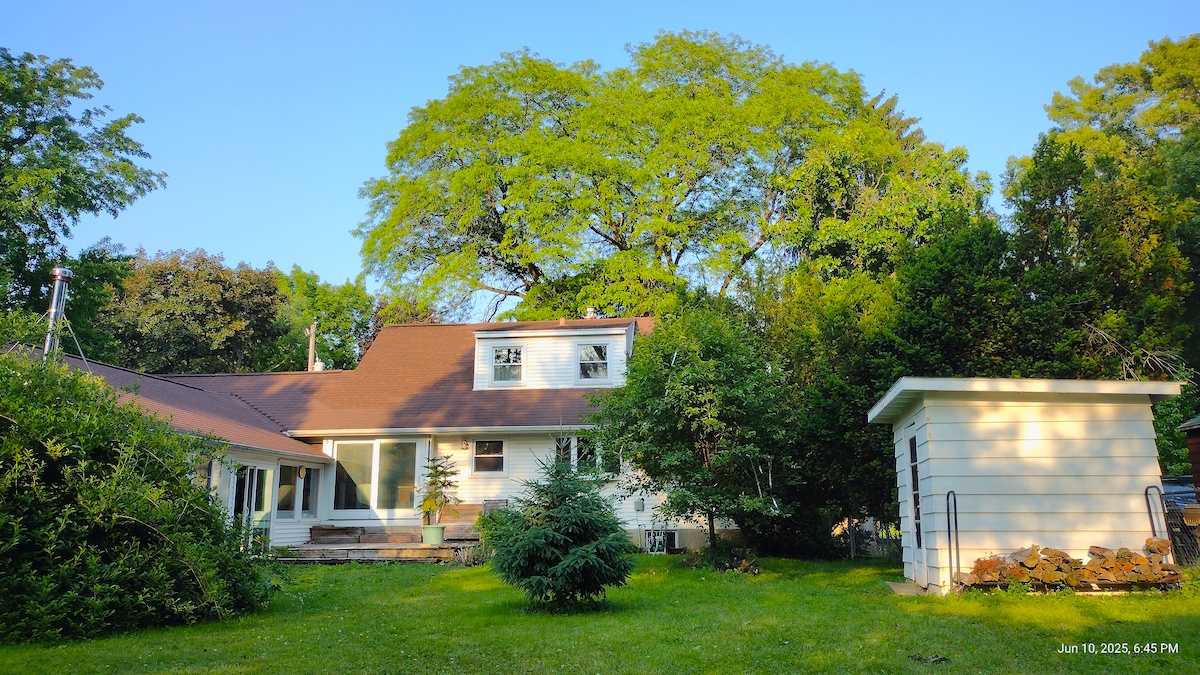
My backyard.
I love to occupy my zero-G chair in the backyard, staring at the black locust tree that arches high above our roofline. I’ve traveled the world and seen its sights. I love Italy and Alaska; I really like Iceland, Austria, Croatia, and Costa Rica. But my favorite place in the whole wide world? Right here, in my backyard.
Fooboo.
Fooboo and I sit here of evenings and commune with the Great All. This communion is sweeter by a glass of wine—or Benedictine, better yet. I share a bit of sharp Wisconsin cheddar with Fooboo. He gobbles it and, if a morsel drops, chases it among the grass blades. I eat mine on a Wasa rye cracker.
I read a book—a history or biography, or a good novel. I see birds and sometimes frame them in my Nikon 8×30 binoculars.
But even at eighty, life’s not all about sitting and relaxing. I picked up some firewood logs the other day from a guy who wanted to get them out of his backyard. I’ll give them a new home, split into pieces, in my woodstove next winter. As I was loading the heavy wood into my little car, he said, “You’re a tough old bird, aren’t you?” I think he meant it as a compliment, not an insult, but in any case I’ll take the rap.
LeRoy “Satchel” Paige in 1970. Photo by Bernard Gotfryd. Public domain.
Some people don’t make it to eighty; others are in poor shape when they get there. I’m blessed to be able to continue most of my usual activities—and suppose I’d better do so as long as I can. Satchel Paige said, “Don’t look back. Something might be gaining on you.”
I would not be in such fine fettle, or in any fettle at all, had I not been saved from myself by a grand young woman—Joelle Caroline Nelson—when I was twenty-five. She’s like me—or rather, I’ve become like her. Hungry for life.
Me and my significant other.
“It takes life to love Life.” That was the advice of Lucinda Matlock in Edgar Lee Masters’s Spoon River Anthology.
What is this I hear of sorrow and weariness,
Anger, discontent and drooping hopes?
Degenerate sons and daughters,
Life is too strong for you —
It takes life to love Life.
That’s a more stirring philosophy than I would have come up with on my own, but it approximates my lifemate’s approach to all things, and in fifty-five years I guess I have soaked some of it up.
So I keep on playing tennis, which is just plain fun. And I keep on walking the dog, even when my hips hurt. And I’ll keep mowing the lawn, walking thousands of steps behind the Toro; though I don’t enjoy it all that much, I’m terrified to stop. And I reckon I’ll get all that wood split before winter.
I’m not ready to quit life yet. Tough old bird, you know.
But the best thing about old age—and I’m only starting to grok the fullness of it, Gentle Reader—the best thing is, I get to enjoy and appreciate everything. Things that used to drive me crazy now do nothing but warm my heart.
The folly, stupidity, and perversity of the human race? Well, what do you expect? It’s only human. We all mean well. We can’t help that we’re limited creatures. But in the living of life, we do throw off occasional gleams of splendor.
I think my worst birthday was when I was thirty. I had reached three decades of age and felt I had not accomplished anything. I meant I had not written a symphony or the great American novel; I had not made a million dollars; I was not President of the United States. I was a failure.
What I did not know then, but do know now, is that most of us don’t leave a great big mark on history. Most of us leave a whole lot of little marks—and half of them, for better or worse, we don’t even know we’re leaving.
It can take a lifetime to wise up to the great joy of living.
The poet W. D. Snodgrass, when he was only thirty, wrote:
While scholars speak authority
And wear their ulcers on their sleeves,
My eyes in spectacles shall see
These trees procure and spend their leaves.
There is a value underneath
The gold and silver in my teeth.
Though trees turn bare and girls turn wives,
We shall afford our costly seasons;
There is a gentleness survives
That will outspeak and has its reasons.
There is a loveliness exists,
Preserves us, not for specialists.
I’ve tried sometimes, but never quite succeeded, in specializing. Guess I’m just a tough old bird.
We went to Monona again this year for the Memorial Day Parade.
Last year, our granddaughter, Elsie, marched in the parade with the Monona Grove High School band, playing her trombone. We were very proud.
This year she was chosen for the honor of twirling one of the band’s decorative flags, so she donned a special outfit and left the trombone at home. She was not carrying our nation’s colors, you understand—just one of several blue-and-white flags that decorate the band’s arrival as it marches down Monona Drive. She marches ahead of the instrumental players and twirls the flag in a decorative display. We were very proud.
Elsie twirls the flag.
This parade is not one of the solemn events of Memorial Day. It’s more like a celebration of community spirit. It starts with a color guard carrying the U.S. and Wisconsin flags. Then everyone in Monona, except spectators, marches or walks down Monona Drive. Many sprinkle items of candy upon the bystanders. Some of them drive old-fashioned cars or huge trucks with elaborate paint jobs. There is a gentleman dressed as Uncle Sam who zips up and down the street on a penny-farthing bicycle. It’s all very grand, and happy.
#
Bratwurst on grill. Photo by Dan Fuh, licensed under CC-BY-SA-2.0
Memorial Day—the Monday observance of the official Memorial Day—is the culmination, here in the Madison area, of a long weekend of food indulgence at The World’s Largest Brat Fest. The event, held on Willow Island near the Memorial Coloseum, features bratwurst sandwiches of all possible descriptions served to enthusiastic consumers in the name of hundreds of worthy charities. It starts on Friday morning with Take Your Brat to Work Day, your annual opportunity to zoom through a quick bratwurst pickup lane and bring a few thousand calories of warm sausages with you to your office, and it ends on Sunday night or whenever the brats run out.
It, too, is a celebration of some kind.
#
Veterans—in uniform and with U.S. flags—are integral to both the parade and the brat fest. They show up everywhere, usually being thanked for their service.
As a Vietnam veteran of the U.S. Air Force, I find myself charmed and gratified whenever our fellow citizens thank us for our service. But thoughtful veterans may reflect that not all of us came home to enjoy the blessings of liberty, to chomp the bratwurst, to march in the parade.
Some paid in blood. Some paid the ultimate price. Some laid their lives as a sacrifice upon the altar of freedom. Memorial Day is about them, about their loss of life, about our loss of their continuing company. It is, on that account, a day of rue and woe.
Franklin
Stanley
I think of my uncles, Stanley and Franklin Sommers, both bomber pilots, both shot down in flames before I was even born. I feel like I know them, even though I never met them.
Billy Harff
I remember Bill Harff, my buddy from the Rattlesnake Patrol in Boy Scout Troop 27, Kenosha, Wisconsin. Billy died of fragmentation wounds near Polei Kleng Airfield in Vietnam in 1968, hit by fragments from a mortar round that burst in the air above him. But I recall him alive and vibrant, pounding tent pegs at a campground or playing a rough-and-tumble Scout game called “British Bulldog.”
Brian and Ryan in happier days.
I remember Ryan Jopek, the hale, cheery 20-year-old son of my friend Brian. I photographed them, father and son together, before Ryan went off to Operation Iraqi Freedom in 2006. He was killed by an improvised explosive device in Tikrit. I know his father feels the loss every day.
There are almost too many to count, yet each one is counted by somebody. Every death is personal to someone. Through blunders of policy or failures of execution, our nation can waste young lives in fruitless battle. Yet those who died in vain cannot be less honored than those who won some clear, unarguable victory.
They are all ours, they gave their all for us, and the least we can do is remember.
#
Don’t get me wrong, Dear Reader. I love my granddaughter, and she looks great in a majorette outfit, twirling a flag.
For the record, I like brats as well as the next man, maybe even better.
But we who remember the honored dead ought to say something about their sacrifice, at least once a year.
Last week in this space, Dear Reader, I mentioned my trip to the Grand Canyon. A pilgrimage, I called it. But in truth, I just wanted to visit a landmark, to cross an item off my bucket list.
Like everyone else, Your New Favorite Writer knew Grand Canyon from Disney films, National Geographic specials, and the like. But that is not the same as being there. I figured it was about time I joined the park’s visitor list.
I signed up for a week-long Road Scholar tour of the canyon’s North and South Rims. Road Scholar, formerly known as Elderhostel, is an organization that provides educational travel programs for older adults. I’ve taken five of their tours and always found them interesting and enjoyable. This sixth was no exception.
Twenty-four of us, first-timers at the canyon, gathered in Flagstaff, Arizona. Our guides would be Joel Kane and Rocky Sullivan. Joel, a geologist, previously worked seven years as an interpretive park ranger in Grand Canyon National Park. Rocky is a writer and cowboy poet who has also been a hot air balloon pilot and cabinet maker. Their kindness and expertise, and the uniformly warm spirit of the group members, made the trip work.
We spent one day exploring the red rock country of Sedona. The next day, we drove north from Flagstaff past the San Francisco Peaks, through a forest of ponderosa pine, ascending from 6,800 feet elevation at Flagstaff to 7,000 at the South Rim, arriving at mid-morning in a state of high anticipation.
What would we make of it? Would our reactions echo those of many who have gone before, or is each person’s experience of the place unique?
We stepped off our van at the South Rim Visitors’ Center and walked to the nearby Mather Point overlook. Joel suggested we keep our eyes on the path in front of us and raise them only after arrival at the viewing point. I followed his suggestion.
“All right,” he said. “We’re there. Look up.”
I looked up.
It was staggering.
The visual scale was overwhelming.
This was nothing you could prepare for, nothing I can describe.
I-Max, eat your heart out.
Charlotte Stone, one of our Road Scholars, views Grand Canyon and visitors from the top of Mather Point.
#
For thousands of years, proto-Americans and historic tribes have lived and worked in the depths of the canyon and on its rims. Today’s Hopi, Zuni, Hualapai and Havasupai peoples are thought to descend from earlier peoples who left abundant evidence of their sojourns. National Park Service archeologists have explored less than five percent of the region’s area, yet have found more than two thousand separate sites for study.
The winding green patch in the center of the photo is Havasupai Gardens, a cottonwood oasis once home to Havasupai people until the National Park Service evicted them in 1928. It is now a public campground for Grand Canyon hikers, and belated efforts are underway to pay respect to the Havasupai for past wrongs endured.
John Wesley Powell. Public Domain.
White, European people touched the canyon as early as 1540, when Captain García López de Cárdenas led a small group of Spanish soldiers to the South Rim. But it wasn’t until John Wesley Powell descended the Colorado River in 1869, with ten men in four wooden boats, that the words “Grand Canyon” came into the American vernacular. Until then, the region was unexplored. Powell, a Union officer who had given an arm for his country at Shiloh, put Grand Canyon on the map. Powell led another expedition two years later.
Fred Harvey. Public Domain.
Then, true to America’s genius for exploiting resources, others began to arrive: explorers, adventurers, fortune-seekers, builders. Many sought gold or other precious minerals. Ralph Cameron built a toll road to the South Rim and filed many mining claims, not so much to extract metal as to snap up choice real estate.
There came developers like the Atchison, Topeka, and Santa Fe Railroad, which built a spur line from Williams, Arizona, to the South Rim; and entrepreneurs like Fred Harvey the railroad restaurateur, who established a grand hotel, El Tovar, on the canyon rim.
El Tovar Hotel.
Vista from Hermit’s Rest, one of Mary Colter’s buildings.
There were artist/explorers like photographers Emery and Ellsworth Kolb, who opened a studio and made the earliest still and motion pictures of the canyon. There were artist/builders like architect Mary Colter, whose structures, often of native Kaibab limestone, defined a new Southwestern aesthetic style.
The lives of these pioneers overflow with remarkable incidents and exploits, enough to fill books and museums in plenty. And the feats of more recent Grand Canyoneers—such as the pipeline across the chasm, which supplies the South Rim’s five million tourists a year with fresh spring water from the less-visited North Rim—are just as remarkable.
The formation known as Wotan’s Throne.
But a question rises in one’s brain as all this canyonesque lore unfolds: What is it about this great vacuity—this vast rancho of open air bordered by extravagant tons of stratified, water-chiseled rock—that re-organizes the people, and even the space, within its realm?
Maybe it’s something about the geology. Perhaps that’s why Joel, with his bottomless treasury of igneous and sedimentary arcana, is the person best qualified to guide our little expedition. For the canyon seizes one’s attention not just by its hugeness or its sculptural complexity. Rather, it compels one to think about processes.
The Grand Canyon, 277 river miles long, ten to eighteen miles wide, and more than a mile deep, is the only place on Earth where such a large area of land came to be shaped in this particular way.
Road Scholars view the canyon from the North Rim.
As we amiable tripmates view the Grand Canyon from hundreds of angles at two dozen different viewing platforms, as we overfly it in a special sightseeing plane, looks of concentration and reckoning pass across the faces of my fellow Road Scholars. This visage is composed in equal measures of disbelief and recognition. It says:
Something momentous happened here, on a giant stage, over vast reels of time. What was it? What happened here?
Joel explains as much as he can by dramas of uplift, folding, eruption, erosion—thick layers of different kinds of rock laid over one another, then dislocated by earthquakes, floods, and other cataclysms over geologic time. The simultaneous uplift of a huge tract—the Colorado Plateau—all in one piece. And always the irresistible power of water flowing downward.
Rocky adds human dimensions—a keen knowledge and respect for the lore and practices of long generations of native Americans who have called this place home.
Questions remain, an unsettled feeling. This landscape was shaped by titanic battles among the forces of nature. Yet without us, it’s incomplete. I don’t mean to imply, Dear Reader, that it was all staged for our benefit. But without our presence, without our testimony—without our need to relate to the world where we have been placed—what could it possibly mean?
Juniper and piñon pine embrace the canyon’s incipient glow at sunset.
We are a part of that we wonder at. If not, then how could we be so moved?
The canyon’s real presence demands some kind of imagination. And then you find your own imagination too small to encompass it. And you wonder, at least I do, what imagination was big enough to create it?
A visit here is a soul event. Maybe it was a pilgrimage, after all.
I can’t write about it yet, Gracious Reader. It’s too big.
This is a repost of an item that originally appeared November 19, 2024. Although the information is six months out of date, the emotions are still true. Hope you enjoy it.
I’m creeping up on eighty.
At such an age, one ought to have something for the world. Something to leave behind when you go. Wisdom.
Not just any old wisdom, you understand.
Not just: “Treat people well on your way up, because you might meet them again on your way down.”
Or: “Don’t neglect to floss; ignore your teeth and they’ll go away.”
Comic Henny Youngman. Public Domain.
Good nostrums both, but I mean something deep. Something universal, touching one’s inner life.
Take emotion. I say that in the Henny Youngman sense: “Take my emotion . . . please!”
As in, “You can have it. I don’t want it.”
#
With me, a little emotion goes a long way.
In old age, I’ve become a writer of fiction. (See Izzy Strikes Gold! and the soon-to-be-republished Price of Passage.) What we fiction writers principally strive for is to pluck emotional strings in the reader.
Sure, we want to entertain, we want to inform; but the brass ring on this carousel is moving the reader. Emotion is the gold standard of art.
Ansel Adams, who obsessed over the minute details of photography—lens aperture, depth of field, developer time, characteristic exposure curves of different films and papers, the tonal scale of the finished print—that Ansel Adams, the supreme technician, said: “A great photograph is one that fully expresses what one feels, in the deepest sense, about what is being photographed.” (My italics.) He wanted to express emotion.
Adams also said, “I give it to you as a spectator, and you get it or you don’t get it, but there’s nothing on the back of the print that tells you what you should get.” He saw that what he strove to express might not strike a resonant chord on another person’s emotional keyboard. But the possibility of doing so was the whole point of his art.
Moonrise, Hernandez, New Mexico, one of Ansel Adams’s most famous photos. Photographed on November 1, 1941, 4:49:20 p.m. local time, as subsequently determined through independent analysis by amateur astronomer Dennis di Cicco. Public Domain.
I show my stories to quite a few people for critique—colleagues, friends, so-called beta readers—before turning it on the public at large. The feedback I most often receive is that my characters seem to lack emotion. They need humanizing.
Why am I reluctant to inject emotion?
I happen to like my characters flat and unaffected. Only after several colleagues tell me that a character is too calm and phlegmatic—only then will I revise my work to develop an underlying core of fear, joy, or throbbing pain.
Once I give in and do that, the work gets stronger and more interesting. From long experience, I know that.
Yet I resist doing so.
The fact is, Dear Reader, I dislike emotion.
Now, don’t get me wrong: I don’t hate emotion. I don’t despise it. I don’t abhor it. That would be emotional, which is the last thing I want to be.
I distrust emotion. I look upon it with suspicion.
Rex Harrison as Henry Higgins. Fair use.
I’m like Henry Higgins of My Fair Lady, as voiced by Rex Harrison: “. . . a quiet living man . . . who likes an atmosphere as restful as an undiscovered tomb . . . a pensive man . . . of philosophic joys who likes to meditate, contemplate free from humanity’s mad inhuman noise.”
#
Is it possible to live life free of emotional upset?
Tilt-a-Whirl. Fair use.
Could it be that life is a teeter-totter, after all? Or maybe a Tilt-a-Whirl?
One Thursday night recently, I dreamed a dream: I drove through pleasant countryside. In the seat beside me was my wife. Only we weren’t married yet. We were still the young people we had been many years before. I sincerely hoped she was enjoying the ride, and liking my company enough to want to do it again.
But the windshield turned opaque. It grayed out. The car hurtled along the road, but I couldn’t see where it was going. I was terrified.
I woke up , and it was Friday.
I dismissed the dream and drove off to Onalaska, about three hours from home, to attend the Wisconsin Writers Association annual conference. There I saw some old friends, made some new ones, and learned a few things about writing and marketing. It was a good conference.
On the way home Saturday afternoon, I stopped in Mauston for dinner. When I came out of Denny’s half an hour later, night had fallen. I drove south on the highway, into the black.
Strange optical effects vexed the darkness. The sky ahead—which should have been black stippled with small points of light from farms or vehicles—was instead a uniform sheet of gray. It looked like I was approaching a raised concrete overpass, one which kept receding as I drove toward it.
But the overpass was illusory. In fact, when I did drive under an actual overpass, it caught me by surprise. I didn’t think it was real until it passed overhead. And there, splayed across the windshield before me, hung another overpass—one that I was almost sure was a phantom.
The sides of my vision seemed to be lined with vertical concrete walls, as if the road were passing through a tunnel. You could say I had tunnel vision.
What I actually have, Dear Reader, is macular degeneration—an insidious condition that robs me of sight inexorably, by tiny degrees. These night-time illusions were just the latest symptom.
Before reaching Sauk City, I decided I will no longer drive at night. At least, not at speed, on rural highways. It’s the first clipping of my wings due to old age. A curtailed freedom.
A day or two later I remembered my odd dream the previous Thursday night. It seems prophetic now.
#
Only minutes after my momentous decision to give up night driving, I struck a deer that leapt in front of my car. It was purely coincidental. Because of how it happened, I can say for sure that the deer strike was not caused by my night vision problems.
Still, it shook me up. But you would hardly know that, Gentle Reader, from the flat, just-the-facts-ma’am, report of it which I posted here last Tuesday.
At any rate, within a space of three days, I had received a fateful prophecy, made a dreaded decision, and incurred major vehicular damage.
Some people might call that a tough weekend.
#
One week after the collision with the buck, I traveled to Washington, D.C., in the company of eighty-six fellow veterans, and escorted by my much-loved daughter, Katie, on Badger Honor Flight Mission 57. I’ve posted that in some detail here and here, so I shan’t belabor it further.
Stunned by the reception. Photo by Kari Keunzi Randall. Used by permission.
Only: It was something I had never expected to do, an opportunity offered me as if to make up for a decades-old slight from the nation, which I did not grieve at the time. Now that this honor was virtually thrust upon me, I felt such a catharsis of long-withheld gladness—such a glorious rush of love—that I now question the value of this lifelong habit of stuffing my emotions into my back pocket where I can ignore them.
That’s all.
#
Being the Alert and Perspicacious Reader that you are, you will no doubt have noticed an underlying theme to these ruminations: Your New Favorite Writer is getting older. He is tripping over events that may spark strong feelings of a kind that he has little experience of, and little taste for, welcoming in an honest and open way.
You might say a prayer for him, if you’re so inclined.