We went to Monona again this year for the Memorial Day Parade.
Last year, our granddaughter, Elsie, marched in the parade with the Monona Grove High School band, playing her trombone. We were very proud.
This year she was chosen for the honor of twirling one of the band’s decorative flags, so she donned a special outfit and left the trombone at home. She was not carrying our nation’s colors, you understand—just one of several blue-and-white flags that decorate the band’s arrival as it marches down Monona Drive. She marches ahead of the instrumental players and twirls the flag in a decorative display. We were very proud.
Elsie twirls the flag.
This parade is not one of the solemn events of Memorial Day. It’s more like a celebration of community spirit. It starts with a color guard carrying the U.S. and Wisconsin flags. Then everyone in Monona, except spectators, marches or walks down Monona Drive. Many sprinkle items of candy upon the bystanders. Some of them drive old-fashioned cars or huge trucks with elaborate paint jobs. There is a gentleman dressed as Uncle Sam who zips up and down the street on a penny-farthing bicycle. It’s all very grand, and happy.
#
Bratwurst on grill. Photo by Dan Fuh, licensed under CC-BY-SA-2.0
Memorial Day—the Monday observance of the official Memorial Day—is the culmination, here in the Madison area, of a long weekend of food indulgence at The World’s Largest Brat Fest. The event, held on Willow Island near the Memorial Coloseum, features bratwurst sandwiches of all possible descriptions served to enthusiastic consumers in the name of hundreds of worthy charities. It starts on Friday morning with Take Your Brat to Work Day, your annual opportunity to zoom through a quick bratwurst pickup lane and bring a few thousand calories of warm sausages with you to your office, and it ends on Sunday night or whenever the brats run out.
It, too, is a celebration of some kind.
#
Veterans—in uniform and with U.S. flags—are integral to both the parade and the brat fest. They show up everywhere, usually being thanked for their service.
As a Vietnam veteran of the U.S. Air Force, I find myself charmed and gratified whenever our fellow citizens thank us for our service. But thoughtful veterans may reflect that not all of us came home to enjoy the blessings of liberty, to chomp the bratwurst, to march in the parade.
Some paid in blood. Some paid the ultimate price. Some laid their lives as a sacrifice upon the altar of freedom. Memorial Day is about them, about their loss of life, about our loss of their continuing company. It is, on that account, a day of rue and woe.
Franklin
Stanley
I think of my uncles, Stanley and Franklin Sommers, both bomber pilots, both shot down in flames before I was even born. I feel like I know them, even though I never met them.
Billy Harff
I remember Bill Harff, my buddy from the Rattlesnake Patrol in Boy Scout Troop 27, Kenosha, Wisconsin. Billy died of fragmentation wounds near Polei Kleng Airfield in Vietnam in 1968, hit by fragments from a mortar round that burst in the air above him. But I recall him alive and vibrant, pounding tent pegs at a campground or playing a rough-and-tumble Scout game called “British Bulldog.”
Brian and Ryan in happier days.
I remember Ryan Jopek, the hale, cheery 20-year-old son of my friend Brian. I photographed them, father and son together, before Ryan went off to Operation Iraqi Freedom in 2006. He was killed by an improvised explosive device in Tikrit. I know his father feels the loss every day.
There are almost too many to count, yet each one is counted by somebody. Every death is personal to someone. Through blunders of policy or failures of execution, our nation can waste young lives in fruitless battle. Yet those who died in vain cannot be less honored than those who won some clear, unarguable victory.
They are all ours, they gave their all for us, and the least we can do is remember.
#
Don’t get me wrong, Dear Reader. I love my granddaughter, and she looks great in a majorette outfit, twirling a flag.
For the record, I like brats as well as the next man, maybe even better.
But we who remember the honored dead ought to say something about their sacrifice, at least once a year.
What can I say? Nothing that has not been said before.
It gives me a sinking feeling in my stomach. People died for me. Rightly or wrongly, wisely or foolishly, for good cause or in vain—they gave their lives.
This morning we will attend the Memorial Day Parade in Monona. Given just a little wedge of dry weather, we’ll cheer as our granddaughter marches down the street, playing her trombone in the high school band. We’ll applaud, full of pride and happiness—as we ought.
Our happiness came with a price tag. Later in the day, we’ll make time to remember the fallen.
My great-great-grandfather, Anders Gunstensen, who died of dysentery contracted at Vicksburg in 1863, as surely a victim of the war as if a bullet had found his heart.
My uncles, Stanley and Franklin Sommers, shot from the sky at opposite ends of the earth—one over the Solomon Islands, the other over France. They were uncles I never knew, taken before I entered the world.
My friends Billy Harff and Bruce Hulting, among the many lost when America stumbled into a little-understood war in Southeast Asia.
Ryan Jopek, a Wisconsin Guardmember who died in Iraq, before his twenty-first birthday. I photographed him with his father before he left Madison.
It’s personal.
War comes for each new generation, with the regularity of a clock striking twelve.
The aggressor fails to resist the lure of power. The defender can hardly be blamed for choosing survival.
The cost is obscene, but young men and women must pay it just the same.
Let us weep for our lost brothers and sisters and honor their sacrifice.
Uncle Ed was First Officer (ranking copilot) on the Anzac Clipper, a flying boat westbound over the Pacific on Sunday morning, December 7, 1941.
The plane had left San Francisco on December 5 but developed mechanical trouble and had to turn back. She was rescheduled for a 2:00 pm departure on December 6, but the pilot, Captain Harry Lanier Turner, requested and received a half-hour delay so he could attend his daughter’s first piano recital in Oakland.
Anzac Clipper at Clear Lake, California, 1941. From Fandom.com, licensed under CC-BY-SA.
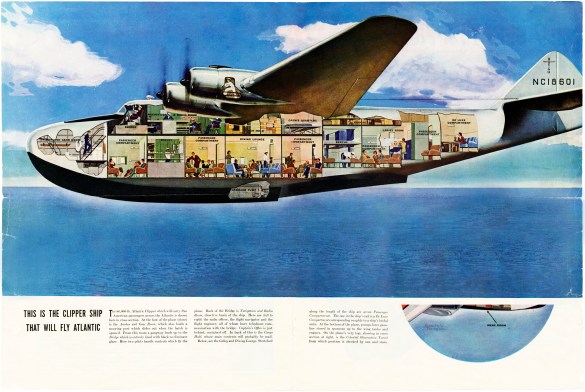
The Boeing 314A was the ultimate flying boat. With four huge 1,600-horsepower engines faired into its 152-foot wingspan, it could cruise at 183 miles per hour, with a service ceiling of 19,200 feet and a range of 5,200 miles without refueling. The plane was so large an engineer could creep through a passage in the wing to observe or service any of its engines in mid-flight.
A DeLuxe Ride
Even with all that power on the wings, passengers could talk normally in its elegant soundproofed cabin. There was a dining lounge amidships, where two stewards catered four-star meals on white linen using real silver and china. Best of all, you could cross the Pacific in a week, not the three or four weeks that a boat took. But you had to pony up $760 for a one-way passage. That’s equivalent to almost $14,000 in 2020 dollars.
The seventeen passengers aboard the Anzac Clipper that day were no doubt well-heeled. Movie stars, royals, and high government officials often rode Pan American’s Clippers. With their morning juice and coffee, they got a reminder from the stewards to set their watches to Hawaii Time, which was 8:30 am.
In the spacious crew compartment over their heads, Radio Officer W.H. Bell left his console and strode forward to the “bridge”—Pan Am used nautical terms for everything—with a message for the captain: The Japanese were attacking Pearl Harbor, just an hour’s flight ahead of them.
Photograph taken from a Japanese plane early in the torpedo attack on ships moored on both sides of Ford Island. A torpedo has just hit USS West Virginia on the far side of Ford Island (center). Imperial Japanese Navy. Public Domain.
This was serious, for Pearl Harbor was the Clipper’s actual destination. Hostilities did not come as a complete surprise, however. For months, Pan Am captains had carried sealed envelopes to be opened if war broke out. Captain Turner now reached for his envelope and ripped it open. Meanwhile, the radioman began to hear Japanese and American signals from the furious fight being waged.
“Divert to Hilo”
Pan Am’s secret orders instructed Turner, in the event of an attack on Pearl Harbor, to land at Hilo Bay, on the “Big Island” of Hawaii. He put the Boeing into a slow turn toward the south. Passengers were not told of anything amiss until the Anzac Clipper splashed down two hours later.
The passengers were gathered in the dining lounge and told that Pearl Harbor had been attacked. The Clipper would refuel at Hilo and fly back to San Francisco as soon as possible. They were welcome to ride back or to stay in Hawaii and make their own way to their final destinations.
Special Passengers?
Who were these passengers? According to an April 2016 article by Nam Sang-so in the English-language Korea Times, “There were two VIPs on board; His Imperial Majesty of Iran Mohammed Reza Shah Pahlavi, who was on his way home after visiting President Roosevelt promising that he would cooperate with the United States. The other distinguished guest was U Saw, the Premier of Burma (now Myanmar). He too was on his way home also after visiting that same president and was disappointed by Roosevelt’s refusal to honor his plea for the independence of Burma from Britain. As the western globe route back to Rangoon was blocked by the Japanese fleet, he had to take the eastward route home, stopping at the Japanese Embassy in Lisbon and secretly informing the ambassador that Burma would help Japan in the war against America. The confidential Japanese message sent to Tokyo was decoded by the U.S. Navy. He later played a major role in the assassination of Burma’s national hero Aung San in 1947 and U Saw was later executed by his own people.”
The presence of these two high-level personages is a remarkable claim, inasmuch as I haven’t found it anywhere else; and Mr. Nam does not state his sources. I have sent him an email asking for more information.
I also heard rumors within our family, years ago, that the passenger list included Japanese diplomats flying home after unsuccessful negotiations in Washington, D.C. Like Mr. Nam’s assertion about the Shah and U Saw, it seems remarkable.
However, Pan Am’s Clippers were a remarkable resource in that pre-World War II world—so I can’t completely discount either account.
At any rate, none of the passengers accepted the offer of a free ride back to San Francisco. They all chose to stay in Hawaii and make their way to Honolulu or wherever they were going.
Eastern Exposure
As the Anzac Clipper and its passengers coped with these events, a frenzy had overtaken Pan American headquarters on the 58th floor of New York’s Chrysler Building. Juan Trippe and his lieutenants worked feverishly to save three other Clippers that also stood in harm’s way.
More than 2,500 miles west of Hilo, the Philippine Clipper, a Martin M-130 flying boat captained by John “Hammy” Hamilton, had just left Wake Island en route to Guam. Hamilton received orders to turn around, fly back to Wake, and evacuate all Pan Am personnel from the tiny atoll. While the Clipper was being refueled at Wake, the station came under aerial attack. After climbing out of the ditch where he had taken cover, Hamilton found the aircraft, though stitched by strafing fire, had not been seriously damaged. She was still flyable. After stripping all non-essential items out of the plane to lighten the load, Hamilton took off with 34 passengers, including two seriously wounded. He flew to Midway, an island which had also been attacked, and the next day onward to Hawaii.
At Hong Kong, the Hong Kong Clipper, a Sikorsky S-42 flying boat, was destroyed in an onslaught of Japanese Zero fighters. Captain Fred Ralph and his crew escaped to the Chinese mainland in an emergency airlift of land-based planes operated by CNAC, Pan Am’s Chinese affiliate.
Captain Bob Ford and the crew of the Pacific Clipper, another Boeing 314, were stranded in Auckland, New Zealand, with the Imperial Japanese Navy blocking their way home. Eventually, Pan Am headquarters ordered them to fly to New York the long way around—via Asia, Africa, the Atlantic, and South America. Without adequate maps, prepared runways and ground crews, or even reliable supplies of aviation fuel, the intrepid crew worked their way around the globe. Their epic 31,500-mile, month-long trek brought them back to New York in early January—the first circumnavigation of the globe by a commercial airliner.
Whither the Anzac Clipper?
First Officer Edward F. Sommers gets a kiss from his daughter Elaine. Clipped from the San Francisco Chronicleof December 10, 1941, and scanned.
Meanwhile, the crew of the Anzac Clipper had brought their plane home without incident. They left Hilo the evening of December 8, flew in the dark while maintaining radio silence, and arrived in San Francisco the next day, unshaved and missing about three days’ sleep. The San Francisco Chronicle published a photo of Uncle Ed being welcomed home by Elaine, his four-year-old daughter.
#
Thus ends the glamor era of flying boats—with a bang, not a whimper. The ocean bases Pan Am had painstakingly built at Wake, Midway, and other places, fell to the Japanese. The company’s fleet of nine B-314s were purchased by the U.S. government for a million dollars each. Under the aegis of the U.S. Navy, they flew thousands of hard miles from 1941 until the end of the war. In 1945 the government offered to return them to Pan American at $50,000 apiece, but Trippe declined the offer. Longer-range, land-based aircraft were the future, especially now that most cities fhad built airports.
The B-314s’ war service, however, was noteworthy. They were used for critically important passengers and cargo. They flew badly-needed aircraft tires to China for use by the Flying Tigers. They flew President Franklin D. Roosevelt to and from the 1943 Casablanca Conference with Churchill and other leaders.
Since Uncle Ed was a Naval Reserve officer as well as a Pan American pilot with experience flying B-314s, I can’t help wondering whether he was one of the pilots who flew them for the Navy. Guess I’ll have to ask my cousins.