ANOTHER Unusual Day

I often feel I’m standing at the edge of the Universe, yelling into a tiny megaphone. My words fly out . . . no echo answers back, and it makes me wonder.

But sometimes, there is a response. 

In January 2020 I posted a piece under the heading “A Most Unusual Day.” 

(The post had no relation to the Jimmy McHigh-Harold Adamson song introduced by Jane Powell in the 1948 film A Date With Judy and later swung in a hip version by June Christy and the Stan Kenton Orchestra. I merely stole the song’s title to characterize a particular day in the life of my uncle, Edward F. Sommers, a pilot for Pan American Airways.)

On December 7, 1941, Uncle Ed was enroute to Honolulu from San Francisco, flying as first officer on Pan Am’s Anzac Clipper. That Sunday morning, radio signals made it clear Pearl Harbor was under attack. Captain Harry Lanier Turner changed course and landed at Hilo, two hundred miles away.

The Anzac Clipper. Photo from https://pan-american-clippers.fandom.com, licensed under CC-BY-SA.

My rambling January 2020 post told about Uncle Ed’s experience that day and in the days following. I also mentioned the near-simultaneous attacks on several Pan Am stations in the western Pacific.

The post drew several Facebook comments and one on-page comment at the time of its posting. Then three and a half years passed.

Mac’s Comment

Suddenly, three weeks ago, a long comment was posted on the page by Mac McMorrow, a lifelong resident of Hawaii’s Big Island. In the late 1930s, dengue fever and bubonic plague were common in the Hawaiian islands. As a result, McMorrow’s father, the first graduate of MIT’s public health engineer program, was hired to suppress the disease-prone rat population near Hilo. 

Though Mac McMorrow was a two-year-old toddler in 1941, Honoluolu Star-Advertiser columnist Bob Sigall reached out to him recently to comment on a note from one Alvin Yee. Yee had written:

The young Shah of Iran and his first wife, Queen Fawzieh, sometime between 1939 and 1945. Photo by Cecil Beaton. Public Domain.

“On the morning of Dec. 7, 1941 an unscheduled Pan Am Clipper flying boat [the Anzac Clipper my Uncle Ed copiloted] landed in Hilo Bay after eluding the Japanese attack on Pearl Harbor and [Mac McMorrow’s] father tried to go on board and inspect everyone for disease but some haughty State Department official wouldn’t allow it saying the passengers were VIPs. 

“I happen to know the passengers included the young Shah of Iran and the Premier of Burma and their travelling parties on their way back to Asia. . . . Check with Mac to see if I got this story straight.” 

McMorrow, in his reply to Sigall, stated: “I can’t confirm very much of his story based on what was passed down to me by my father. I doubt it was my father who was confronted by the State Department official. I think my father would have mentioned that kind of incident to me. My father was the senior Territorial Health Officer on Hawaii Island and he would have had the plane quarantined if the regulations were not followed.”

He then adds a tantalizing tale:

Eurasian mystery woman? Photo by Chang Liu on Unsplash.

[W]hat I remember my father telling me was that a passenger on the plane was a US diplomat. He had to return to the mainland on the Clipper. However, accompanying him was an attractive Asian/Eurasian woman who was not an American citizen. She was not allowed to return on the flight. She was left in Hilo when the Clipper took off the next day. One of our handsome family friends quickly took her under his “protection”. He escorted her around Hilo for several days until she could get to Honolulu. You can imagine the gossip little Hilo would have enjoyed, even under martial law. 

Gracious Reader, this is the first whisper of this attractive Asian/Eurasian woman to reach Your New Favorite Writer’s ears. Or eyes, actually. It’s downright titillating.

Idle Speculations

One can easily imagine a diplomat traveling sub rosa with an attractive woman to whom he was not officially attached—even in the innocent 1940s. In fact, if we were enjoying a novel or a screenplay, you could count on it. A living informant telling us he heard it as fact from his father certainly adds credibility.

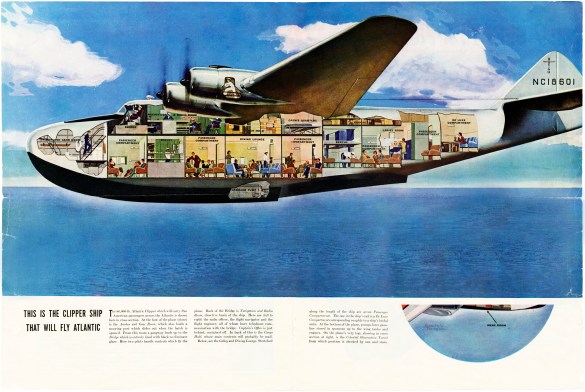
Cutaway view of Boeing 314 Clipper by Kenneth W. Thompson. Smithsonian’s National Air and Space Museum.

As to Alvin Yee’s assertion that “the young Shah of Iran [Mohammed Reza Pahlavi] and the Premier of Burma” were passengers on the plane: That’s not far-fetched, since the Boeing 314 Clippers were the ultimate form of transportation at the time, a natural choice for the rich, famous, and powerful. But the only other place I have seen this specific claim was in a 2016 article by Korea Times writer Nam Sang-so. I have emailed Mr. Nam a couple of times to find out where he got his assertion, but thus far have received no response. 

This leaves me wondering whether Alvin Yee’s information came from Nam Sang-so’s article or from some other source. 

Uncle Ed’s daughter Elaine greets him with a kiss on his return. Clipped from the San Francisco Chronicle of December 10, 1941, and scanned.

Robert Daley, in An American Saga: Juan Trippe and his Pan Am Empire, says, “The Clipper [was to] be refueled here at Hilo and flown back to San Francisco as soon as possible. Passengers were welcome to ride back [or else] they could stay here and make their own way to Honolulu or Mauir or wherever they were going.” He says all the passengers opted to stay in Hawaii but makes no claim that any of them were VIPs. He mentions no Iranian royalty, Burmese politicians, or mystery women. But a lack of evidence that they existed is not necessarily evidence they did not exist, if you see what I mean.

So for now these things must remain intriguing mysteries.

Thanks, Mac

But I do thank Mac McMorrow, now evidently a very active 84-year-old, for adding to the mystery. 

Even more, I thank him for honoring one of my posts by responding. You, too, Fair Reader, are welcome to add your comments to this or any other post on my “Reflections” blog. Or you may email me with comments. My address is larryfsommers@gmail.com.

Safe and happy travels to you all—whether by flying boat, magic carpet, or pickup truck.

Blessings,

Larry F. Sommers

Your New Favorite Writer

A Most Unusual Day

Uncle Ed was First Officer (ranking copilot) on the Anzac Clipper, a flying boat westbound over the Pacific on Sunday morning, December 7, 1941. 

The plane had left San Francisco on December 5 but developed mechanical trouble and had to turn back. She was rescheduled for a 2:00 pm departure on December 6, but the pilot, Captain Harry Lanier Turner, requested and received a half-hour delay so he could attend his daughter’s first piano recital in Oakland.

Anzac Clipper at Clear Lake, California, 1941. From Fandom.com, licensed under CC-BY-SA.

The Boeing 314A was the ultimate flying boat. With four huge 1,600-horsepower engines faired into its 152-foot wingspan, it could cruise at 183 miles per hour, with a service ceiling of 19,200 feet and a range of 5,200 miles without refueling. The plane was so large an engineer could creep through a passage in the wing to observe or service any of its engines in mid-flight. 

A DeLuxe Ride

Even with all that power on the wings, passengers could talk normally in its elegant soundproofed cabin. There was a dining lounge amidships, where two stewards catered four-star meals on white linen using real silver and china. Best of all, you could cross the Pacific in a week, not the three or four weeks that a boat took. But you had to pony up $760 for a one-way passage. That’s equivalent to almost $14,000 in 2020 dollars. 

Cutaway view of Boeing 314 Clipper by Kenneth W. Thompson. Smithsonian’s National Air and Space Museum.

The seventeen passengers aboard the Anzac Clipper that day were no doubt well-heeled. Movie stars, royals, and high government officials often rode Pan American’s Clippers. With their morning juice and coffee, they got a reminder from the stewards to set their watches to Hawaii Time, which was 8:30 am. 

In the spacious crew compartment over their heads, Radio Officer W.H. Bell left his console and strode forward to the “bridge”—Pan Am used nautical terms for everything—with a message for the captain: The Japanese were attacking Pearl Harbor, just an hour’s flight ahead of them. 

Photograph taken from a Japanese plane early in the torpedo attack on ships moored on both sides of Ford Island. A torpedo has just hit USS West Virginia on the far side of Ford Island (center). Imperial Japanese Navy. Public Domain.

This was serious, for Pearl Harbor was the Clipper’s actual destination. Hostilities did not come as a complete surprise, however. For months, Pan Am captains had carried sealed envelopes to be opened if war broke out. Captain Turner now reached for his envelope and ripped it open. Meanwhile, the radioman began to hear Japanese and American signals from the furious fight being waged.

“Divert to Hilo”

Pan Am’s secret orders instructed Turner, in the event of an attack on Pearl Harbor, to land at Hilo Bay, on the “Big Island” of Hawaii. He put the Boeing into a slow turn toward the south. Passengers were not told of anything amiss until the Anzac Clipper splashed down two hours later.  

Hawaii map showing Pearl Harbor and Hilo. From Visitpearlharbor.org.

The passengers were gathered in the dining lounge and told that Pearl Harbor had been attacked. The Clipper would refuel at Hilo and fly back to San Francisco as soon as possible. They were welcome to ride back or to stay in Hawaii and make their own way to their final destinations. 

Special Passengers?

Who were these passengers? According to an April 2016 article by Nam Sang-so in the English-language Korea Times, “There were two VIPs on board; His Imperial Majesty of Iran Mohammed Reza Shah Pahlavi, who was on his way home after visiting President Roosevelt promising that he would cooperate with the United States. The other distinguished guest was U Saw, the Premier of Burma (now Myanmar). He too was on his way home also after visiting that same president and was disappointed by Roosevelt’s refusal to honor his plea for the independence of Burma from Britain. As the western globe route back to Rangoon was blocked by the Japanese fleet, he had to take the eastward route home, stopping at the Japanese Embassy in Lisbon and secretly informing the ambassador that Burma would help Japan in the war against America. The confidential Japanese message sent to Tokyo was decoded by the U.S. Navy. He later played a major role in the assassination of Burma’s national hero Aung San in 1947 and U Saw was later executed by his own people.” 

The presence of these two high-level personages is a remarkable claim, inasmuch as I haven’t found it anywhere else; and Mr. Nam does not state his sources. I have sent him an email asking for more information. 

I also heard rumors within our family, years ago, that the passenger list included Japanese diplomats flying home after unsuccessful negotiations in Washington, D.C. Like Mr. Nam’s assertion about the Shah and U Saw, it seems remarkable. 

However, Pan Am’s Clippers were a remarkable resource in that pre-World War II world—so I can’t completely discount either account.

At any rate, none of the passengers accepted the offer of a free ride back to San Francisco. They all chose to stay in Hawaii and make their way to Honolulu or wherever they were going.

Eastern Exposure

As the Anzac Clipper and its passengers coped with these events, a frenzy had overtaken Pan American headquarters on the 58th floor of New York’s Chrysler Building. Juan Trippe and his lieutenants worked feverishly to save three other Clippers that also stood in harm’s way. 

  • More than 2,500 miles west of Hilo, the Philippine Clipper, a Martin M-130 flying boat captained by John “Hammy” Hamilton, had just left Wake Island en route to Guam. Hamilton received orders to turn around, fly back to Wake, and evacuate all Pan Am personnel from the tiny atoll. While the Clipper was being refueled at Wake, the station came under aerial attack. After climbing out of the ditch where he had taken cover, Hamilton found the aircraft, though stitched by strafing fire, had not been seriously damaged. She was still flyable. After stripping all non-essential items out of the plane to lighten the load, Hamilton took off with 34 passengers, including two seriously wounded. He flew to Midway, an island which had also been attacked, and the next day onward to Hawaii.
Captain Robert Ford, panam.org.
  • At Hong Kong, the Hong Kong Clipper, a Sikorsky S-42 flying boat, was destroyed in an onslaught of Japanese Zero fighters. Captain Fred Ralph and his crew escaped to the Chinese mainland in an emergency airlift of land-based planes operated by CNAC, Pan Am’s Chinese affiliate.
  • Captain Bob Ford and the crew of the Pacific Clipper, another Boeing 314, were stranded in Auckland, New Zealand, with the Imperial Japanese Navy blocking their way home. Eventually, Pan Am headquarters ordered them to fly to New York the long way around—via Asia, Africa, the Atlantic, and South America. Without adequate maps, prepared runways and ground crews, or even reliable supplies of aviation fuel, the intrepid crew worked their way around the globe. Their epic 31,500-mile, month-long trek brought them back to New York in early January—the first circumnavigation of the globe by a commercial airliner.

Whither the Anzac Clipper?

First Officer Edward F. Sommers gets a kiss from his daughter Elaine. Clipped from the San Francisco Chronicleof December 10, 1941, and scanned.

Meanwhile, the crew of the Anzac Clipper had brought their plane home without incident. They left Hilo the evening of December 8, flew in the dark while maintaining radio silence, and arrived in San Francisco the next day, unshaved and missing about three days’ sleep. The San Francisco Chronicle published a photo of Uncle Ed being welcomed home by Elaine, his four-year-old daughter. 

#

Thus ends the glamor era of flying boats—with a bang, not a whimper. The ocean bases Pan Am had painstakingly built at Wake, Midway, and other places, fell to the Japanese. The company’s fleet of nine B-314s were purchased by the U.S. government for a million dollars each. Under the aegis of the U.S. Navy, they flew thousands of hard miles from 1941 until the end of the war. In 1945 the government offered to return them to Pan American at $50,000 apiece, but Trippe declined the offer. Longer-range, land-based aircraft were the future, especially now that most cities fhad built airports.

The B-314s’ war service, however, was noteworthy. They were used for critically important passengers and cargo. They flew badly-needed aircraft tires to China for use by the Flying Tigers. They flew President Franklin D. Roosevelt to and from the 1943 Casablanca Conference with Churchill and other leaders.

Since Uncle Ed was a Naval Reserve officer as well as a Pan American pilot with experience flying B-314s, I can’t help wondering whether he was one of the pilots who flew them for the Navy. Guess I’ll have to ask my cousins. 

Blessings,

Larry F. Sommers, Your New Favorite Author