Last Friday, I had the good fortune to present a workshop titled “A Bulletproof Beginning: Five Ways to Anchor Your Story in Urgency from Word One” at the annual Wisconsin Writers Association Conference, held in Stevens Point.
I say “good fortune” for several reasons:
I got paid.
I heard the sound of my own voice—sweet music to my ears, indeed.
Most of all, I was with 175 friends of the Writing Persuasion—folks who have an itch they can scratch only by setting pen to paper, or fingers to keyboard. These friends understand one another’s need. About sixty of the 175 attended my breakout session.
Some of my good friends relaxing just before my workshop last Friday.
A lot of people have told me they got something good out of it.
So, why keep it to myself? For readers who did not have the opportunity to attend, I will try to encapsulate a 50-minute talk in the next seven weekly blog posts.
Here goes:
A Bulletproof Beginning
What’s the big deal about a beginning? Why the fuss?
Aristotle, right, argues with Plato (strongly resembling Leonardo da Vinci) in this detail from “The School of Athens” by Renaissance painter Raphael (1483-1520). Public Domain.
Dear Reader, a philosopher named Aristotle said, about 2,400 years ago, that every story has a beginning . . . a middle . . . and an end. That may seem obvious, but apparently nobody before Aristotle thought to write it down.
And nobody since Aristotle has gone much beyond that simple observation in explaining story structure. If you want to hassle me about Joseph Campbell’s/ Christopher Vogler’s Twelve Stages of the Hero’s Journey, or about Blake Snyder’s Fifteen-Beat “Save the Cat” structure—sure, let’s have that argument someday. But in the meantime, consider:
Of the three parts of a story, the beginning is most important. Why?
Because if your beginning is no good, no reader will experience the joys of the middle and end. They won’t stick around.
More so, if the reader is an agent, editor, or publisher considering your story for publication or film production. Typically, such mandarins want the first ten pages included with a cold query. But that does not mean they will read ten pages.
No. They will read maybe one page. Or maybe just the first paragraph. And if that doesn’t knock their socks off, they’re done. They have a lot of scripts to read. You must earn your way to the second and subsequent pages.
Most of all, the beginning is important because it establishes the conditions under which the rest of the story plays out. The break into Act II, the many twists and turns thereafter, the great change of color and tenor at mid-point, the swiftening action as you move into Act III, the exciting climax and final denouement—all are present in embryo in the beginning of the story. If they’re not, it won’t work.
Studio publicity photo of Billy Wilder and Gloria Swanson on the set of Sunset Boulevard, ca. 1950. Public Domain.
Billy Wilder—the great German-American film genius responsible for Ninotchka,Sunset Boulevard, Double Indemnity, Some Like it Hot, and many other classic movies, said, “If you have a problem in the third act, your real problem is in the first act.” If you go back and fix the first act, the third act will work better.
By the way, Gentle Reader, did you ever notice how many lectures, workshops, or articles about story construction for prose fiction rely heavily on movies for their examples? Here’s the reason: Owing to the format and function of film scripts, the screenwriter has nowhere to hide from the need for STRUCTURE.
A seasoned scripter can sit in a darkened movie house, discern the arrival of the Great Change at Midpoint, look at his watch, see that 58 minutes have elapsed, and predict—with dead accuracy—that the film’s total run time will be 116 minutes. It’s really that cut and dried. It’s all about structure.
The beginning is the first great pillar of structure in any story, filmic or otherwise. That’s why it’s important.
As I told my friendly audience last Friday, I cannot tell you how to write a good beginning. It’s your story, you figure it out.
But here are FIVE BIG IDEAS—three Dos and two Donts—that ought to help quite a bit:
Engage the reader immediately.
Do not drown the reader in information.
Introduce important characters and plots early.
Do not let INFORMATION bog down the profluence of the narrative.
Shape early action toward later plot points.
Now, Dear Reader, go ponder these things in your heart. Come back at this time next week, and we will consider Point 1: How to engage the reader immediately.
Does a writer spring full-bodied from the brow of Zeus, like Athena? Does a writer rise painfully from the sawdust of the arena floor, like Eric Hoffer?
Are writers born, or made?
These things have been on my mind lately, perhaps because the Fall Conference of the Wisconsin Writers Association is about to convene in Stevens Point. I am on the program, offering a workshop modestly titled “A Bulletproof Beginning: Five Ways to Anchor Your Story in Urgency from Page One.” I sure hope I know what I’m talking about.
But who are these people I’ll be meeting with? Folks a lot like me, only as different as different can be. You see, we all have our separate concerns and urgencies.
I write about Norwegians, Greg Renz writes about firefighters, Bob Allen writes about fish, and Deb Farris writes about the promptings of the Spirit in the workings of her life.
So you see, we are all the same.
All I know is, writers write.
Louisa May Alcott, the real-life model for Jo March. Public Domain.
We are those who write because we cannot not write.
Some, like Jo March and John-Boy Walton, scribble in notebooks from early childhood and sell their first work as teenagers. Others rumble quietly like dormant volcanoes, then erupt without warning in middle age.
John-Boy with pen in hand. Public Domain.
My friend Greg Renz waited till retirement to novelize the experiences he had been processing over twenty-eight years as a Milwaukee firefighter. In those years, he told some of his stories informally on more than one occasion.
I doubt anybody becomes a writer without a prelude of some kind. What warming-up exercises did Homer go through before composing twenty-seven thousand lines of dactyllic hexameter known as the Iliad and the Odyssey?
A Writer’s Odyssey
I, Your New Favorite Writer, set off on the yellow brick road of Literary Lionhood at age seventy. Notions long marinated in quaint bottles on the dusty shelves of my psyche spilled forth in written words, abruptly made manifest to all the world.
Like Jo, John-Boy, Homer, and Greg, I did not come to this calling completely cold. There was a detective story at the age of eight; a comic strip starring me as a cowboy, complete with sidekick, fighting bad guys; a seventh-grade essay on traffic safety, which won me a $25 savings bond—the first time I was paid for writing; plus news stories and feature articles for my high school paper.
In college, I became a radio thing. In the Air Force, I listened in on Chairman Mao’s flyboys and wrote down what they said—sometimes, even, wrote down what they meant to say.
Back in civilian life, after years of muddled career launches, I managed to burrow into the Wisconsin Department of Military Affairs. This is the agency that oversees the state’s National Guard and its Emergency Management division. There, I served the adjutant general as a photographer, writer, and editor.
When it came time to retire—and I was all for retirement—I still wanted to write. Some guys settle down to a life of golf or fishing or public service. I settled down to a last desperate effort to say what was on my mind.
I realized the truths I wanted to tell could best be told by fiction. Some say truth is stranger than fiction, but I think truth is the subject matter of fiction. There is no point in making up a story if it does not express what’s at the heart of the human experience.
I found out it’s not all that easy. I’m still working on it.
I’ve been working on it full time for almost ten years now. In that time, what have I learned?
I have learned you are more likely to be struck by lightning than to make any real money as a novelist. John Steinbeck said, “The profession of book writing makes horse racing seem like a solid, stable business.” This seems a considerable understatement.
I have learned the Protagonist must protag.
I have learned that no matter what it is you ought to be writing, what you will write is what you are damned well determined to write, and that’s all there is to it.
Along the way, I have assembled enough words in a sufficiently plausible order to get two novels published—with the backing of actual, professional publishers—and am well along on the initial assemblage of words for a third.
These marvels of modern literary science to not fly off the shelves and into the cash register of their own accord. Oh, no, Dear Reader: Each copy must be individually sold by the author in the flesh, at a bookstore or an arts and crafts fair. A few people might purchase them on the Internet, but those people are exceptions.
Go on, be an exception: Buy my books.
But whether you buy them or not, rest assured I will go on writing them.
Here, after undue delays, is the capstone to my series about the Wild West—cowboys mostly imaginary, conjured up in the twentieth century to provide idealized heroes from the nineteenth.
Wyatt Earp at age 39, c. 1887. Public Domain.
Unlike the fictional cowboys I followed as a child, Wyatt Earp and Bat Masterson were real, historical figures. They were authentic Western lawmen. The most cursory reading of their eventful lives will show that their fame was deserved.
Also unlike the fictional cowboys, Earp and Masterson did not cease to exist after the 1870s and 1880s.Both men lived well into the twentieth century, into the era of automobiles and radio and motion pictures. Each, in the new century, tried to package his own image.
Though very different men, they had some things in common. Both were born east of the Mississippi in the years before the Civil War. Too young to become soldiers—though Wyatt tried unsuccessfully to enlist at age thirteen—they were drawn, by circumstance or interest, into the great American West in the years after the Civil War.
Bat Masterson age 26, 1879. Photo by Robert Marr Wright, Public Domain.
Wyatt Earp and Bat Masterson were rough, complicated men with checkered careers. They gambled, operated on both sides of the law, and pursued affairs or common-law marriages with multiple women.
They also excelled at law enforcement in the wildest towns of the frontier—places like Dodge City, Deadwood, and Tombstone. Each man took part in numerous gunfights and showed himself cool and resourceful under fire. Their lives were hodgepodges of romance, self-interest, irresponsibility, responsibility, and violence.
Bat Masterson (standing) and Wyatt Earp, Dodge City lawmen, 1876. Bat’s hand rests on the butt of his six gun, holstered for cross draw. Courtesy Jack DeMaattos collection. Public Domain.
Earp and Masterson were friends from their time serving together as Dodge City lawmen. They liked and respected each other.
It was remarkable they came through all their adventures unscathed. Masterson did walk with a cane, the result of a pelvic wound in his first gunfight.
As the nineteenth century drew to a close, both men drifted into other pursuits—not instead of, but at first in addition to, law enforcement. After the famous 1881 gunfight at O.K. Corral and a flurry of retaliatory raids that followed it, Wyatt met up with Bat Masterson at Albuquerque and both men repaired to Trinidad, Colorado. There, Masterson became, first, a faro dealer in a saloon and later, the town marshal.
Earp soon left Trindad for other challenges. Over the next quarter-century, the footloose Wyatt roamed the west, with his third and final wife Josephine “Sadie” Marcus, blazing his way through law enforcement jobs, saloon ownerships, gambling and sporting interests—he refereed the Fitzsimmons-Sharkey heavyweight championship fight in San Francisco in 1896—and mining ventures, including a flyer in the Klondike gold rush of 1898.
In 1911, when Earp was 63, he and Josephine began living in Los Angeles part-time while also working a mine in the California desert. They continued that pattern of life until his death eighteen years later.
Since he spent time in L.A., Wyatt befriended actors and directors in the nascent Hollywood film industry, serving as an unpaid consultant on several Western films. He became close friends with cowboy actors William S. Hart and Tom Mix and with director John Ford. He exercised a formative influence on the young John Wayne, who met him at Mix’s ranch and by his own admission copied Earp’s walk, talk, and style.
Wyatt wanted his story told on the silver screen. “If the story were exploited on the screen by you,” he wrote to William S. Hart, “it would do much toward setting me right before a public which has always been fed lies about me.” In 1925 he began working with a friend, mining engineer John Flood, on a biography. Unfortunately, Flood was a poor writer, and the project went nowhere.
Hugh O’Brian as Wyatt Earp, 1959. Public Domain.
At the time of his death in 1929, Wyatt Earp’s public reputation was smudgy, due partly to his ambiguous role in the gunfight at O.K. Corral and partly to a public perception that as referee in the Fitzsimmons-Sharkey fight, he had thrown the fight to Sharkey by an improper ruling. Only in 1931, with the publication of Stuart N. Lake’s extremely flattering biography Wyatt Earp: Frontier Marshal, did Earp’s reputation begin to soar. Josephine, by hiding unsavory details about his life, played a part in this redemption.
In 1955, 26 years after his death, Wyatt Earp received the distinction of having his own television show, The Life and Legend of Wyatt Earp, starring Hugh O’Brian. According to the show’s theme song, sung by the Ken Darby Singers:
Well, he cleaned up the country,
The old Wild West country.
He made law and order prevail.
And none can deny it,
The legend of Wyatt
Forever will live on the trail.
Oh, Wyatt Earp! Wyatt Earp—brave, courageous, and bold—
Long live his fame, and long live his glory,
And long may his story be told.
IMDB lists fifteen feature-length films about Wyatt Earp, ten of them made since the debut of the TV show, the other five earlier—but none made before the 1931 Lake biography Wyatt Earp: Frontier Marshall.
#
Then, what of Bat Masterson?
Bat spent the 1880s and 1890s dabbling in law enforcement, journalism, dalliance with married women, and the world of prizefighting—not as a fighter but as a second, a timekeeper, and a friend of fighters and promoters.
Eventually, in 1902, he moved to New York City with his wife, Emma.
The day after his arrival, Bat was in trouble, scooped up by New York police who took him for an accomplice of a man they were arresting for bunco. He got the charge dropped but had to pay a ten-dollar fine because of the concealed weapon he was carrying.
A friend got Bat a job as a columnist for the New York Morning Telegraph. His column, “Masterson’s Views on Timely topics,” appeared three times a week from 1903 till his death in 1921. It concerned boxing and other sports-related topics.
Gene Barry plays Bat Masterson on TV, 1958. Public Domain.
Alfred Henry Lewis, the friend who had gotten him the job, also published a fictionalized biography of Bat called The Sunset Trail. He encouraged Bat to write sketches about his adventures, which Lewis published in Human Life magazine. In the same magazine, Masterson provided biogaphical studies of several famed gunfighters, men he had known—Ben Thompson, Wyatt Earp, Luke Short, Doc Holliday, and Bill Tilghman. Other, similar articles were to follow, but Masterson apparently tired of the exercise, and Lewis wrapped up the series with his own article, “The King of the Gun-players: William Barclay Masterson.”
Lewis introduced Bat to President Theodore Roosevelt, who took an immediate liking to him. TR got him appointed deputy U.S. Marshal for the Southern District of New York, with a respectable $2,000 annual salary (equivalent to about $70,000 today). He admonished the former frontier roughneck: “You must be careful not to gamble or do anything while a public officer which might afford opportunity to your enemies and my critics to say that your appointment was improper. I wish you to show this letter to Alfred Henry Lewis and go over the matter with him.” The president was on guard against Masterson’s known propensity to go off the rails. Bat kept the deputy marshal’s job until 1909, when Roosevelt’s successor, William Howard Taft, relieved him of that responsibility.
Bat continued writing his boxing column in the Telegraph. He was prominent in the crowd at the Johnson-Willard fight in Havana, Cuba, in 1915, serving as timekeeper or possibly as one of Jess Willard’s seconds.
Bat Masterson circa 1911 in New York City. Public Domain.
He died of a heart attack in 1921, at age 67, while sitting at his desk working on his column for the Telegraph. About five hundred people attended his funeral. Attendees included writer Damon Runyon, a friend, who delivered the following eulogy: “He was a 100 percent, 22-karat real man. Bat was a good hater and a wonderful friend. He was always stretching out his hand to some down-and-outer. He had a great sense of humor and a marvelous fund of reminiscence, and was one of the most entertaining companions we have ever known. There are only too few men in the world like Bat Masterson and his death is a genuine loss.”
The epitaph on his tombstone at Woodlawn Cemetery in New York City says, “Loved by Everyone.”
Eleven years after Bat’s death, Damon Runyon published a collection of his distinctive New York influenced short stories under the title Guys and Dolls. The stories were later adapted into a hit Broadway musical by Frank Loesser, Jo Swerling, and Abe Burrows. The central character of the stories, and of the musical, was a high-rolling gambler from Colorado named “Sky Masterson.”
And now you know, as Paul Harvey used to say, the rest of the story.
James Fennimore Cooper, c. 1850. Photo by Matthew Brady. Public Domain.
Long before Marshal Matt Dillon strode the dusty streets of Dodge City; before Hoppy, Roy, and Gene rode the range; before Tom Mix and Hoot Gibson twirled their lassoes; before William S. Hart oozed western authenticity; before The Great Train Robbery was committed to celluloid—in fact, before movies could be produced and radio waves modulated—there were writers singing the praises, and hyping the romance, of the American West.
James Fennimore Cooper (1789-1851) may have been the first novelist to glamorize the West in his Leatherstocking Tales, which featured rugged frontier scout Natty Bumppo. The Deerslayer and his Native American friends, Chingachgook and Uncas, held sway in the forests of New York State. But in those days, as mentioned previously, the West was in the East. At least The Prairie—the last novel in the series, in story chronology—takes the aged Pathfinder all the way to the vast plains beyond the Mississippi.
Ned Buntline, c. 1886. Photo by Sarony, New York. Public Domain.
After Cooper, the next notable writer to euhemerize the West was Edward Zane Carroll Judson Sr. (1821-1886), a heavy drinker who went about the country giving temperance lectures, a raffish troublemaker who barely escaped the noose in more jurisdictions than one. Seeking sensational material to publish about Wild Bill Hickok, who had driven him off at gunpoint, Judson on the rebound met William F. “Buffalo Bill” Cody. The two gregarious men became friends, and Judson’s career as “Ned Buntline,” writer of western stories, was launched.
He published a serial novel, Buffalo Bill: King of the Border Men, in the New York Weekly beginning in 1869. That became the basis for two plays about the great man, one of which—written by Buntline—starred Cody as himself, with appearing Buntline in a supporting role. For several years, the great Cody shot buffalo for the railroad in summer and portrayed himself on stage in winter. This was Buffalo Bill’s introduction to show biz. If you want to know where that led, rent or borrow a copy of Annie Get Your Gun.
Emma Ghent Curtis, author of The Administratrix, c. 1894. Photographer unknown. Public Domain.
Buntline wrote other western-themed dime novels, none as successful as his early promotion of Buffalo Bill. Judson (Buntline) died of congestive heart failure in 1886, having briefly been one of the wealthiest authors in the country.
Owen Wister, c. 1903. Photographer unknown. Public Domain.
Meanwhile, Emma Ghent Curtis (1860-1918), a Hoosier transplanted to Colorado, was writing The Administratrix. Published in 1889, it was the first real cowboy novel, outside of the dime-novel tradition. Its protagonist is a woman who falls in love with a cowboy and then cross-dresses as a cowboy in order to find his murderer. Though Curtis may be fairly said to have invented the genre—wouldn’t you know?—it’s a man who gets all the credit.
Poster for the Broadway production of The Virginian by Wister and Kirke La Shelle, 1903. Public Domain.
Philadelphian Owen Wister (1860-1938) penned a novel of the West and got it published in 1902 as The Virginian. Unlike Curtis’s obscure novel, The Virginian sold 200,000 copies in the first year. It’s credited with establishing many now-familiar tropes including the cowboy hero, the innocent schoolmarm, and the devious villain. Wister became “the father of Western fiction.” The Virginian was made into a successful stage play and has been the basis of five movies and a TV show. The original novel has sold 1.5 million copies to date.
Riders of the Purple Sage, by Zane Grey. Harper & Brothers. Fair use.
In Lackawaxen, Pennsylvania, a dentist, former minor league baseball player, and aspiring author named Zane Grey (1872-1939) read The Virginian, studied its style and structure, and decided to try his hand at a Western novel. After western adventures including a hunting trip to the North Rim of the Grand Canyon, he got the feel of the West and taught himself to be a convincing Western writer. His novel The Last of the Plainsmen was rejected by Harper & Brothers but serialized by Outing magazine. The next one, The Heritage of the Desert, was published by Harper and became a best-seller. Two years later he produced Riders of the Purple Sage, his most successful book and one of the most successful Western novels in history.
Grey died in 1939 at age 67, the author of more than ninety books, most of them Westerns, and one of America’s first millionaire authors.
“Hopalong Takes Command,” an illustration by artist Frank Schoonover for a 1905 Hopalong Cassidy story, in the collection of the Delaware Art Museum. Licensed under CC-BY-SA-3.0.
Another who deserves mention is Clarence E. Mulford (1883-1956). In 1904, Mulford created the cowboy character Hopalong Cassidy. In a series of short stories and 28 novels from then until 1941, Mulford sketched Cassidy’s adventures, elaborating a “detailed and authentic world filled with characters drawn from his extensive library research” (Wikipedia).
Mulford sold film rights to Hollywood producer Harry Sherman, who made a popular series of Hopalong Cassidy films. On the silver screen, Cassidy’s character was changed from a profane, rough-hewn cowpuncher to the rather genteel, upstanding, hero portrayed by actor William Boyd and idolized by millions of us kids in the 1950s. (I even bought Hopalong Cassidy Cookies. They were delicious.)
Louis L’Amour in 1970. Photo by Thomas J. Kravitz, Los Angeles Times. Licensed under CC-BY-4.0
If Zane Grey and Clarence Mulford were prolific, the next great Western author was superabundant. Louis L’Amour (1908-1988) wrote 89 novels, fourteen short-story collections, and two full-length works of nonfiction. Almost all of them Westerns. His novels really began to sell around 1950. Just at that time, when he was still a hungry writer, L’Amour actually wrote four new Hopalong Cassidy novels, under a pseudonym, under contract for people who were planning a series of books and magazine stories to capitalize on Hoppy’s new-found fame.
Poster for Hondo, a movie based on a Louis L’Amour short story, “The Gift of Cochise,” novelized by L’Amour upon the film’s release. Fair use.
L’Amour’s version of Hopalong Cassidy was inspired by Mulford’s original roughneck, but the editors softened the character to comport with his new Hollywood identity. L’Amour disclaimed authorship of those four books forever after.
Your New Favorite Author’s long-time friend Bill Martinez, who worked for Bantam Books when L’Amour was under contract to them, escorted the celebrated author on elaborate book tours. He was a nice man, Bill told me, but on tour he needed someone to protect him and carve out down time, especially since he was ill at that stage of his life.
Poster for Lonesome Dove, based on the novel by McMurtry. Fair use.
And just when we might have thought all possible changes had been rung on the Western literary canon, along comes Larry McMurtry (1936-2021). McMurtry was a writer for all seasons, producing a large body of work in several genres and types, but much of it was Western fiction. The most famous book is probably McMurtry’s epic 1985 cowboy novel Lonesome Dove. The book, about retired Texas Rangers who own a cattle company and go on a cattle drive, won the Pulitzer Prize and was adapted into a four-part TV miniseries starring Tommy Lee Jones and Robert Duvall. Because of the era when it was written, Lonesome Dove dealt with adult issues including sex, violence, and betrayal in a more forthright way. Most people who have read Lonesome Dove—or, for that matter, any of McMurtry’s other major works—acknowledge him to be a master storyteller.
#
Your New Favorite Writer is well aware, Dear Reader, that there have been Westerns written and filmed since Larry McMurtry. But I think it’s amazingly advanced of me to work in Lonesome Dove, what with its being post-1957 and all.
Perhaps you’ll be relieved to learn this installment concludes our little colloquium on Westerns—except that there is one curious post-script to scribe, or footnote to note, about a couple of larger-than-life characters who bridged the span of time, having one boot firmly in the Old West and the other in what we may think of as modern-day America.
Roy Rogers, Gene Autry, and Hopalong Cassidy were the Big Three.
Supreme Pictures poster for 1936 Johnny Mack Brown film Desert Phantom. Public Domain.
But there were also Johnny Mack Brown, John Wayne, Jock Mahoney the Range Rider, and others. They rode across desert, plains, and mountains, chasing bad guys and protecting the innocent. That all happened in a hazy time frame that might have been the 19th century but sometimes looked like the 20th—when the moviemakers included automobiles, for example.
An endless series of cowboy films made in the 1940s—“B” pictures, made mostly by Republic or other “Poverty Row” studios—played endlessly on our TV sets in the 1950s.
Television was new. It was all black and white, with constant technical problems, despite which it swept the nation. “In 1948, 1 percent of U.S. households owned at least one television; in 1955, 75 percent did,” says Wikipedia.
Family watches TV in 1958. Photo by Evert F. Baumgardner. Public Domain.
That made my family late adopters; we got our first TV in 1957. Before that, I would drop by my friends’ houses after school to watch Midwest Matinee on WCIA-TV, Channel 3 out of Champaign, Illinois. Midwest Matinee, formerly Western Theater, was just like the afternoon show on every other TV station in the land. A genial host, in this case “Sheriff Sid,” entertained a gaggle of children in the studio but mainly introduced segments of old cowboy films.
Sheriff Sid and the kids. Fair use.
Local stations could rent these classics cheaply, and a large crowd of children would glue themselves to their sets. The films shown on afternoon kids’ shows seldom featured the Big Three—Roy, Gene, and Hoppy. They were superstars, still at the top of the box office. But we kids had an appetite for stars like Wild Bill Elliott, Lash LaRue, Rex Allen, and the Cisco Kid.
Rex Allen had his own comic book series. Public Domain.
All this late-afternoon western viewing was a result of local stations renting low-budget westerns. Prime Time, the domain of the Big Three networks—CBS, NBC, and ABC—was dominated by situation comedies like I Love Lucy and The George Burns and Gracie Allen Show and by quiz shows like You Bet Your Life and The $64,000 Question.
But funny things can happen in Hollywood. The high-budget western film industry, which had given us pre-war epics like John Ford’s Stagecoach (1939), starring John Wayne, and Cecil B. DeMille’s Union Pacific (also 1939), with Barbara Stanwyck and Joel McCrea, now invented a new product called “adult westerns.”
These were films with a western setting but with dramatic psychological undertones or social messages. Films like Stanley Kramer’s High Noon (1952), starring Gary Cooper and Grace Kelly, and George Stevens’s Shane (1953), with Alan Ladd, Jean Arthur, Van Heflin, Brandon DeWilde, and Jack Palance, made network programmers sit up and take notice. Something new was going on.
Gary Cooper pleads for Grace Kelly’s understanding in High Noon. Public Domain.
In those days, the early 1950s, Radio was still a force, producing and airing a full variety of programs, including dramas acted out with convincing sound effects. It was only just dawning on America that everybody wanted to watch TV.
In 1952, CBS had launched a radio drama called Gunsmoke about a western marshal, Matt Dillon, played by popular voice actor William Conrad. It was meant to be a more adult kind of western than the kids’ cowboys who dominated the dial—The Lone Ranger, the Cisco Kid, and the Big Three.
Matt Dillon, by contrast, would be a hard man disillusioned by constantly meeting the lowest scum of the frontier. He had a close, unspecified relationship with a dance-hall hostess, Miss Kitty, and provided steady business in the form of gunshot victims for the town physician, Doc Adams. He also had an assistant named Chester, who had little of the competence, and none of the comic relief, of traditional sidekicks like Gabby Hayes, Smiley Burnett, and Pat Buttram.
James Arness as Matt Dillon in Gunsmoke, 1956. Public Domain.
Gunsmoke episodes featured adult themes, and Marshal Dillon often found himself on the short end of the stick. The program ran for nine years during a time when radio drama was dying, the medium dissolving into a platform for disc jockeys and talk show hosts.
It was so popular that CBS made it over for TV. The manly-voiced yet pudgy actor William Conrad was replaced in the role of Matt Dillon by lanky and manly James Arness. The first television episodes of Gunsmoke ran in 1955. It played continuously in prime time, on a weekly basis, for twenty years.
Hugh O’Brian as Wyatt Earp, with Louise Fletcher, 1961. Public Domain.
In Hollywood, success breeds imitation. The imitation can be so instant that sometimes all the players seem to have the same idea at the same time. On ABC, The Life and Legend of Wyatt Earp, starring Hugh O’Brian, premiered just four days before Gunsmoke on CBS. And Cheyenne, starring Clint Walker, came along, also on ABC, two weeks later.
It took a couple of years for the notion to sink in, but the floodgates were opened. We, the American people, simply couldn’t get enough TV westerns:
Broken Arrow, with John Lupton and Michael Ansara, ABC 1956-1960.
Have Gun—Will Travel, starring Richard Boone, CBS 1957-1963.
Sugarfoot, with Will Hutchins, ABC 1957-1961.
Wagon Train, with Ward Bond and Robert Horton, NBC 1957-1962 and ABC 1962-1965.
Maverick, starring James Garner and Jack Kelly, ABC 1957-1962.
Trackdown, with Robert Culp, CBS 1957-1959.
Wanted Dead or Alive, with Steve McQueen, CBS 1957-59.
Bronco, with Ty Hardin, ABC 1958-1962.
Steve McQueen as bounty hunter Josh Randall in Wanted Dead or Alive, 1958. Public Domain.
Bat Masterson, starring Gene Barry, NBC 1958-1961.
Lawman, starring John Russell and Peter Brown, ABC 1958-1962.
The Rifleman, with Chuck Connors, ABC 1958-1963.
Rawhide, with Eric Fleming and Clint Eastwood, CBS 1959-1965.
Bonanza, starring Lorne Greene, Pernell Roberts, Dan Blocker, and Michael Landon, NBC 1959-1973.
Laramie, with John Smith, Robert L. Crawford Jr., Robert Fuller, and Hoagy Carmichael, NBC 1959-1963.
The Virginian, starring James Drury and Doug McClure, NBC 1962-1971.
The Rebel, starring Nick Adams, ABC 1965-1961.
The Big Valley, starring Barbara Stanwyck, ABC 1965-1969.
The Wild Wild West, starring Robert Conrad and Ross Martin, CBS 1965-1969.
The High Chaparral, with Leif Erickson and Cameron Mitchell, NBC 1967-1971.
Alias Smith and Jones, with Pete Duel/Roger Davis and Ben Murphy, ABC 1971-1973.
I’ve probably left some out. They were all over the dial. Besides the newly-created westerns listed here, networks and local stations kept right on playing new installments and reruns of our old kiddie shows featuring the Lone Ranger, Roy Rogers, Hopalong Cassidy, and Gene Autry. Not to mentnion variants such as Sergeant Preston of the Yukon, a Canadian western, and Sky King, an aviation western.
#
Your New Favorite Writer grew up on all this intellectual property, should you choose to call it that. Dear Reader, it was intensely romantic to me.
I listend on the radio three nights a week to The Lone Ranger, that daring and resourceful masked rider of the plains. And between movies and TV, I spent hundreds of hours in Monument Valley.
But living in Illinois, I had never been any place that was not flat. When I was twelve, we moved to Wisconsin, and I learned for the first time there were hills—gently rolling, rounded hills, with holsteins grazing peacefully by well over ten thousand picturesque lakes.
I had never seen an honest-to-God mountain.
In 1958, we set out in our 1953 Buick Special for a grand tour of the West. I was thirteen and my kid sister, Cynda, was eight. We were thrilled.
Dad laid a sheet of plywood across the transmission hump in the back seat so there would be a flat floor. Cynda and I thus had our own compartment, with two sleeping berths: back bench seat and plywood floor with a sleeping bag laid over the top. There was no question of seat belts. Cars did not have them, and we did not yet know we needed them. Luckily, [SPOILER ALERT:] we did not crash.
We drove down through Illinois and Missouri, following Route 66. Not much to see, only a few oil wells with rocking-horse-style pumpjacks at the wellheads.
In western Kansas, however, around Dodge City—Gunsmoke territory, Wyatt Earp territory— the landforms began to change. Undulating hills were covered with clump grass—not actual sagebrush yet, but something definitely western-looking.
Aapproaching Albuquerque, New Mexico, we saw our first mountains, the Sandia Range, from fifty miles away! Whoa. This was something.
Sandia Mountains at sunset. Photo by G. Thomas. Public Domain.
Aunt Jo, who lived in Albuquerque, took us to Old Town, where everything was heavily Spanish-influenced. We went to a nice Mexican restaurant and ate tamales and sopapillas. We shopped in a store that claimed to be a “trading post,” where I bought a pair of genuine Indian mocassins. They weren’t very comfortable, but I sure enjoyed wearing them.
North of Albuquerque, in Taos, we stayed in our first motel. It was the usual kind of 1950s motel: A row of little cabins. The motel office in the center cabin had postcards and matchbooks that bore the slogan “Best in the West.” It didn’t mean just this particular motel. There was a group of motels that advertised together. They, as a group, were “Best in the West.”
I don’t know whether that chain evolved into today’s Best Western or not. Local motels being part of a larger, regional group—that was novel. We had never heard the term “Holiday Inn” or “Motel 6.”
We drove on through New Mexico, Colorado, Wyoming, South Dakota, and back across Minnesota and Wisconsin to home.
We saw lots of mountains. And cowboys. And tumbleweeds. And Indians. And such like.
I thought it was great. I didn’t get enough of it. In the intervening years, I’ve spent little time in the great American West. But I’ve always enjoyed it.
Maybe the reason I enjoy it so much is all those shows I saw. Not the reality of the American West, but a fanciful version conjured by writers, producers, directors, actors, and others. Did you notice I listed “writers” first? Tune in next Tuesday.
My publisher’s KDP account has been reinstated, and all her books are now back up on Amazon, including my best-selling immigrant epic The Price of Passage and also the heartwarming coming-of-age story, Izzy Strikes Gold! But apparently, it took the credible threat of legal action to do it.
FORTUNATELY,
we do not rely on Amazon to get our books in people’s hands. You can purchase either or both of these books direct from the publisher by clicking these links: Izzy and Passage.
Thank you for your unwavering support of fine literature from small, independent presses.
Larry F. Sommers, Your New Favorite Writer
#
Now for this week’s post:
By the time Your New Favorite Writer was a boy, in the 1950s, “the West” no longer applied to any place east of the Mississippi. The states of the old Northwest Territory were now called “the Midwest.” The term had expanded to include the first tier of trans-Mississippi states: Minnesota, Iowa, and perhaps Missouri.
An 1846 map of the realm we now think of as the West. Public Domain.
One of the so-called border states, Missouri had been a slave state from 1820 till the Civil War, and only by force of arms was it kept from joining the Secession. Still, Missourians talked and acted pretty much like us, so we reckoned they were Midwesterners. As for states below Missouri—Arkansas and Louisiana—those were still the Old South, my friend.
States west of that first tier, and extending all the way to the Coast, were what we now meant by “the West.” In our minds, it was the Old West, the Wild West. It was the domain of the cowboys.
Riders of the Plains
And we had plenty of cowboys. Besides actual cowpokes who did dusty and deadly jobs to bring us the beefsteaks we were starting to get attached to, there were also the Real Cowboys—that is to say, the heroes of the Silver Screen.
My dad grew up in the Depression days of the 1930s. Admission at the local cinema was a dime for a child, or two kids for fifteen cents. Dad would sell some old newspapers, rags, or scrap metal to rustle up a nickel. Then he’d wait till a pal came along with a whole dime of his own. Dad would add his nickel, and the two would enter for fifteen cents. Not much chance they were buying popcorn.
Tom Mix, c. 1925. Photo by Albert Witzel. Public Domain.
They followed the Wild West exploits of Tom Mix and Hoot Gibson, top guns of the second generation of movie cowboys. By the time Dad came along, the gritty realism of William S. Hart had given way to glamor. Tom Mix, a former ranch hand, parlayed his cowpunching skills, physique, and ready smile into gigantic stardom, appearing in 291 films—all but nine of them silent. Mix played the handsome hero in a dashing cowboy outfit. His transportation, Tony the Wonder Horse, became a star in his own right.
Hoot Gibson, Dad’s other favorite, was a rodeo champion who turned to film work in the 1920s. Like Mix, he did his own stunts, but his roles were more humorous and light-hearted. He led the first rank of cowboys-other-than-Tom-Mix, along with Ken Maynard and Bob Steele.
Hoot Gibson, right, with Charles K. French, in The Bearcat (1922). Public Domain.
The Big Three
By the time I came along in the 1950s, a third generation of cowboys rode the cinematic range: Roy Rogers, Gene Autry, and Hopalong Cassidy. These luminaries shone all the more brightly to me, since I approached them mainly through the non-visual medium of radio. They all had radio shows as well as films. I didn’t often go to the movies, but the radio was on every night in our house. Roy and Gene were singers, and their weekly programs featured a lot of western music.
The Sons of the Pioneers in 1944. Bob Nolan center, Roy Rogers second from right. Fair use.
Roy Rogers was often backed up by the Sons of the Pioneers, a stellar Western singing group he had co-founded in the 1930s, along with Bob Nolan and Tim Spencer. Their hits, written by Nolan, included “Tumbling Tumbleweeds” and “Cool, Clear Water.” Roy, billed as “King of the Cowboys,” was also joined by his wife Dale Evans, “the Queen of the West.”
Roy and Dale on Trigger, at Placerita Canyon, California, late 1940s. Fair use.
Roy’s horse, Trigger, eclipsed Tom Mix’s Tony and all other movie cowboy horses. A large, gorgeous golden palomino stallion, Trigger learned 150 trick cues, could walk fifty feet on his hind legs, and was even housebroken—an unusual ability in a horse, but one which came in handy when he and his master appeared in hotels, theaters, and hospitals. After Trigger’s death in 1965, Rogers had his hide preserved and mounted by a taxidermist and put on display in the Roy Rogers-Dale Evans Museum. Your New Favorite Author had the good fortune to see Trigger at the museum not long before it closed in 2009.
Roy’s wife, Dale, known for championing children born with disabilities and for her strong Christian faith, was also a songwriter of some note, author of the couple’s television sign-off song, “Happy Trails,” and the 1955 gospel hit “The Bible Tells Me So.”
Gene Autry came to be called the Singing Cowboy—a great pre-emptive advertising claim. There were a lot of singing cowboys, but Gene was The Singing Cowboy. He held first place in Motion Picture Herald’s “Top Ten Money-Making Western Stars” poll from 1937 to 1942, at which point he went into the Army Air Corps, because there was a war on. When he told Republic Pictures of his plans to enlist, they threatened to promote Roy Rogers as “King of the Cowboys” in his absence, and they followed through on that. When Autry returned from service, he was still a Republic property and needed promotion, so they billed him as “King of the Singing Cowboys.” But Rogers had already overtaken him at the box office.
Autry and his horse Champion left Republic for Columbia Pictures in 1947, and he chose a new sidekick, Pat Buttram, in place of his former sidekick Smiley Burnett. Both Rogers and Autry also benefited from the presence of George “Gabby” Hayes as sidekick in many of their earlier films.
Gene Autry and Smiley Burnette singing in In Old Santa Fe (1934). Public Domain.
The role of America’s Singing Cowboy fit Autry well, and he lived up to it. I listened to his radio progam, Gene Autry’s Melody Ranch, every Saturday night. Listening to the show was my reward for taking a bath! The show offered a variety of Gene’s western adventures with radio sound effects, with comic relief by Pat Buttram, and a few Gene Autry songs backed by the Cass County Boys. Gene had a friendly tenor voice, and in addition to his theme song, “Back in the Saddle Again,” and other western songs, he made a fortune in the holiday song business, starting with the original recording of “Rudolph the Red-Nosed Reindeer.” He also laid down memorable tracks of “Frosty the Snowman,” “Here Comes Santa Claus,” and for Easter, “Here Comes Peter Cottontail (Hoppin’ Down the Bunny Trail).”
Wikipedia notes that Gene Autry “is the only person to be awarded stars in all five categories on the Hollywood Walk of Fame, for film, television, music, radio, and live performance.”
Movie poster for the 1936 film Hopalong Cassidy Returns, starring William Boyd. Public Domain.
The third major cowboy of our era, Hopalong Cassidy, was in a class by himself. For one thing, he made no pretense of singing. But boy, did he have a nifty outfit! Hoppy dressed all in black, with a tall black hat that dwarfed Roy’s and Gene’s white ones. The black duds were set off nicely by a silver ox-skull neckerchief slide, silver-white hair, and the great white horse, Topper.
The original Cassidy, as depicted thirteen years earlier on the cover of Argosy All-Story Weekly, December 15, 1923. Public Domain.
It was all an effect orchestrated by producer Harry “Pop” Sherman and movie star William Boyd, who played the role of Hoppy. The character Hopalong Cassidy was transformed from the hard-drinking, rough-living, profane cowboy created by author Clarence Mulford in a series of pulp stories and dime novels and became the more polished, clean-living straight shooter portrayed by Boyd in the films.
Hopalong’s 54 feature films produced from 1935 to 1944 were better productions than typical cowboy films of the day, so they got favorable exposure by exhibitors. When producer Sherman tired of the franchise and moved on to other projects, Boyd produced twelve more Cassidy films on his own, on a much lower budget. In 1948, when the series was considered dead, Boyd purchased the rights to all 66 films for $350,000.
He brought one of the films to a Los Angeles NBC television station and offered it for showing at a nominal rental. It went over so well they asked for more, and Hopalong Cassidy began a burgeoning new career on TV.
TV! Wait a minute! Who said anything about TV?
Perhaps you noticed, Dear Reader, that I have mentioned movie cowboys and radio cowboys but have not whispered a word about a stunning new invention that was about to rework our lives.
ATTENTION: Owing to some kind of error in the huge, unresponsive bureaucracy of Kindle Direct Publishing, part of Amazon, many of my outstanding small-press publisher’s books are no longer listed on Amazon.com. This includes my Amazon Best-seller immigrant saga The Price of Passage and also the heartwarming coming-of-age story, Izzy Strikes Gold!
FORTUNATELY, we do not rely on Amazon to get our books in people’s hands. You can purchase either or both of these books direct from the publisher by clicking these links: Izzy and Passage.
Thank you for your unwavering support of fine literature from small, independent presses.
I left off other pursuits at age 70 to work seriously on becoming Your New Favorite Writer. By writing and publishing two great books (The Price of Passage and Izzy Strikes Gold!), a few short stories, and about 325 blog posts—weekly ruminations on the past, the present, and topics of literary and historical interest—I have established a late-life career as a minor, yet real, literary lion.
But a few weeks ago, at age 80, this literary lion discovered a serious condition—a lumbar stenosis—that required surgery if I wanted to spend the rest of my days upright and ambulatory. It’s a tough operation, involving a long dorsal incision, six hours on the table, and the placement of rods and screws inside my spine.
I solemnly vow, Gentle Reader: This is the last time I will lumber you with tales of Your New Favorite Writer’s surgical woes. As rumors, spread by me, of post-operative grief have turned out to be exaggerated, we will return next week to interesting stuff.
Suffice it to say: An octogenarian takes several months to recover from this kind of event. I am working on it.
Br’er Fox throws Br’er Rabbit in the briar patch. Walt Disney Productions. Fair Use.
NOW, HERE IS THE COMPENSATORY BLESSING that has been revealed: In the past weeks—just before the Big Health Scare, continuing through it, and afterwards as well—a more ambitious literary agenda has come into focus. It includes a way through the thicket of the current work-in-progress, a WWII-era historical novel; the impetus for a narrative nonfiction work on a “history-of-religion” topic; a Vietnam-era military memoir; a speculative fiction comic novella partly inspired by the Big Health Scare; several new short stories; and a more sustainable approach to marketing and selling these gorgeous hunks of intellectual property.
All this may keep me busy until I’m 100. We’ll see how it goes.
Gentle Reader, from this end of the telescope I suddenly see every bit of life—every difficulty, every failure, all the boredom and frustration experienced at tasks I didn’t want to be doing—or more precisely, tasks the preparatory value of which I did not grasp—every problem encountered and surmounted or endured: I now see all of that as simply a fair price paid for the marvelous vista gleaming just ahead.
Excuse me, but I’ve got to get to work. See you next week.
ATTENTION: Owing to some kind of error in the huge, unresponsive bureaucracy of Kindle Direct Publishing, part of Amazon, many of my outstanding small-press publisher’s books are no longer listed on Amazon.com. This includes my Amazon Best-seller immigrant saga The Price of Passage and also the heartwarming coming-of-age story, Izzy Strikes Gold!
FORTUNATELY, we do not rely on Amazon to get our books in people’s hands. You can purchase either or both of these books direct from the publisher by clicking these links: Izzy and Passage.Thank you for your unwavering support of fine literature from small, independent presses.
Not my lower back, but someone’s. Image by Jmarchn, licensed under CC-BY-SA-3.0.
I am an aged writer now recovering from a major surgical project on my lumbar spine. They re-aligned and fused the L3 and L4 vertebrae through a seven-inch incision, in a six-hour operation.
Ouch.
Recovery is not so quick and easy.
I used to make my own breakfast, because I like it a certain way, and my wife does not get hungry as early as I do. Now, she cooks the oatmeal, and I just sit at the table and spoon on the berries.
After breakfast, it used to be: shower, shave, dress, and go about my day. Now, I totter from the table to the recliner and stretch out for my first rest period. Breakfast is tiring, you know.
In the recliner, blissful relaxation takes over. My whole body feels happy except for some minor discomfort in the back—you know, where they did the construction project. To relieve the boredom, I check the email on my cell phone, and maybe look at the day’s news headlines. But, you know, holding up the phone above my head wears me out, so I have to take it in stages.
Eventually, I make my way to the bathroom for the shower-shave-and-dress routine. It takes longer than it used to. By the time I present myself, fully dressed and smelling good, it’s time for lunch.
And lunch—well, you know—lunch can be exhausting. I need a time of rest after lunch.
On a good day, there may be an hour, or half an hour—between post-lunch rest and mid-afternoon nap—to sit at the laptop, focus, and achieve something. It may be only re-arranging medical appointments. Or puzzling out the meaning of a significant email. Or tending to something that needs advance planning, like marketing events several months in the future.
Maybe I can write a page or two on one of several works in progress. But not much progess. It goes by inches, not yards.
Then it’s time to rest again. You get the idea.
The thing is, Dear Reader, I have, at this moment, three or four good books in me—fun books, interesting books, useful books—but it’s hard work to get them out of my head and onto paper. It takes time. Your New Favorite Writer’s time at this point, like J. Alfred Prufrock’s, is being measured out with coffee spoons.
But one must endure.
I discovered I am not young anymore. Some wag long ago minted the lines:
“How do I know that my youth is all spent?
Well, my get up and go has got up and went.”
And it’s true, Neighbor. It’s true.
Shakespeare portrait by John Taylor (1585-1651). Public Domain.
the lean and slipper’d pantaloon,
With spectacles on nose and pouch on side;
His youthful hose, well sav’d, a world too wide
For his shrunk shank; and his big manly voice,
Turning again toward childish treble, pipes
And whistles in his sound.
Some old men move as if they were made of Waterford crystal. I fear I’m starting to walk that way.
At eighty, when you are blindsided by something your body has been saving up for decades, you can be forgiven for wondering what else might be in store. You can’t help turning a kind of mental corner.
Life will be different now, maybe wildly different. At the very least, adjustments must be made.
But it’s early in recovery yet. I’ll be back, Dear Reader.
I pray the good Lord will give me the time I need to get what’s in my head out onto paper.
St. Louis Gateway Arch. Photo by Yinan Chen, Public Domain.
What a difference a week can make. Or, in this case, two weeks.
My apologies, Gentle Reader, for not posting here last week. I was busy attending a national church convention in St. Louis. We had a wonderful time, caught up with a lot of old Congregationalist friends, and learned a few new things.
We got a scare on the way home. Your New Favorite Writer experienced a sudden weakness of the thighs amounting to total collapse. I had to hunker over the sink in the hotel bathroom because my legs wouldn’t stand up. It was terrifying.
Praise the Lord, it was a transient episode. After a minute or two, I was all right.
But it happened again at home the day after we got back. This time, I called 911.
A squad of paramedics and firefighters swooped down and bore me, as on angels’ wings, to the University of Wisconsin Hospital Emergency Room. It was all very swift and efficient.
MRI image of lumbar spinal stenosis. Not mine, but similar. Image by Jmarchn, licensed under CC-BY-SA-3.0.
It was still scary.
At the hospital, medicoes gave me an MRI scan and found spinal stenosis in the lumbar region. Displaced vertebrae squeezed the nerves that work my legs, and that’s what caused a temporary paralysis. If left untreated, this condition might kill those nerves and make me a permanent invalid.
I sure am glad we have doctors. And nurses. And MRI machines, and the technicians who run them. God bless them, every one.
I have an appointment with a neurosurgeon, and we’ll schedule an operation to fix the problem. Soon, I hope.
Regular readers of this blog will appreciate the irony. In our last installment, I had just turned 80 and was flying high with the thrill of being in such good shape, looking forward to an active old age.
“Pride goeth before destruction, and an haughty spirit before a fall.”—Proverbs 16:18
“How are the mighty fallen!”—2 Samuel 1:19.
The Bible has a lot of sayings like that.
I never used to be very good at praying, but I’ve gotten better—because so many friends need prayers. In the last decade, no day goes by but two or three people of my acquaintance need intercessory prayer—often for cancer, but for other woes as well.
I often thank God for the astounding string of blessings that has allowed me to escape major health threats. Until now.
Going to the ER was an emotional experience. Answering questions posed by paramedics, doctors, and nurses, my voice trembled—a sign that I was shaken.
Lying on the gurney awaiting an MRI scan, I prayed sincerely to the Lord God above—up there somewhere beyond the fluorescent ceiling lights. I prayed an intercessory prayer, this time on my own behalf. But I also mentioned my friends Stu and Janet, visited by different forms of cancer—because the Lord knows we’re all in this together.
After my MRI scan, as I lay on the gurney awaiting transport back to the ER, I said Psalm 23 in my mind two or three times. I was led beside the still waters; I was made to lie down in green pastures; His rod and His staff, they comforted me.
Over a long lifetime I have been, at times, a reluctant convert, honoring God more by omission than observance. But as we age, our perspective tends to true up. Life is fleeting and precious.
Years of spiritual training and practice have prepared me, at least a bit, for this moment. I know some good ways to get in harmony with the Creator and enjoy my role in His universe.
I hope the surgery will be soon. Please pray that I make a good recovery.
Last week was a big one—my eightieth birthday and our fifty-fifth wedding anniversary.
Your New Favorite Writer is now an octogenarian and, presumably, past ordinary cares.
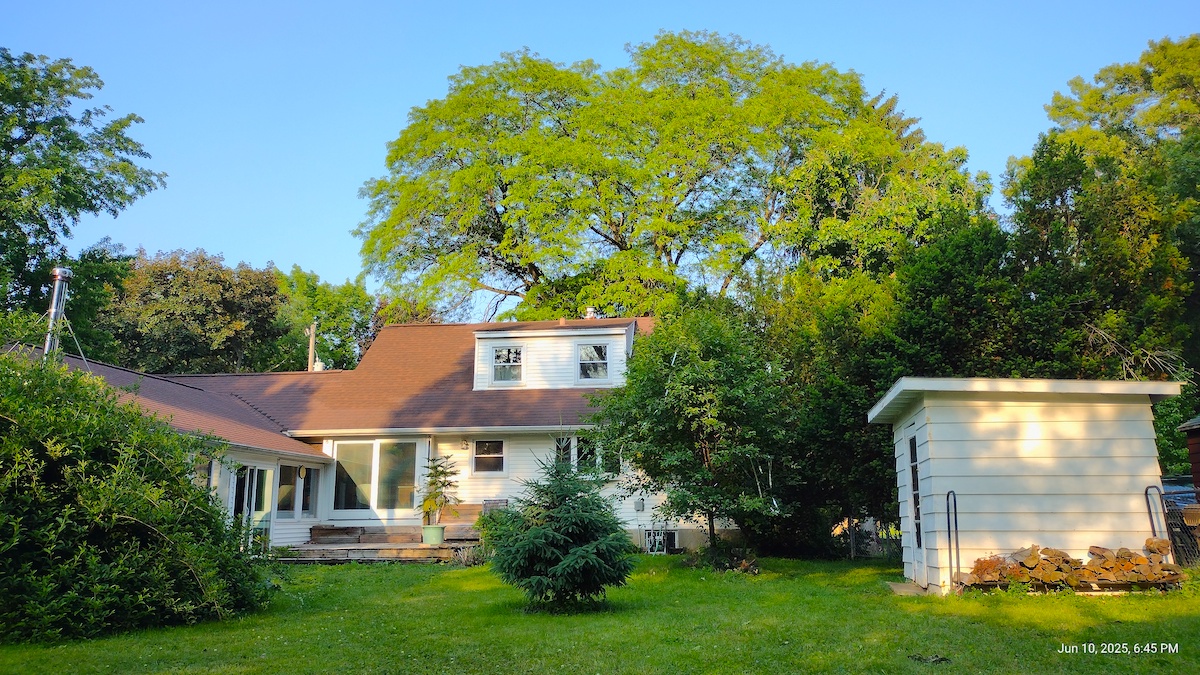
My backyard.
I love to occupy my zero-G chair in the backyard, staring at the black locust tree that arches high above our roofline. I’ve traveled the world and seen its sights. I love Italy and Alaska; I really like Iceland, Austria, Croatia, and Costa Rica. But my favorite place in the whole wide world? Right here, in my backyard.
Fooboo.
Fooboo and I sit here of evenings and commune with the Great All. This communion is sweeter by a glass of wine—or Benedictine, better yet. I share a bit of sharp Wisconsin cheddar with Fooboo. He gobbles it and, if a morsel drops, chases it among the grass blades. I eat mine on a Wasa rye cracker.
I read a book—a history or biography, or a good novel. I see birds and sometimes frame them in my Nikon 8×30 binoculars.
But even at eighty, life’s not all about sitting and relaxing. I picked up some firewood logs the other day from a guy who wanted to get them out of his backyard. I’ll give them a new home, split into pieces, in my woodstove next winter. As I was loading the heavy wood into my little car, he said, “You’re a tough old bird, aren’t you?” I think he meant it as a compliment, not an insult, but in any case I’ll take the rap.
LeRoy “Satchel” Paige in 1970. Photo by Bernard Gotfryd. Public domain.
Some people don’t make it to eighty; others are in poor shape when they get there. I’m blessed to be able to continue most of my usual activities—and suppose I’d better do so as long as I can. Satchel Paige said, “Don’t look back. Something might be gaining on you.”
I would not be in such fine fettle, or in any fettle at all, had I not been saved from myself by a grand young woman—Joelle Caroline Nelson—when I was twenty-five. She’s like me—or rather, I’ve become like her. Hungry for life.
Me and my significant other.
“It takes life to love Life.” That was the advice of Lucinda Matlock in Edgar Lee Masters’s Spoon River Anthology.
What is this I hear of sorrow and weariness,
Anger, discontent and drooping hopes?
Degenerate sons and daughters,
Life is too strong for you —
It takes life to love Life.
That’s a more stirring philosophy than I would have come up with on my own, but it approximates my lifemate’s approach to all things, and in fifty-five years I guess I have soaked some of it up.
So I keep on playing tennis, which is just plain fun. And I keep on walking the dog, even when my hips hurt. And I’ll keep mowing the lawn, walking thousands of steps behind the Toro; though I don’t enjoy it all that much, I’m terrified to stop. And I reckon I’ll get all that wood split before winter.
I’m not ready to quit life yet. Tough old bird, you know.
But the best thing about old age—and I’m only starting to grok the fullness of it, Gentle Reader—the best thing is, I get to enjoy and appreciate everything. Things that used to drive me crazy now do nothing but warm my heart.
The folly, stupidity, and perversity of the human race? Well, what do you expect? It’s only human. We all mean well. We can’t help that we’re limited creatures. But in the living of life, we do throw off occasional gleams of splendor.
I think my worst birthday was when I was thirty. I had reached three decades of age and felt I had not accomplished anything. I meant I had not written a symphony or the great American novel; I had not made a million dollars; I was not President of the United States. I was a failure.
What I did not know then, but do know now, is that most of us don’t leave a great big mark on history. Most of us leave a whole lot of little marks—and half of them, for better or worse, we don’t even know we’re leaving.
It can take a lifetime to wise up to the great joy of living.
The poet W. D. Snodgrass, when he was only thirty, wrote:
While scholars speak authority
And wear their ulcers on their sleeves,
My eyes in spectacles shall see
These trees procure and spend their leaves.
There is a value underneath
The gold and silver in my teeth.
Though trees turn bare and girls turn wives,
We shall afford our costly seasons;
There is a gentleness survives
That will outspeak and has its reasons.
There is a loveliness exists,
Preserves us, not for specialists.
I’ve tried sometimes, but never quite succeeded, in specializing. Guess I’m just a tough old bird.