Consider the raspberry. A quirky envoy from paradise, no doubt, but all the sweeter for it.
The haps of climate change have brought us days and nights warm out of season, with only a touch of frost to date, so I forage in our berry patch out back.
My little darlings.
What with homeowner neglect of the canes, it’s been a scanty summer and fall for the little, lumpy, juicy red fruits—but in their sparse numbers they just keep coming! On November 4 I found enough of the little darlings to brighten my oatmeal for a couple of days.
Raspberries grow all over Northern Europe and North America. One of my best memories is of a long train ride in Sweden, when the train took a siding somewhere north of Uppsala to let another train pass. We were to be idled for about half an hour, so the conductor let us all off to stretch our legs. Some sharp-eyed boys spotted a huge mass of bushes in the trackside ditch—bushes just bursting with ripe red raspberries. We made the best of it, reaching through scratchy canes over and over for little flavor bombs. Students and professors, housewives and mechanics, bemused American tourists and Swedish children, all climbed back on board with smiles on our faces. We did not all speak the same language, but raspberries are an international lingua franca.
The Norwegian word for raspberry is bringebaer. It’s so common in Scandinavia that you see it everywhere. They have Nordic specialties like bilberries, lingonberries, and cloudberries, but regular old raspberries are the great staple. Breakfasts and smorgasbords are freighted with heavy bowls of bringebaer siltetøy—raspberry jam, festooned with myriads of little yellow seeds.
Raspberries were given by God as a delivery system for the seeds that bring more raspberries. The berry is composite, an agglutination of about one hundred spherical drupelets, each bearing and feeding one seed. Do the math: a hundred raspberries equals about ten thousand seeds.
Maybe the seeds account for the roughness—“rasp”—that people associate with these berries. Or maybe it’s the thorns which adorn their stems, scratchy obstacles through which you must plunge your hands again and again to gain the prize. Even with thorns and seeds, it’s a prize worth having.
Raspberries are red, but they also appear in black, purple, and yellow varieties. They’re all good. I think I like the flavor of the red ones best, but when I was a kid we had a patch of black raspberries, and they were—how can I put it?—exotically, almost sinfully delicious.
Their raspyness may also account for why “raspberry” is a synonym for that mouth business otherwise known as a Bronx cheer. It’s a compound noise, with little clicks piled on top of one another, like the drupelets on a bringebaer, or the stickers on its stem.
I can give you no better wish, Dear Reader, than lots of raspberries in your future. You’ll have to excuse me now, while I go brush the seeds out of my teeth.
Dear Reader, you may think by putting it off and procrastinating, by leaving it to the last minute, you have missed the chance to cast your vote in the 2026 elections.
Well, you have not. Nothing could be further from the truth.
Due to a little-known loophole in the law, you are technically allowed to cast your vote TODAY—Tuesday, November 3, 2026, Election Day. Any time until the polls close at 8:00 p.m.
Yes, it’s true. You can still vote on Election Day. So if you by any chance have not voted yet, drop anything you’re doing and rush down to the polls. Provided you are an American citizen over the legal voting age of eighteen. Bring your photo ID with you.
I’m going to do it today.
#
Actually, I’ve always voted on Election Day, except a couple of times when I was actually out of the country on Election Day. Call me old-fashioned.
“Why don’t you vote early, O New Favorite Writer?”
Because there is a special day established for voting, and it’s Election Day. Elections held in November are always on the first Tuesday after the first Monday of the month—never before the 2nd, never after the 8th. Other elections are held in other months, but each of them has a particularly designated Election Day.
Election Day is a kind of tribal rite in American-style democracy—a time for everybody to gather together and exercise their enormous power, the power of the ballot, all at once. Mostly, of course, cancelling each other out. But still.
In the old days, before the so-called Australian ballot system was introduced in the 1890s, your vote was public. You marched up to the clerk and stated your preference. Your vote was duly recorded and announced orally, for the benefit of all the political hacks hanging around the polls keeping score. So everybody knew how everybody else voted. That could make it a little uncomfortable for you afterwards, depending on which neighborhood you lived in and how you voted.
Now, we get to vote in private and see the results announced on the evening news. Or the next morning. Or the next week or month, depending on the jurisdiction and the vagaries of politics.
#
Just because I prefer to vote on the actual election Day itself doesn’t mean you are obligated to. In recent years there has been a trend for casting your ballot early. This was acelerated by the recent pandemic and also by laws in various jurisdictions making early voting easier. The candidates and parties like this, because it allows them to get a running start, so to speak, and try to lock in the votes of their base for the candidate of their choice. A lot of individual voters like it, too, but I don’t know why. You’d have to ask them.
Even though I prefer to wait until the big day, I know it would be a big mistake to rule out early voting altogether—especially voting of the absentee variety. If there had not been absentee voting in 1864, General McClellan would probably have ousted President Lincoln, negotiated a weak peace—and the whole Civil War to that point, hundreds of thousands of lives and millions of dollars of property damage, would have been pointless. Lincoln was put over the top by the near-unanimous vote of the boys in Union blue, many of whom voted in the field, responding to special canvassers sent from their home states.
We ought not to disenfrachise those for whom voting in person on Election Day is impractical.
#
Some people feel voting is pointless, because what does one vote amount to among many thousands of votes? I can see that line of reasoning, but I vote anyway—only because it’s the one time the politicoes ask my opinion on what disasters they are about to unleash and who ought to have the honor of unleashing them. I always want my opinion to have been registered.
I breathe a sigh of relief on Election Day, because it means we will now be spared political commercials, for a week or two at least, until the next round begins.
The advertising is one of the most dispiriting things about our system for the average, patriotic citizen. We are forced to endure months of bombast in which every candidate of every party is blackguarded as the veriest scoundrel who ever came down the pike.
Give me a break. Please. They can’t all be as bad as they all say they are.
Knox College can be beautiful in October. It occupies eighty-two acres near the center of Galesburg, Illinois.
Knox College campus. Old Main, where Lincoln and Douglas debated. Knox website, fair use.
Founded in 1837, the college fought hard to abolish slavery. It was the site of the fifth Lincoln-Douglas debate, when Lincoln said of Douglas, “he is blowing out the moral lights around us, when he contends that whoever wants slaves has a right to hold them.”
When I attended, in a previous century, it was a school of about 1,200 students. Now, as my class enjoys its sixty-year reunion, there are about 1,100. They are far more diverse than we were, as to skin color, but otherwise look like we did: Young. Pliable. On the verge of something big, yet unaware of what it will be.
Only a handful from our class—still standing, still able to travel—showed up for Homecoming. A retired banker who has survived Vietnam and cancer; an old lawyer who once played great basketball; another who practiced law for seventeen years, then became a welder; a ne’er-do-well who spent twenty-four years explaining our government to its owners and retired into literary lionhood; and a few others.
Members of the Class of 1966 have seen great places and done great things. Now we are old, relics of the past.
#
In the fall of 1962, all I knew about college was: The professor would stand at the front of the room and lecture, and the students were supposed to write it all down in their notebooks.
I sat aloft, in a large lecture room with seats rising in tiers, and gazed down, as if through the wrong end of a telescope, at a bearded man in a sport coat who stood and waited, alive with pent-up energy, by the chalkboard at the front of the room. The course was freshman biology.
Paul Shepard in 1970. Fair use.
A bell rang. The bearded man took off his coat, draped it over a chair, picked up a chalk, turned to the board, and printed in precise letters: “The community: an integrated assemblage of mutually adjusted organisms.”
Zowie!
My very first day in college, and already I had (1) seen a man with a beard, (2) been exposed to an elegant concatenation of polysyllabic words, (3) copied it slavishly into my notebook, and (4) been introduced to the science of biology through the concept of community.
What is this? Biology is about cutting up frogs; community is a group of people. What gives?
Can one expand one’s little brain to conceive that “community” might apply not to just people, but to organisms in general? We were about to hear the word “ecology,” many of us, no doubt, for the first time. Certainly not the last.
How could I know, Dear Reader, that in less than a month, Rachel Carson would publish a book called Silent Spring? That almost eight years later, a U.S. Senator from Wisconsin would launch a calendar event called Earth Day? That ecology would become a big, hairy thing?
Dr. Paul Shepard, the young, intense professor with the beard, already knew where things were headed.
#
Knox is what is traditionally known as a “small liberal arts school.”
Small it is, but “liberal arts”? What does that mean? Princeton University’s Undergraduate Admissions page puts it this way:
A liberal arts education offers an expansive intellectual grounding in all kinds of humanistic inquiry.
By exploring issues, ideas and methods across the humanities and the arts, and the natural and social sciences, you will learn to read critically, write cogently and think broadly. These skills will elevate your conversations in the classroom and strengthen your social and cultural analysis; they will cultivate the tools necessary to allow you to navigate the world’s most complex issues.
The liberal arts curriculum is not job training, though it may in some cases lead to a job. Liberal arts colleges offer a broad education.
Today, colleges are under fire, liberal arts or otherwise—perhaps because of cost factors.
It’s been suggested that liberal arts colleges are simply, like the Class of 1966, a relic of the past.
#
I was a freshman in October 1962 when my English professor, Michael Crowell, introduced me to Archibald MacLeish. Mr. MacLeish was at the height of his long trajectory as poet, playwright, Librarian of Congress, and public intellectual. I have told elsewhere how he signed my copy of his Pulitzer-prize-winning play, JB.
Betty Friedan in 1960. Photo by Fred Palumbo, New York World Telegram staff photographer. No known copyright restrictions.
I was a sophomore when I sat in a room with perhaps sixty other students and heard Betty Friedan promote and defend her book, The Feminine Mystique, published within the past year and challenging the whole framework of women’s—and men’s—sex-linked social roles. Friedan had not yet morphed into the Earth Mother of second-wave American feminism. For one thing, the second wave did not exist until after she called it into being. When I heard her speak in the intimate setting of the Common Room at Knox, she was a prim, professional writer doggedly defending her provocative point. She was calm, articulate, and took no prisoners.
Ramblin’ Jack Elliott, right, with some other folk singer. Fair use.
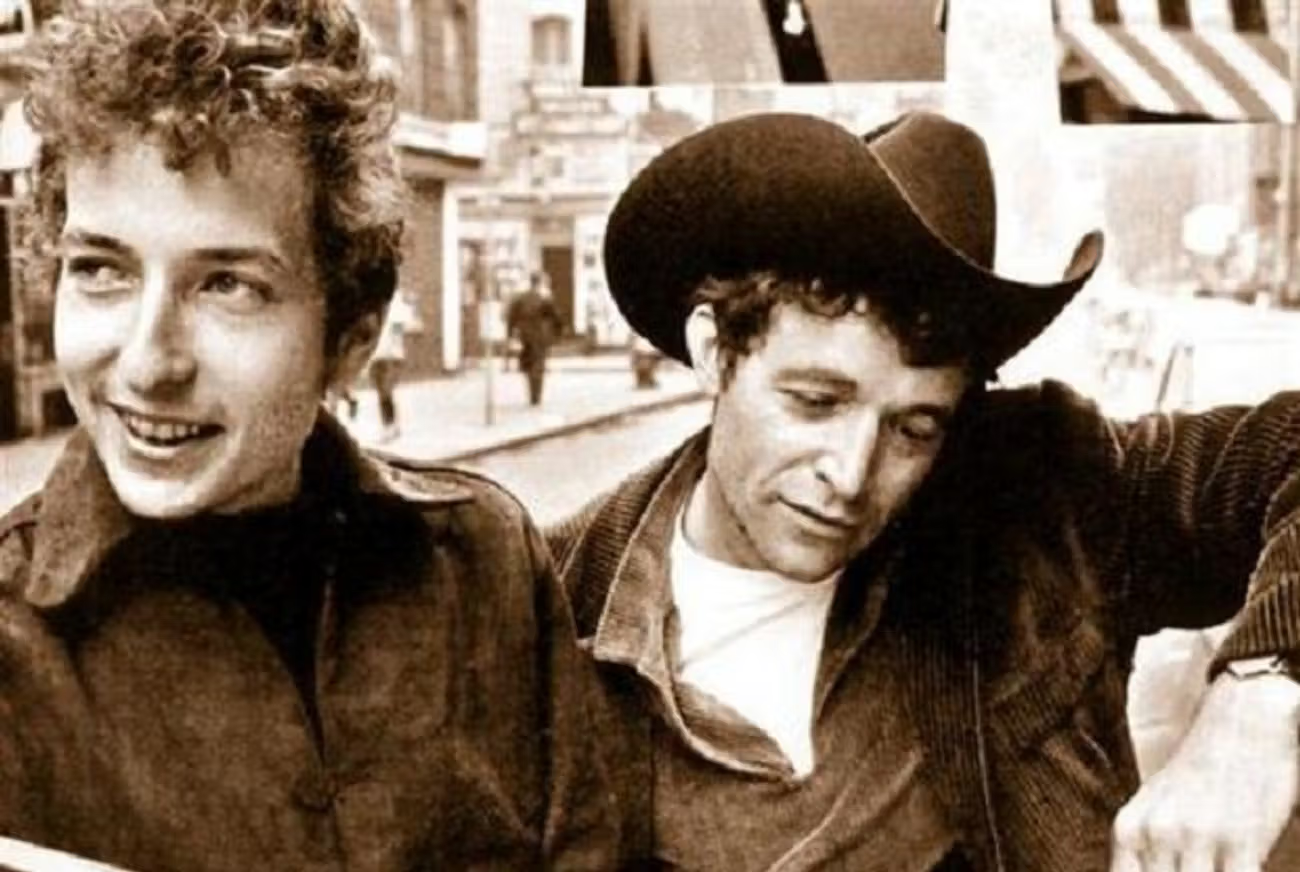
I was probably a junior when Ramblin’ Jack Elliott came to Knox and gave a concert of western and folk music, and I interviewed him briefly for WVKC-FM, the college radio station. Elliott was a pal of Woody Guthrie and many other leaders of the folk music craze of that era. As I write this, Ramblin’ Jack is still alive and even older than Your New Favorite Writer.
Big Joe Williams in concert, 1971. Photo by Patrick Denoréaz, licensed under CC-BY-SA-3.0-migrated.
Must have been around that same time, I sat in a small, darkened room with ten or twenty aficionados and listen to Big Joe Williams as he noodled and riffed a long segué of Mississippi blues songs on his nine-string acoustic guitar.
Such opportunities were common at Knox in those days. For the sake of today’s students, I hope they still are.
But then, as you know, the small liberal arts college is on its way out. Nothing to see here, folks. Move along.
#
I was not well-organized or strongly motivated during my Knox days. The things I learned were mostly things you could not help learning even if you dragged your feet on the academic program and generally avoided study.
From Paul Shepard I learned there is such a thing as community, which is indeed an integrated assemblage of mutually adjusted organisms.
From Betty Friedan, I learned when you are under attack, don’t concede your critic’s gratuitous assumptions. Contest them. A hostile male student suggested that liberating women would lead to the neglect of their young children. I thought Friedan would say the benefit to women was worth the cost to their children. Instead, she replied “the studies show” that children who spend their days in well-run day care centers come into adulthood “better adjusted” than children raised only by their mothers. She did not say which studies, or what “better adjusted” means. These assertions have been fiercely disputed since she insisted on them. But she did not willingly give away points.
Jean Jacques Rousseau, 1753 portrait by Maurice Quentin de La Tour. Public Domain.
As freshmen, we had a history prof named Skip Kay. His name was Richard, but everyone called him Skip. He was an enigmatic fellow, a medievalist with a shy smile that showed up at times you were not looking for it, and a scholarly otherness that made him an easy target for freshman ridicule. But his class, Western Civilization 105-6, was a requirement. One of the textbooks was W.G. DeBurgh’s The Legacy of the Ancient World (1924), a dense little volume that described ancient Israel, Greece, and Rome. The other was Beatty and Johnson’s The Heritage of Western Civilization, a collection of excerpts from old dead white guys such as Plato, Aristotle, Descartes, Jean Jacques Rousseau and Sigmund Freud.
Some few of these old dead ideas trickled into my youth-addled brain and remain stuck in there to this day. Yet what I remember most is a comment Skip unleashed in mid-lecture sometime about halfway through the first semester. I wish I could recall it word for word, but the gist was this:
“When we study these things—the antiquities, the humanities, the arts and literature of societies that have gone before us—bit by bit we internalize something called ‘The Liberal Ideal.’ That is, the conviction that there are more things than we may dream of in our philosophy, and that when we differ—even differ sharply—over matters of great importance, it is still possible, it is still desirable, to sit down with the other fellow and reason together; that one person cannot know everything; and that the widest learning begets a corresponding degree of humility and respect.”
I don’t remember the exact words, but the concept, what Skip Kay called The Liberal Ideal—without reference to liberal and conservative dogmatics in today’s politics—that old dead Liberal Ideal has been stuck in my head ever since.
Which just goes to prove the liberal arts education is indeed obsolete—for what use could anybody make of such crazy old notions in today’s advanced, forward-looking world?
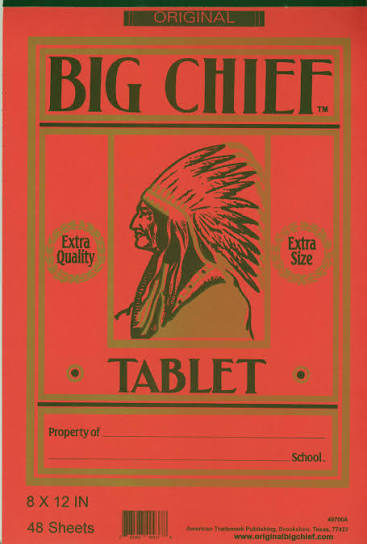
They gave us wooden pencils, Eberhard Faber or Ticonderoga. We applied them to sheets of lined, low-grade, paper, bound into pads. Pencil tablets, they were called. Big Chief and Goldenrod were two common brands.
The paper was so pulpy the point of your No. 2 pencil bumped on an unreduced wood chip here and there, a trivial obstacle, no real impediment to learning.
They taught us to form capital letters and small letters. “Lower-case” was not in our lexicon. We practiced our capital and small letters over and over. It was called “printing.”
“Later,” they said, “after you know printing, we’ll teach you writing.”
By early in the third grade, I had gotten pretty good at printed letters. It was time to put them to use, so during a lull when some classmates struggled to finish a silent reading assignment, I created a hard-boiled detective story. Mrs. Winders left me in peace while I wrote—excuse me—while I printed a story that could have been an episode of Richard Diamond, Private Detective, starring Dick Powell, which I heard every Saturday afternoon on the radio.
Considering the materials at hand, you could call it pulp fiction.
By then, we were starting to learn cursive. Mrs. Winders didn’t use such a Latinate word for it. She just called it “writing.” Or “longhand.” You had to run the letters together so they linked up to make a word. You changed their shapes to match ideal examples shown on horizontal cards above the blackboard.
All through fourth and fifth grade, and maybe sixth as well, we studied “penmanship.” You spent fifteen minutes or half an hour making a loopy line like a coiled spring—all the loops the same size, evenly spaced and nicely rounded. Mine never came close.
But they couldn’t teach you penmanship without pens. We graduated to smooth paper, so we could write on it with our new pens. First they gave us steel dip pens with green plastic shafts with which to practice writing with ink. You had to dip the pen every half-word or so. I think they only gave us those things to give us a feel for what Thomas Jefferson must have felt when writing the Declaration of Independence with a goose quill.
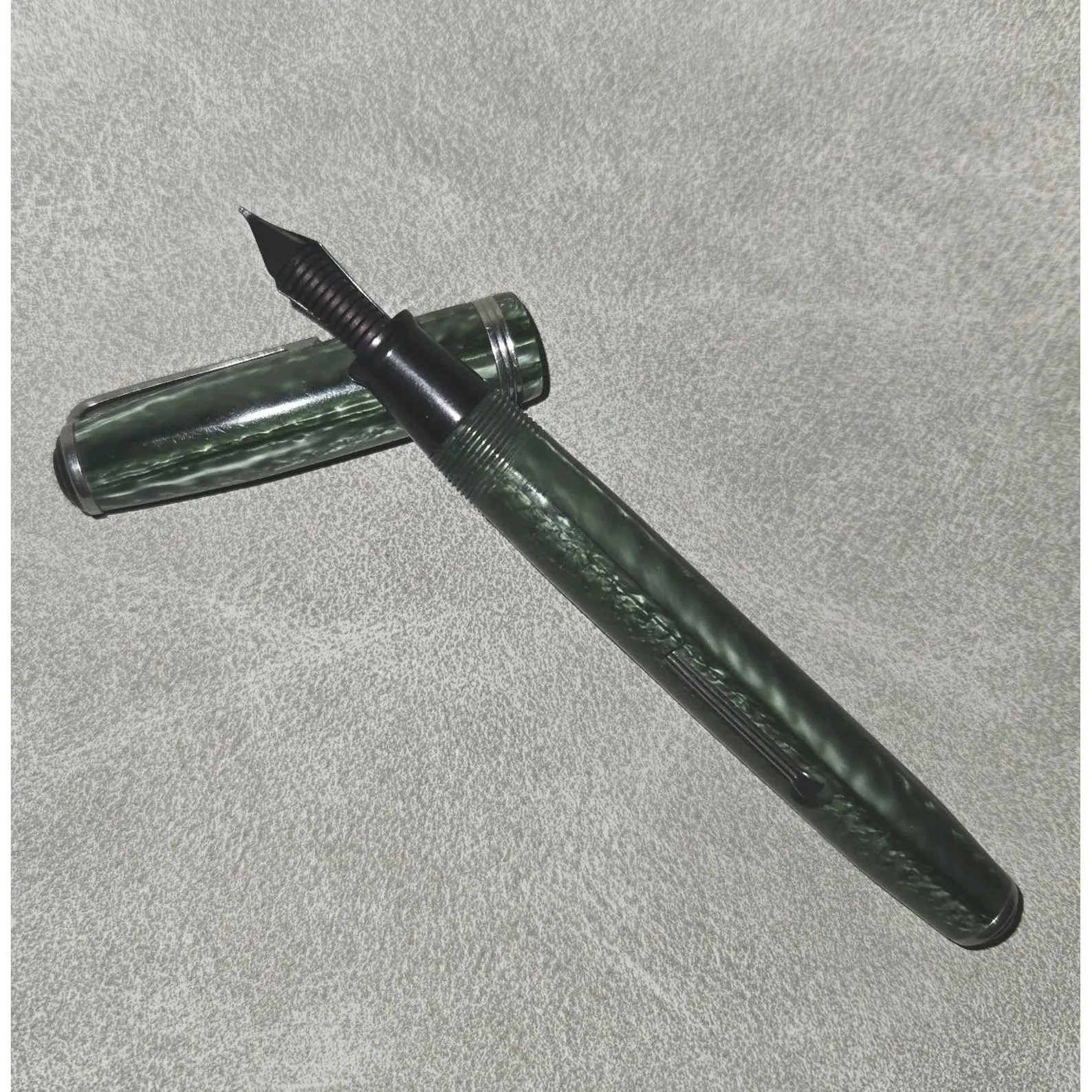
It made you long for something better. Enter the Esterbrook student fountain pen: a sleek cylinder that carried liquid ink in its barrel, ink which flowed by capillary action down to the point or “nib” at the business end. Suddenly you could write whole sentences, pages even, before you had to stop and refill.
Many companies made fountain pens, but Esterbrook seemed to have the market cornered on elementary school students. The companies in cutthroat competition to serve the adult market in the Midwest were Sheaffer Pens of Fort Madison, Iowa, and Parker Pens of Janesville, Wisconsin. (Full disclosure: My mother worked, right out of high school, as a steno/typist in the secretarial pool of Sheaffer Pens.)
All fountain pens, of whatever make, worked the same. You pulled out a lever on the barrel to compress the rubber ink bladder inside the pen.Then you dipped the nib in a bottle of ink and released the lever. Outside air pressure forced ink up the pen into the now expanded ink bladder. It was a clever arrangement.
The smooth flow of ink onto paper was a thing to be treasured. Of course, the complicated machine that delivered the ink was also capable of leaking black or dark blue stuff all over your hands and your clothes. It was a serious skill to handle a fountain pen without leakage.
Within a few years, we were all writing with ballpoints. The old fountain pens were put away, forgotten utterly.
MacLeish. Public Domain.
Luddites there were, of course, who clung to the old technology. In autumn of 1962, I met Pulitzer Prize-winning poet and dramatist Archibald MacLeish, who signed my copy of his play JB. In doing so, the great man flaunted a real luxury fountain pen—a Waterman or a Cross, for all I know—which dispensed indelible black ink. He did it with calm panache.
I doubt Archibald MacLeish, even in his teen years, ever experienced a leaky pen. There were no blots on his escutcheon. (You could use your Funk & Wagnalls on that.)
Today, only re-enactors and fanatics use quill pens or dip pens. But the redoubtable old fountain pen is making a resurgence among the younger set.
What accounts for this rebound? Luxury, that’s what. Today’s consumers value the aesthetic and tactile effects of writing with a time-honored nib wrapped in an elite package. It’s a good thing they value it, because the experience starts at around fifty bucks, and beyond that, the sky’s the limit.
I have pretty much abandoned pens in favor of a laptop keyboard. When I resort to penmanship these days, it’s usually to sign for something on a digital pad, using my fingertip as stylus.
This finger-pen has further degraded my scrawl. But for receiving a case of wine via UPS, it’s mightier than any sword.
Today, we’re looking into word origins. Most words, other than simple words such as “oof,” are actually compounds made of two or more simple words.
Black + berry = blackberry.
Blue + berry = blueberry.
Pod + cast = podcast.
Cur + mudgeon = curmudgeon.
We could easily get carried away with this sort of thing, but that would be ex + cessive.
What’s Your Point?
Kevin McCarthy tentatively investigates podcasting. Still image from Invasion of the Body Snatchers, 1956. Fair use.
The point is, Dear Reader, this old curmudgeon is now appearing on podcasts. Believe it or otherwise. You can catch one here, and another one here. And I’m lined up for more.
Stay tuned.
Only you don’t really tune podcasts. You just, uh, I don’t know . . . listen?
Six months ago I couldn’t even spell podcast. Now I are one.
Back to compound words.
Raspy all over. Photo by author.
Rasp + berry = raspberry. Did you ever notice how they’re kind of raspy?
But what must a berry do to be cran? Or mul? These things are cloaked in mystery.
As is podmudgeoning.
All I know is, I’m frightfully good at it. You should tune in. Or, uh, listen.
See, Here’s the Thing
I really don’t grok podcasts in their fullness. I’ve never figured out what the point of listening or watching something is, when you can read about it on good old reliable paper.
This wisdom, obviously, does not apply to football. Or Jeopardy! But every rule must have one or two exceptions.
The fact that I don’t listen to podcasts does not disqualify me from starring in them. As mentioned above, I’m frightfully good at it. (See here and here.)
But if I’m just an old curmudgeon, why would I want to star in podcasts, anyway?
To sell books, that’s why!
You see, I talk about my books, and how I wrote them, and millions of podcast listeners will rush to Amazon and buy my books.
Circling the Drain
Do you see the reasoning? Tons of people who like to listen to things, or watch things, are naturally going to rush out and pay good money to buy something they have to crack open and look at. And then it doesn’t say anything. It just sits there.
They’ll have to read it.
Why would they read something, when they can spend the time listening to something else instead?
Just because I’m so frightfully good at mudgeoncasting?
Bright, sunny days. Crisp, chill nights. Views of turning leaves, smells of burning leaves. Football weather. Harvesters’ weather. Apples-mashed-into-cider weather.
I love October. Perhaps because, here in Wisconsin, it’s apt to be the last gasp of glory before the hammer comes down. Cold and snow are just around the corner.
If you’re German, especially if you’re Bavarian, it means beer and pretzels. Oktoberfest is so well loved that it starts in September! The Müncheners like to get, you know, a running start.
Tsar Nicholas II in 1912. Public Domain.
V. I. Lenin in 1920. Photo by Pavel Zhukov. Public Domain.
But suppose you’re Russian? A different story—one which lacks the essential element of gemütlichkeit. October 1905 was the height of Russia’s “first revolution,” which began with workers’ protests the preceding winter and swelled over the following months. By October, Tsar Nicholas II was so weakened that he issued an “October Manifesto,” pledging to create a legislative assembly, halt censorship and violations of freedom of association, and expand the right to vote.
The Tsar’s promises defused the immediate crisis, but revolutionary urges kept on simmering. Partisans who wanted to implement the Tsar’s reforms were called Octobrists. Their opponents were Kadets, or Constitutional Democrats, who sought a fuller reform program. In the ensuing squabbles, all political order broke down until 1917, when Vladimir Lenin’s Bolsheviks launched a new revolution in St. Petersburg—the second revolution that year.
Version 1.0.0
Lenin’s revolution started on 7 November, but since Russia was still on the old Julian calendar, the date has always been commemorated as 25 October. The Octobrists of 1905 were steramrolled by another October only twelve years later. Octobrists turned out to be not the bright dawn of a new order, but the last harrumph of the old.
The new order, which began in October 1917, was not all that happy. It spelled death for tens of millions and great suffering for Russia and many neighboring nations.
Sputnik I, 1957, replica. Image by Soyuz235, Public Domain.
On the bright side, the Communist revolution gave fledgling author Tom Clancy a great title for his debut novel: The Hunt for Red October.
Another October victory for Russia was the launch of Sputnik, the first artificial satellite, on 8 October 1957, near the fortieth anniversary of the Soviet state. Perhaps you’ve seen the film October Sky about the “rocket fever” induced in young American students by the successful flight of Sputnik. It’s even referenced in my own middle-grade book Izzy Strikes Gold!
#
What about us? Does America have any October phenomena to compare with those of other countries? I nominate the good old American “October Surprise.”
With major elections held in early November, we’ve developed a national tradition of low, desperate trickery. If your candidate trails in October, what beter time to cause public mayhem to which your opponent must respond, or drop some obscure besmirchment on your opponent’s reputation, one that’s difficult to understand or pin down? Dropped late enough in October, the October Surprise works because the targeted candidate doesn’t have enough time to make an appropriate response to the situation or marshal exonerating facts.
The thing is, with large numbers of ballots being cast and submitted in the months before Election Day, the October Surprise is losing a lot of its electoral punch. It may go the way of the dodo bird, and then we’ll have to fall back on Jack-o-Lanterns for fun.
The dead, restored to life, consort with me in the dark.
Dad and Mom in January 1942, long before they became dead people.
Sleep lifts the curtain of mortality to admit, willy-nilly, the long-departed. Here strides my father. There sits my mother. Uncle Harry might pop in for a chat. They do things and speak speeches of life and relation: acts and words that seem normal, as normality is reckoned in the surreal, trans-midnight landscape of dreams.
Joe Nelson, pre-death.
One night recently the ghostly visitors were not my parents but my wife’s parents—my inlaws, Joe and Elsa Nelson. The words of our conversation did not survive to daylight. But I do recall that I used soapy water and a brush to clean Joe’s hearing aid, a behind-the-ear model. Only—wouldn’t you know?—it was not Joe Nelson talking with me as I washed his hearing aid, but rather my old grandpa, Alvin LaFollette.
Grandpa LaFollette, photographed when still alive.
Not only do the dead appear; they are also somewhat interchangeable. One can sit in for another in a tag-team existence that would be confusing in real life but is par for the course in dreamland.
I worried about shorting it out—the hearing aid—because even asleep I know such devices are allergic to water. But this one was a strange kind of hearing aid. The arc of its form resembled a curved molar or tusk from some long-extinct beast, recently unearthed, more than it resembled an electronic device. It was puzzling that Grandpa should wear something like that on his ear; but I stopped worrying about getting it wet, as electricity did not seem to be a factor.
In their respective factual, pre-death lives, neither Grandpa LaFollette nor Joe Nelson ever wore, or needed, a hearing aid. But in the non-factual, post-death realm beyond the veil of sleep, everything takes on a different aspect.
I am the only person in my dreams with hearing aids in his factual, pre-death life. I need them to help me hear and am grateful that Veterans Affairs provides them free of charge. (My hearing loss is service-related.) And you can bet I never let them get near soap and water.
#
The whole episode has set me wondering: Could these late visitors be the real souls of persons who were close to me? The notion comforts me, even though these dear departed are just as human and fallible in dreams as they were in real life.
The prevailing theory, in our quasi-rational world, would have you believe my midnight specters are only psychic archetypes, spun up by my subconscious, based on long-ago interactions with the persons they represent: internalized authority figures, programmed to control me from beyond the grave.
I like my ghost theory better. These folks who arrive from time to time in my sleeping world do not in fact control me. After their deaths, as before, I take their utterances and attitudes for what I think they’re worth.
But it’s nice to have the visit. At my present age, the companionship is valued.
My mother delivered me to the world in Galesburg, a small city in West Central Illinois. I lived for several years in Streator, an even smaller city in Northwest Illinois. My family all hailed from the Galesburg area, and Streator is only eighty miles away.
Having lived the last sixty-nine years in Wisconsin, I have taken to calling Illinois people Flatlanders. From the vantage of Madison, that is certainly what they are.
Western Illinois terrain. Photo by Chris Light, licensed under CC-BY-SA-4.0. Note hills in background.
But in old times, when I lived in Illinois, my family and friends and I did not think of ourselves as Flatlanders. The country where we lived did not seem flat to us. The terrain, molded but not steamrolled by ancient glaciers, swelled up into knolls here and there. Gradients, though gentle, were not entirely missing. Almost everywhere you could find little gullies and streambeds. There were wrinkles in the land. So although we lived in a flat country, we hardly deemed it so.
Grant Wood, American Gothic, 1930. Art Institute of Chicago. Public Domain.
Nor did we think of ourselves as silent, taciturn, or expressionless. Just like physical topography, the scale of social volubility is relative. We would not have called ourselves reserved or close-mouthed, although it must be admitted we did not talk as much, or as rapidly, as big-city people. Or Italians, for example.
Moments of quiet stretched on. Nobody felt the need to puncture them with talk. When something needed saying, we spoke.
Yes, people from elsewhere might have considered us reticent.
Grandpa in 1944.
More to the point, emotions seldom poured out of us in torrents of words. Those impulses which did erupt were more apt to be negative than positive; some people, like my paternal grandfather, seemed to express themselves rather too much—in a cranky, critical vein. I never thought to wonder, until much later in life, whether such outbursts were a random personality trait or whether they might be a form of relief from lives spent in suppressive silence.
The novel I have been working on for the last two or three years is based on the Illinois people I came from. When I shared pages with a few fellow writers, they felt frustrated by the flat affect of my characters. These folks in the novel hardly ever said anything that would give a clue to what feelings were inside them. This lack of emotion was mentioned numerous times, and my instinctive defense was always: “That’s how they were.”
But, recognizing that my colleagues had a point, I have been trying to instill more life into these flat characters. They’re more emotional now than when I first started writing them. It remains possible that some readers may still find them flat and, therefore, unappealing.
I’m afraid at some point, I will still need to fall back on, “But that’s the way they were.”
Maybe that’s what this new book is trying to say. People who seem unexpressive may still seethe with fears, anxieties, resentments, and unexpected wellsprings of joy—which they do not bother, or do not dare, to document with words.
#
Silence runs in my family. It lies in deep pools with the bones of long-dead ancestors and creeps forward, generation by generation, infecting the living down to the present day.
I don’t know much about this silence, why it prevails, why it persists. It just is. It always has been.
Dad in 1940.
When we talk, we never seem to mention anything that matters. Even those things which are good and pleasant, we speak of sparingly.
Silence can be warm and beneficial. It can spare an active mind the incessant preoccupation with trivia, liberating it for works of consequence. It can foster equanimity, tranquillity, and peace.
But silence can also be malignant.
When my father grew very old, he became talkative. I learned that he had always, even from childhood, envied and resented his eldest brother. Not that he would have mentioned it to anyone—especially his eldest brother.
Uncle Ed and Aunt Mary around 1940.
Uncle Ed became a senior airline pilot, highly respected, even on occasion heroic. He made good money and fathered three children, who had the advantage of growing up in a series of foreign locales. My father’s sour attitude toward him went back to the days of their youth, when, in his view, “Edward always got the best of things.” To hear Dad tell it, Ed dictated the family’s living place and claimed the town’s most genteel, well-heeled, and sought-after young lady for his bride.
I doubt Uncle Ed ever knew of Dad’s resentment. Of course, he might have discerned something off-kilter in their relationship, had he been a very sensitive person. But that kind of empathy does not run in our family.
Everybody today knows the misery being inflicted on Ukraine by our Russian dictator du jour, Vladimir Putin. Not everyone may be aware of the MILLIONS of deaths inflicted by the Soviet Communists under Joseph Stalin in the 1930s. It’s a tale of barbarous inhumanity and suffering, a lingering scar on the Ukrainian psyche.
A “Red Train” of carts in 1932 takes grain confiscated from the first harvest of a Ukrainian village, depriving the local people of their usual source of food. Ukrainian state archives, photographer unknown. Public Domain.
Borden’s book, The Harvest Keeper, tells that story. Millions starved to death on account of Stalin’s social and agricultural policies—forced collectivization of agriculture and the seizure of crops from the peasants who raised them. The famine came to be called the Holodomor, a Ukrainian word that simply means “death by hunger” but carries a strong whiff of genocide.
Was starvation a deliberate tool to destroy the Ukrainian people and prevent Ukraine from asserting its independence? What if it was merely a result of stupid policies enforced by callous brutality? What would be the practical difference?
Starved peasants on a street in Kharkiv, 1933. Photo by Alexander Wienerberger. Public Domain.
Historians may argue about such questions, but Tammy Borden does something better: She shows us the results in the lives and deaths of the people who experienced it. The Harvest Keeper is a fictionalized yet accurate narrative of Borden’s grandmother, Amalia Tomtschik, and her farming family.
A horse of the Ukraine in 1932-33. Photographer unknown. Public Domain.
This is the best kind of historical fiction, at once sweeping and intimate. It gives an up-close view of horrific events, with an eye to small details that were passed down in family stories. The travails of the fictional Amalia closely depict the life of the real Amalia. Her epic endurance and survival are guaranteed to give the reader an equal mix of anxiety and satisfaction, as well as righteous indignation toward the brutal Stalinist regime.
I highly recommend this book, both for historical content and literary power. Well done, Tammy Borden!
BUT FIRST, A WORD FROM OUR SPONSOR: This Saturday, September 12, from 10 am to 2 pm,I’ll be at the New Berlin Ale House Book Fair, 16000 W. Cleveland Avenue, New Berlin, Wisconsin. Stop and see me. I’ll have plenty of copies of my books, The Price of Passage and Izzy Strikes Gold! I’ll be happy to sell you one, or more than one, complete with the author’s signature! Two exciting historical novels—one more for adults and one more for children. With Christmas coming up, they’re great gifts for friends and family members. See you there! Now, on with the show:
CHICAGO NEWSPAPER COLUMNIST SIDNEY J. HARRIS, followed by millions in 200 papers during the 1960s and ’70s, would loose upon the public, from time to time, a column that was just a series of unconnected observations—not a whole, structured, 350-word essay, like his typical column.
Harris had two standard slug lines for such divertissements: “Thoughts At Large” and “Things I Learned En Route to Looking Up Other things.” Both categories were usually interesting and worth a read. What I have for you today is more in the former vein than the latter.
The thing is an oxymoron. Artifice is a result of intelligence, not a source of intelligence.
God alone has knowledge. People and animals have intelligence. Computers and other machines have routine operations.
Humans, using intelligence, invented the routines used by the machines. Even if those programs can generate further programs with no further human input, the derivative programs and their output are still not intelligence. They are merely routines.
#
This is a good place to consider mortality. I tend to reject it, but that won’t avail in the end.
I may just sit here dissolving and slowly melt into the landscape. But it’s not likely to happen that way. Something is apt to go wrong, and wdespite what doctors may do, and things will likely get worse. I hope it’s not too painful.
Is this morbid? Where’s the line between morbidity and mortality? Actuaries can tell you, but I’m not sure I want to know.
One can’t help thinking about such things. It’s good the world offers other topics to the mind: Grandchildren. Writing projects. A lawn to mow. Good friends, good dogs, good liquor.
My wife grows old along with me, so it’s anybody’s guess who’ll go last. I hope, for my sake, that she survives me. I’m not sure I could live without her. You could file that under torrure.
#
What is the goal of theology? I mean the main goal, the top goal, the overriding goal, the only real goal, to which any other goals must be subordinate?
All of these are plausible and perhaps worthy goals, but all of them strike me as resting on a partial or incomplete picture of this “God-Man Reality” in which we live.
#
I think a more robust overall goal in my Christian walk is simply to acknowledge the sovereignty of God and my own status as a child of God. I think this is, at bottom, what the Book of Job is all about. It’s worth a read, even though it is long and bewildering.
I place great reliance on the immortality of the soul. I believe we are not bodies who have souls but, rather, souls who have bodies. The body is mortal; it dies and decays. The soul persists in God’s universe, and that soul is in God’s care. So the prospect of going to Heaven when I die is not terribly urgent in my mind, trusting as I do that I—my soul—will of course go where the all-sovereign, almighty God assigns it. And that will be right. I will, in a very real sense, go home.
Everywhere, venom goes about as virtue, umbrage parades as honor, and grievance goes robed in the garb of righteousness. But when rage is our proudest possession, we are bankrupt.
Anger and strife are the path to doom; love is the way of life.
God is love, and love is hope.
Love is the way out of our angst and despair.
God’s love is the great truth and the only hope. Those who embrace it live out their lives in joy and blessedness.