Veritas

Knox College can be beautiful in October. It occupies eighty-two acres near the center of Galesburg, Illinois.

Knox College campus. Old Main, where Lincoln and Douglas debated. Knox website, fair use.

Founded in 1837, the college fought hard to abolish slavery. It was the site of the fifth Lincoln-Douglas debate, when Lincoln said of Douglas, “he is blowing out the moral lights around us, when he contends that whoever wants slaves has a right to hold them.” 

When I attended, in a previous century, it was a school of about 1,200 students. Now, as my class enjoys its sixty-year reunion, there are about 1,100. They are far more diverse than we were, as to skin color, but otherwise look like we did: Young. Pliable. On the verge of something big, yet unaware of what it will be.

Only a handful from our class—still standing, still able to travel—showed up for Homecoming. A retired banker who has survived Vietnam and cancer; an old lawyer who once played great basketball; another who practiced law for seventeen years, then became a welder; a ne’er-do-well who spent twenty-four years explaining our government to its owners and retired into literary lionhood; and a few others. 

#

In the fall of 1962, all I knew about college was: The professor would stand at the front of the room and lecture, and the students were supposed to write it all down in their notebooks. 

I sat aloft, in a large lecture room with seats rising in tiers, and gazed down, as if through the wrong end of a telescope, at a bearded man in a sport coat who stood and waited, alive with pent-up energy, by the chalkboard at the front of the room. The course was freshman biology.

Paul Shepard in 1970. Fair use.

A bell rang. The bearded man took off his coat, draped it over a chair, picked up a chalk, turned to the board, and printed in precise letters: “The community: an integrated assemblage of mutually adjusted organisms.”

Zowie! 

My very first day in college, and already I had (1) seen a man with a beard, (2) been exposed to an elegant concatenation of polysyllabic words, (3) copied it slavishly into my notebook, and (4) been introduced to the science of biology through the concept of community. 

What is this? Biology is about cutting up frogs; community is a group of people. What gives?

Can one expand one’s little brain to conceive that “community” might apply not to just people, but to organisms in general? We were about to hear the word “ecology,” many of us, no doubt, for the first time. Certainly not the last. 

How could I know, Dear Reader, that in less than a month, Rachel Carson would publish a book called Silent Spring? That almost eight years later, a U.S. Senator from Wisconsin would launch a calendar event called Earth Day? That ecology would become a big, hairy thing? 

Dr. Paul Shepard, the young, intense professor with the beard, already knew where things were headed. 

#

Knox is what is traditionally known as a “small liberal arts school.” 

Small it is, but “liberal arts”? What does that mean? Princeton University’s Undergraduate Admissions page puts it this way: 

The liberal arts curriculum is not job training, though it may in some cases lead to a job. Liberal arts colleges offer a broad education.

Today, colleges are under fire, liberal arts or otherwise—perhaps because of cost factors. 

It’s been suggested that liberal arts colleges are simply, like the Class of 1966, a relic of the past.

#

I was a freshman in October 1962 when my English professor, Michael Crowell, introduced me to Archibald MacLeish. Mr. MacLeish was at the height of his long trajectory as poet, playwright, Librarian of Congress, and public intellectual. I have told elsewhere how he signed my copy of his Pulitzer-prize-winning play, JB. 

Betty Friedan in 1960. Photo by Fred Palumbo, New York World Telegram staff photographer. No known copyright restrictions.

I was a sophomore when I sat in a room with perhaps sixty other students and heard Betty Friedan promote and defend her book, The Feminine Mystique, published within the past year and challenging the whole framework of women’s—and men’s—sex-linked social roles. Friedan had not yet morphed into the Earth Mother of second-wave American feminism. For one thing, the second wave did not exist until after she called it into being. When I heard her speak in the intimate setting of the Common Room at Knox, she was a prim, professional writer doggedly defending her provocative point. She was calm, articulate, and took no prisoners. 
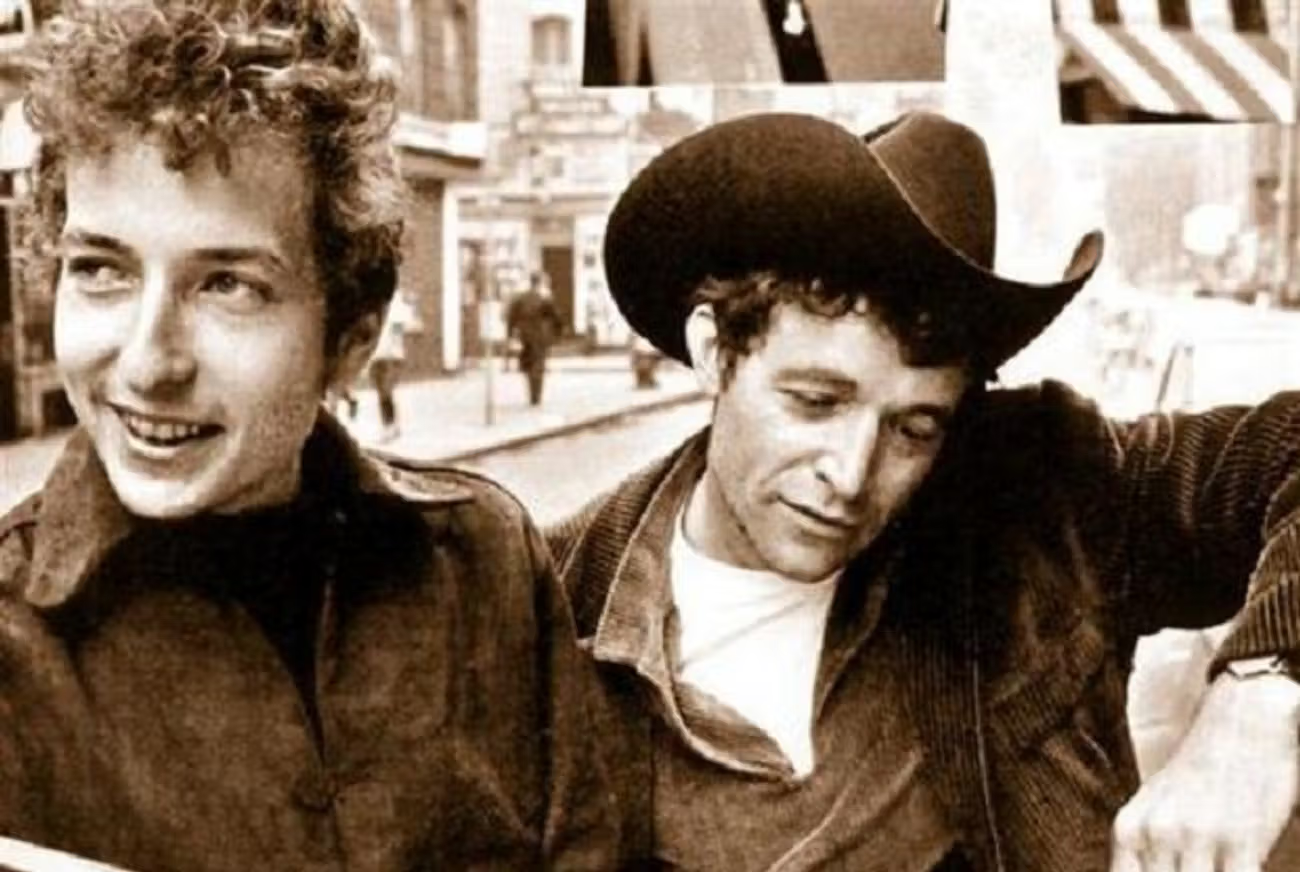
Ramblin’ Jack Elliott, right, with some other folk singer. Fair use.
Big Joe Williams in concert, 1971. Photo by Patrick Denoréaz, licensed under CC-BY-SA-3.0-migrated.

Must have been around that same time, I sat in a small, darkened room with ten or twenty aficionados and listen to Big Joe Williams as he noodled and riffed a long segué of Mississippi blues songs on his nine-string acoustic guitar.

Such opportunities were common at Knox in those days. For the sake of today’s students, I hope they still are.

But then, as you know, the small liberal arts college is on its way out. Nothing to see here, folks. Move along. 

#

I was not well-organized or strongly motivated during my Knox days. The things I learned were mostly things you could not help learning even if you dragged your feet on the academic program and generally avoided study.

From Paul Shepard I learned there is such a thing as community, which is indeed an integrated assemblage of mutually adjusted organisms.

From Betty Friedan, I learned when you are under attack, don’t concede your critic’s gratuitous assumptions. Contest them. A hostile male student suggested that liberating women would lead to the neglect of their young children. I thought Friedan would say the benefit to women was worth the cost to their children. Instead, she replied “the studies show” that children who spend their days in well-run day care centers come into adulthood “better adjusted” than children raised only by their mothers. She did not say which studies, or what “better adjusted” means. These assertions have been fiercely disputed since she insisted on them. But she did not willingly give away points. 

Jean Jacques Rousseau, 1753 portrait by Maurice Quentin de La Tour. Public Domain.

As freshmen, we had a history prof named Skip Kay. His name was Richard, but everyone called him Skip. He was an enigmatic fellow, a medievalist with a shy smile that showed up at times you were not looking for it, and a scholarly otherness that made him an easy target for freshman ridicule. But his class, Western Civilization 105-6, was a requirement. One of the textbooks was W.G. DeBurgh’s The Legacy of the Ancient World (1924), a dense little volume that described ancient Israel, Greece, and Rome. The other was Beatty and Johnson’s The Heritage of Western Civilization, a collection of excerpts from old dead white guys such as Plato, Aristotle, Descartes, Jean Jacques Rousseau and Sigmund Freud.

Some few of these old dead ideas trickled into my youth-addled brain and remain stuck in there to this day. Yet what I remember most is a comment Skip unleashed in mid-lecture sometime about halfway through the first semester. I wish I could recall it word for word, but the gist was this:

“When we study these things—the antiquities, the humanities, the arts and literature of societies that have gone before us—bit by bit we internalize something called ‘The Liberal Ideal.’ That is, the conviction that there are more things than we may dream of in our philosophy, and that when we differ—even differ sharply—over matters of great importance, it is still possible, it is still desirable, to sit down with the other fellow and reason together; that one person cannot know everything; and that the widest learning begets a corresponding degree of humility and respect.”

I don’t remember the exact words, but the concept, what Skip Kay called The Liberal Ideal—without reference to liberal and conservative dogmatics in today’s politics—that old dead Liberal Ideal has been stuck in my head ever since.

Which just goes to prove the liberal arts education is indeed obsolete—for what use could anybody make of such crazy old notions in today’s advanced, forward-looking world?

Blessings,

Larry F. Sommers

Your New Favorite Writer

Antique Road Show, Part II

Grandma and Grandpa Sommers, about 1950.

On October 7, 1949, my grandparents, 65 and 60 years old, cast their fate to the winds and drove Route 66 from Illinois to California in their 1946 Hudson sedan. Recently retired, but with enough savings to travel, frugally, they set off to see the Great West. 

They reached San Bruno, California, two weeks later. They had added 2,871 miles to the Hudson’s odometer and spent $143.11 in total for meals, lodgings, 150 gallons of gas, a new tire, and incidentals.

With Mabel and Bob

The reason they fetched up in San Bruno—near San Francisco International Airport— was that their daughter, Mabel Hiler, lived there with her husband, Bob, and their son, Dickie. Grandma and Grandpa must have let Mabel and Bob know they were coming—mustn’t they? Having known them, I cannot completely rule out the possibility they just showed up on Mabel and Bob’s doorstep one bright Thursday afternoon in October. 

Since Bob Hiler had a good full-time job as a mechanic with United Airlines, and since Dickie was a young boy, Mabel was almost certainly a full-time housewife. Later on I know she worked at a variety of jobs “outside the home,” as we used to say. 

Women drilling a wing bulkhead for a World War II transport plane at the Consolidated Aircraft. Photo by Howard R. Hollem, U.S. Office of War Information. Public Domain.

Probably most women of Aunt Mabel’s generation—which was also my mother’s generation—worked outside jobs at one time or another; but that’s not how it was supposed to be. For one brief, shining moment after World War II, all of America conspired to jam life back into “normal” channels. The men were to wear the pants, the women skirts and aprons. The men would bring home the bacon; the women would cook it, put it on the table, and wash up afterwards. 

Before long, that arrangement would crumble in household after household. How could we afford our everyday needs plus late-model cars plus television sets and of course the finer things of life that were advertised on those television sets, unless Mom took a part-time job “just in the middle of the day, while the kids are in school” to supplement the family’s income. In 1963, Betty Friedan in The Feminine Mystique would advocate for women as full-time breadwinners, no longer to be chained to traditional women’s roles.

Bob and Mabel Hiler, second anniversary, 1938

But I sincerely hope Aunt Mabel was a full-time homemaker when her parents came to California, since they stayed seven months! Grandma kept careful notes on their ramble  across the range, full of where they stayed, where they ate, and what they saw. But not one word about the whole time spent in San Bruno. It’s a mystery. All the principals—Grandpa and Grandma Sommers, Aunt Mable, Uncle Bob, and Dickie Hiler—are gone; I cannot ask them now and did not know enough to ask them when they were still with us. 

Just to picture all five of them spending seven months together in a bungalow in San Bruno beggars the imagination. How did they ward off madness? They must have done something.

The Hudson’s mileage yields one clue. By May 1950, Grandpa and Grandma had clocked 5,326 miles driving to and from California; but their odometer was 8,232 miles older  than when they started. Therefore, while visiting in California, they drove 2,906 miles. That’s about what it would have taken to commute every day into the city from San Bruno—but that’s a silly thought; they had no reason to go downtown daily. They probably made shorter trips for everyday purposes but also drove from time to time to tourist destinations such as Yosemite. (Disneyland was not available yet.) However, they left no record of such trips, nor did I ever hear them spoken of.

Stint in Seattle

There was also a month and a half when they did not drive at all, because they left the Hudson behind. Grandma’s notebook says that on Valentine’s Day 1950 they went to Seattle and stayed a month and a half. They did not drive, they flew. The flight was two and a half hours from San Francisco to Seattle on a DC-6, a modern four-engine prop job. In those days, most airline employees got free flights as a benefit, and these were often transferable. Most likely, Grandpa and Grandma flew United Airlines to Seattle on Bob Hiler’s employee pass. 

In Seattle, they stayed with Edward, the elder of their two surviving sons, his wife, Mary, and their three children. Uncle Ed was a pilot for Pan American World Airways and at that time flew out of Seattle, to and from Fairbanks, Anchorage, and Juneau. 

Grandma’s notebook gives glimpses of this interlude in Seattle: 

Grandma’s notebooks
  • “Sat Feb. 25 – Went to Everett by car with Mary & Edw. Called on Lloyd Engels’ at Everette [sic]. Up Monte Cristo Way as far as roads would permit. Too much snow Early in Season. Dinner in Marysville – nice town.”
  • “Sat. Mar 4. Went to Mt. Vernon. visited with Aunt Susan Beecher and daughters Eva – Ada – & Nina. Back by way of [Whidbey] Island.” They crossed the Deception Pass Bridge at the north end of Whidbey, drove the length of the island, and took the Mukilteo Ferry back to the Mainland near Everett.

Still, they must have passed a lot of time in humdrum ways. (The Space Needle and the Monorail did not yet exist.) Mary was a full-time homemaker and therefore, by prevailing notions, could entertain visiting inlaws without limit. When I knew her, later in life, she was a gracious, adaptable person. No doubt she met the challenge with aplomb.

On April 1, Grandpa and Grandma caught an overnight train from East Olympia for San Francisco, arriving at 11:20 am the next day. After another month and a half with Mabel and Bob in San Bruno, they headed home. 

West to East

Now the silence ends, and Grandma’s pithy travel notes resume the narrative.

They struck straight across country, going by way of Sacramento, Placerville, and Lake Tahoe. Grandma notes the rising topography: 

  • “Plenty Snow – Echo Summit – 7282 Elevation.” 
  • “State Line—Bijou Pines at Bijou near Lake Tahoe.  Spooner’s Summit, East Edge, L. Tahoe (10 miles from Carson City) – El. 7140 ft.” 

They spent a morning sightseeing in Carson City but still made Reno by noon. They got gas, oil, lube, lunch, and back on the road by 1:30. In those days you could leave the car at the gas station; they took care of everything, and you went to lunch.

Outside Heber, Utah, Grandma noted: “Drilling Surprise Wildcat No. 1”—a reference to a new oil well being opened up. Several more wells and refineries were noted as they made their way across Utah and into Colorado.

At Craig, Colorado, a flurry of notes:

  • “Interesting facts about Craig, & Moffat Co. – El. 6200 ft.
  • “(1) Largest wool shipping point in world.
  • “(2) Largest Gilsonite processing & shipping in world. 
  • “Moffatt [sic] County
  • “90 ft vein of coal.
  • “Enough to supply U. States for 900 yrs.
  • “1,600,000 sheep raised annually
  • “20,000 cattle raised annually.
  • “Many Deer.
  • “3,460,500 acres – area of county.”

Think on that, Gentle Reader: Moffat County, Colorado’s 90-foot vein of coal in 1950 was enough to supply the United States for 900 years! It gives one pause.

Enough Coal for 900 Years

First of all, how much coal is a 900-year supply? You need not guess, I can tell you.  The U.S. Energy Information Administration says total coal consumption in 1950 was just shy of 500 million short tons. So, a 900-year supply would have been almost 450 billion short tons. When you consider that just one short ton contains two thousand pounds—that’s a lotta coal.

Does Moffat County still have enough coal to supply the entire United States for 900 years? Probably not. For one thing, almost 70 years have passed, so now we’re talking about an 830-year supply. Except that we no longer use 500 million tons a year. The figure for 2018 is more like 700 million tons—so we’re using it up faster. 

That surprised me. I would have thought we use less coal now, because in 1950 we mostly heated our houses with coal—as a lad I shoveled it into our basement furnace three or four times a day. But now, we heat our houses with natural gas or fuel oil. So, why do we use more coal now? Because coal is burned to generate electricity, and we use way more electricity now than we did then. This graph tells the story:

Source: https://www.eia.gov/todayinenergy/detail.php?id=37692

So, what I thought I knew—that we’re using less coal today—is what Will Rogers would have called “things we do know, that ain’t so.”

Even though we use more coal now than in 1950, the consumption trend is steeply down, having peaked at about 1.1 billion tons in 2009. This is for multiple reasons, including government actions, but mostly because natural gas has gotten a lot cheaper recently. Indeed, coal consumption may plunge below 1950 levels and continue downward. 

There is a retrospective irony in all this. Moffat County could soon have a 900-year supply of coal once again, but it may no longer be worth mining. Still, economics being unpredictable, a resurgence of coal, or a plateau in its decline, may be in the offing. However, I wouldn’t bet the farm on it. Meanwhile, they still mine coal in Moffat County. 

Through the Rockies and Home

Grandpa and Grandma continued through the Rockies via Steamboat Springs, then on through snow-covered Rabbit Ears Pass at 9,680 feet, and across the Continental Divide at Berthoud Pass—11,314 feet. Arriving in the Denver suburb of Englewood, Grandma wrote: “1418 miles Denver from San Bruno. Lg. wet snow with trees & elec. wires down making streets impassable – so had to stay here 3 days.” They left Englewood Saturday, May 27, and drove home through Kansas and Missouri, noting “Lots of black walnuts” around Seneca, Kansas, and “lots of apples & some peaches” near Troy, Kansas. 

On May 29, 1950, they arrived at Dwight, Illinois. Now, the thing about Dwight is that we lived there. My father, Lloyd E. Sommers, was the second of two sons who survived the Second World War. He was a radioman with the 132nd Infantry in the South Pacific. Uncle Ed was a Naval Reserve pilot who continued to fly in his civilian capacity for Pan Am. Uncles Stanley and Franklin, bomber pilots, were shot down early in the war—Stanley in the Solomon Islands, Franklin over France. 

In 1950 we lived in Dwight, where Dad taught high school chemistry. I was nearly five. My sister, Cynda Jo, was born May 2, 1950. She was a 27-day-old baby when Grandma and Grandpa came to visit us on their way home. I would be fibbing if I said I remember their visit. But Grandma’s book says they stayed three days. They needed to ogle the new arrival, no doubt.

They reached home on June 2, having spent $143.30 for gas, oil, food, shelter, and incidentals on the road between California and Illinois. It was a long trip, but it must have satisfied their longings for that kind of adventure, for they never went West again.

Blessings,

Larry F. Sommers, Your New Favorite Author 

Larry F. Sommers