
Knox College can be beautiful in October. It occupies eighty-two acres near the center of Galesburg, Illinois.

Founded in 1837, the college fought hard to abolish slavery. It was the site of the fifth Lincoln-Douglas debate, when Lincoln said of Douglas, “he is blowing out the moral lights around us, when he contends that whoever wants slaves has a right to hold them.”
When I attended, in a previous century, it was a school of about 1,200 students. Now, as my class enjoys its sixty-year reunion, there are about 1,100. They are far more diverse than we were, as to skin color, but otherwise look like we did: Young. Pliable. On the verge of something big, yet unaware of what it will be.
Only a handful from our class—still standing, still able to travel—showed up for Homecoming. A retired banker who has survived Vietnam and cancer; an old lawyer who once played great basketball; another who practiced law for seventeen years, then became a welder; a ne’er-do-well who spent twenty-four years explaining our government to its owners and retired into literary lionhood; and a few others.
Members of the Class of 1966 have seen great places and done great things. Now we are old, relics of the past.
#
In the fall of 1962, all I knew about college was: The professor would stand at the front of the room and lecture, and the students were supposed to write it all down in their notebooks.
I sat aloft, in a large lecture room with seats rising in tiers, and gazed down, as if through the wrong end of a telescope, at a bearded man in a sport coat who stood and waited, alive with pent-up energy, by the chalkboard at the front of the room. The course was freshman biology.

A bell rang. The bearded man took off his coat, draped it over a chair, picked up a chalk, turned to the board, and printed in precise letters: “The community: an integrated assemblage of mutually adjusted organisms.”
Zowie!
My very first day in college, and already I had (1) seen a man with a beard, (2) been exposed to an elegant concatenation of polysyllabic words, (3) copied it slavishly into my notebook, and (4) been introduced to the science of biology through the concept of community.
What is this? Biology is about cutting up frogs; community is a group of people. What gives?
Can one expand one’s little brain to conceive that “community” might apply not to just people, but to organisms in general? We were about to hear the word “ecology,” many of us, no doubt, for the first time. Certainly not the last.
How could I know, Dear Reader, that in less than a month, Rachel Carson would publish a book called Silent Spring? That almost eight years later, a U.S. Senator from Wisconsin would launch a calendar event called Earth Day? That ecology would become a big, hairy thing?
Dr. Paul Shepard, the young, intense professor with the beard, already knew where things were headed.
#
Knox is what is traditionally known as a “small liberal arts school.”
Small it is, but “liberal arts”? What does that mean? Princeton University’s Undergraduate Admissions page puts it this way:
A liberal arts education offers an expansive intellectual grounding in all kinds of humanistic inquiry.
By exploring issues, ideas and methods across the humanities and the arts, and the natural and social sciences, you will learn to read critically, write cogently and think broadly. These skills will elevate your conversations in the classroom and strengthen your social and cultural analysis; they will cultivate the tools necessary to allow you to navigate the world’s most complex issues.
The liberal arts curriculum is not job training, though it may in some cases lead to a job. Liberal arts colleges offer a broad education.
Today, colleges are under fire, liberal arts or otherwise—perhaps because of cost factors.
It’s been suggested that liberal arts colleges are simply, like the Class of 1966, a relic of the past.
#
I was a freshman in October 1962 when my English professor, Michael Crowell, introduced me to Archibald MacLeish. Mr. MacLeish was at the height of his long trajectory as poet, playwright, Librarian of Congress, and public intellectual. I have told elsewhere how he signed my copy of his Pulitzer-prize-winning play, JB.

I was a sophomore when I sat in a room with perhaps sixty other students and heard Betty Friedan promote and defend her book, The Feminine Mystique, published within the past year and challenging the whole framework of women’s—and men’s—sex-linked social roles. Friedan had not yet morphed into the Earth Mother of second-wave American feminism. For one thing, the second wave did not exist until after she called it into being. When I heard her speak in the intimate setting of the Common Room at Knox, she was a prim, professional writer doggedly defending her provocative point. She was calm, articulate, and took no prisoners.
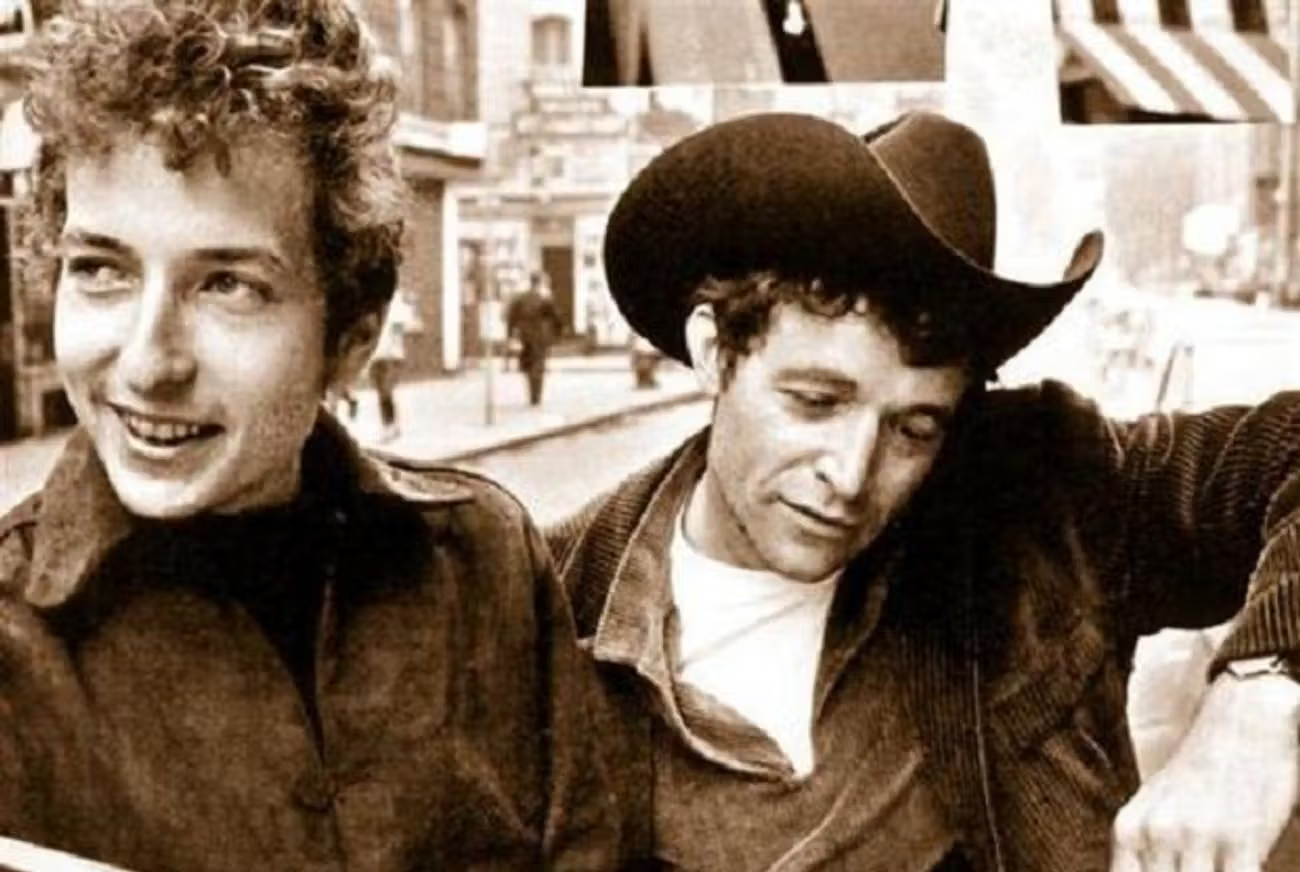
I was probably a junior when Ramblin’ Jack Elliott came to Knox and gave a concert of western and folk music, and I interviewed him briefly for WVKC-FM, the college radio station. Elliott was a pal of Woody Guthrie and many other leaders of the folk music craze of that era. As I write this, Ramblin’ Jack is still alive and even older than Your New Favorite Writer.

Must have been around that same time, I sat in a small, darkened room with ten or twenty aficionados and listen to Big Joe Williams as he noodled and riffed a long segué of Mississippi blues songs on his nine-string acoustic guitar.
Such opportunities were common at Knox in those days. For the sake of today’s students, I hope they still are.
But then, as you know, the small liberal arts college is on its way out. Nothing to see here, folks. Move along.
#
I was not well-organized or strongly motivated during my Knox days. The things I learned were mostly things you could not help learning even if you dragged your feet on the academic program and generally avoided study.
From Paul Shepard I learned there is such a thing as community, which is indeed an integrated assemblage of mutually adjusted organisms.
From Betty Friedan, I learned when you are under attack, don’t concede your critic’s gratuitous assumptions. Contest them. A hostile male student suggested that liberating women would lead to the neglect of their young children. I thought Friedan would say the benefit to women was worth the cost to their children. Instead, she replied “the studies show” that children who spend their days in well-run day care centers come into adulthood “better adjusted” than children raised only by their mothers. She did not say which studies, or what “better adjusted” means. These assertions have been fiercely disputed since she insisted on them. But she did not willingly give away points.

As freshmen, we had a history prof named Skip Kay. His name was Richard, but everyone called him Skip. He was an enigmatic fellow, a medievalist with a shy smile that showed up at times you were not looking for it, and a scholarly otherness that made him an easy target for freshman ridicule. But his class, Western Civilization 105-6, was a requirement. One of the textbooks was W.G. DeBurgh’s The Legacy of the Ancient World (1924), a dense little volume that described ancient Israel, Greece, and Rome. The other was Beatty and Johnson’s The Heritage of Western Civilization, a collection of excerpts from old dead white guys such as Plato, Aristotle, Descartes, Jean Jacques Rousseau and Sigmund Freud.
Some few of these old dead ideas trickled into my youth-addled brain and remain stuck in there to this day. Yet what I remember most is a comment Skip unleashed in mid-lecture sometime about halfway through the first semester. I wish I could recall it word for word, but the gist was this:
“When we study these things—the antiquities, the humanities, the arts and literature of societies that have gone before us—bit by bit we internalize something called ‘The Liberal Ideal.’ That is, the conviction that there are more things than we may dream of in our philosophy, and that when we differ—even differ sharply—over matters of great importance, it is still possible, it is still desirable, to sit down with the other fellow and reason together; that one person cannot know everything; and that the widest learning begets a corresponding degree of humility and respect.”
I don’t remember the exact words, but the concept, what Skip Kay called The Liberal Ideal—without reference to liberal and conservative dogmatics in today’s politics—that old dead Liberal Ideal has been stuck in my head ever since.
Which just goes to prove the liberal arts education is indeed obsolete—for what use could anybody make of such crazy old notions in today’s advanced, forward-looking world?
Blessings,
Larry F. Sommers
Your New Favorite Writer
