
They gave us wooden pencils, Eberhard Faber or Ticonderoga. We applied them to sheets of lined, low-grade, paper, bound into pads. Pencil tablets, they were called. Big Chief and Goldenrod were two common brands.
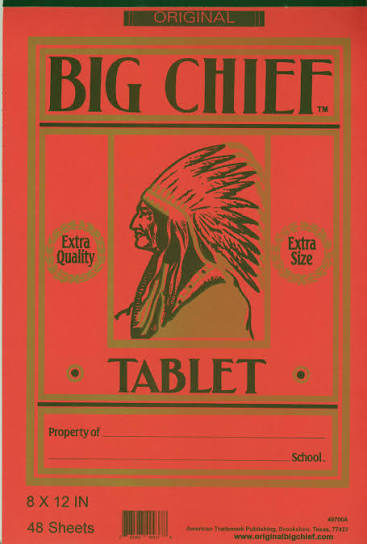
The paper was so pulpy the point of your No. 2 pencil bumped on an unreduced wood chip here and there, a trivial obstacle, no real impediment to learning.
They taught us to form capital letters and small letters. “Lower-case” was not in our lexicon. We practiced our capital and small letters over and over. It was called “printing.”

“Later,” they said, “after you know printing, we’ll teach you writing.”
By early in the third grade, I had gotten pretty good at printed letters. It was time to put them to use, so during a lull when some classmates struggled to finish a silent reading assignment, I created a hard-boiled detective story. Mrs. Winders left me in peace while I wrote—excuse me—while I printed a story that could have been an episode of Richard Diamond, Private Detective, starring Dick Powell, which I heard every Saturday afternoon on the radio.
Considering the materials at hand, you could call it pulp fiction.

By then, we were starting to learn cursive. Mrs. Winders didn’t use such a Latinate word for it. She just called it “writing.” Or “longhand.” You had to run the letters together so they linked up to make a word. You changed their shapes to match ideal examples shown on horizontal cards above the blackboard.
All through fourth and fifth grade, and maybe sixth as well, we studied “penmanship.” You spent fifteen minutes or half an hour making a loopy line like a coiled spring—all the loops the same size, evenly spaced and nicely rounded. Mine never came close.
But they couldn’t teach you penmanship without pens. We graduated to smooth paper, so we could write on it with our new pens. First they gave us steel dip pens with green plastic shafts with which to practice writing with ink. You had to dip the pen every half-word or so. I think they only gave us those things to give us a feel for what Thomas Jefferson must have felt when writing the Declaration of Independence with a goose quill.
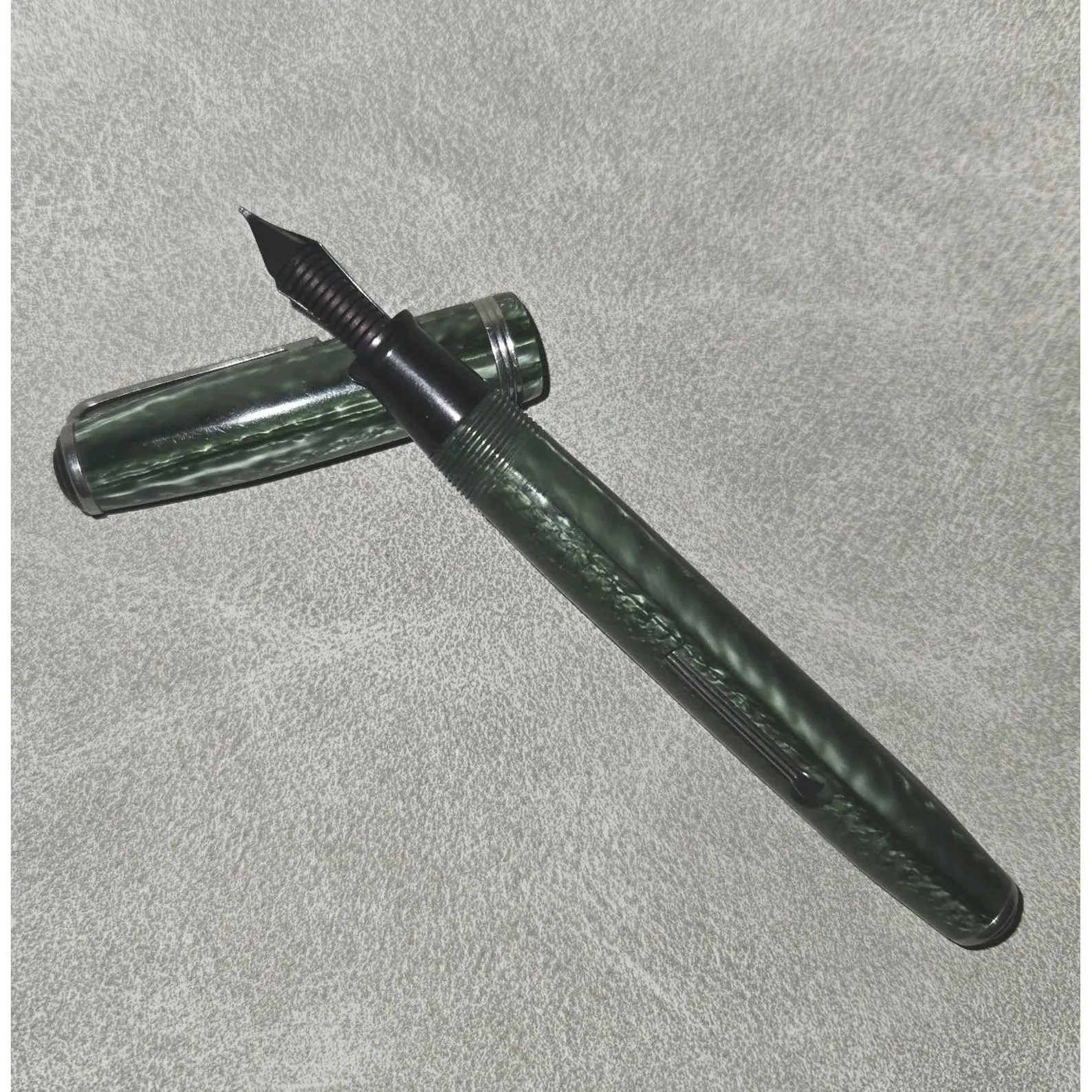
It made you long for something better. Enter the Esterbrook student fountain pen: a sleek cylinder that carried liquid ink in its barrel, ink which flowed by capillary action down to the point or “nib” at the business end. Suddenly you could write whole sentences, pages even, before you had to stop and refill.
Many companies made fountain pens, but Esterbrook seemed to have the market cornered on elementary school students. The companies in cutthroat competition to serve the adult market in the Midwest were Sheaffer Pens of Fort Madison, Iowa, and Parker Pens of Janesville, Wisconsin. (Full disclosure: My mother worked, right out of high school, as a steno/typist in the secretarial pool of Sheaffer Pens.)
All fountain pens, of whatever make, worked the same. You pulled out a lever on the barrel to compress the rubber ink bladder inside the pen.Then you dipped the nib in a bottle of ink and released the lever. Outside air pressure forced ink up the pen into the now expanded ink bladder. It was a clever arrangement.

The smooth flow of ink onto paper was a thing to be treasured. Of course, the complicated machine that delivered the ink was also capable of leaking black or dark blue stuff all over your hands and your clothes. It was a serious skill to handle a fountain pen without leakage.
Within a few years, we were all writing with ballpoints. The old fountain pens were put away, forgotten utterly.

Luddites there were, of course, who clung to the old technology. In autumn of 1962, I met Pulitzer Prize-winning poet and dramatist Archibald MacLeish, who signed my copy of his play JB. In doing so, the great man flaunted a real luxury fountain pen—a Waterman or a Cross, for all I know—which dispensed indelible black ink. He did it with calm panache.
I doubt Archibald MacLeish, even in his teen years, ever experienced a leaky pen. There were no blots on his escutcheon. (You could use your Funk & Wagnalls on that.)
Today, only re-enactors and fanatics use quill pens or dip pens. But the redoubtable old fountain pen is making a resurgence among the younger set.

What accounts for this rebound? Luxury, that’s what. Today’s consumers value the aesthetic and tactile effects of writing with a time-honored nib wrapped in an elite package. It’s a good thing they value it, because the experience starts at around fifty bucks, and beyond that, the sky’s the limit.
I have pretty much abandoned pens in favor of a laptop keyboard. When I resort to penmanship these days, it’s usually to sign for something on a digital pad, using my fingertip as stylus.
This finger-pen has further degraded my scrawl. But for receiving a case of wine via UPS, it’s mightier than any sword.
Blessings,
Larry F. Sommers
Your New Favorite Writer
