The Next Voice You Hear

A church can be the voice of God in our bewildered lives.

Movie poster. Fair use.

In 1950, when Your New Favorite Writer was only five years old, along came The Next Voice You Hear, a film in which God breaks into radio broadcasts, leading people to re-examine their lives. 

Its title came from a standard radio-era trope: A staff announcer’s preparation of the audience for an important message by saying, “The next voice you hear will be . . . .”

In this case, the movie implied, the next voice heard will be God, with a message for the world.

#

The Christian church has always struggled to embody the voice of God for people on Earth. 

In the High Middle Ages, people seemed to accept the notion that what the Holy Roman Catholic Church said, through priests and prelates, was God’s voice. If a pope said, “Go to Jerusalem and conquer it for Christianity,” that’s what people did. It was the voice of God.

Before long, people began to question that equation—mostly because, in the Reformation, “the Church” became two churches, then three. Then a thousand.

With a thousand churches saying different things, how could they all be the voice of God?

#

Today, we have a different problem. Church membership, attendance, and affiliation by any metric you may choose, have all declined—inexorably, year by year, decade over decade. 

In today’s society, it is inevitable that people will say, “Can any church speak for God?”

I am here to affirm, Dear Reader, that it can. See my statement above: “A church can be the voice of God in our bewildered lives.” 

I’m not talking about doctrine. It was once common to suppose that a church could be exactly right—fully orthodox—in its theology. In which case, of course, it spoke with the voice of God.

Few people buy into that kind of thinking anymore. 

Today, Christians are more likely to hew to an old biblical standard: “Ye shall know them by their fruits,” words spoken by Jesus in the Sermon on the Mount.

Permit me to amplify.

#

The church where I worship may serve as an example: Heritage Congregational Church of Madison, Wisconsin. 

Heritage was founded by a group of high-minded civic Christians in 1968. At that time approximately half of all Americans attended church, normally wearing their Sunday best. It was the classic 1950s church. Heritage had about three hundred members soon after it opened its doors. 

Almost immediately, erosion began. Over five and a half decades, our membership dwindled until we are now down to 51 members, theoretically. That translates to an active core group of about two dozen who show up regularly for Sunday morning services and other church events.

Most of us are old. We have three “young” families—mom and dad in their early fifties plus children in their late teens or early twenties. The rest of us are in our seventies and eighties. 

We are not getting any younger. By most reckonings, we ought to be what one old-time member used to call “tired roosters.”

I do not mean we never get tired. We do. 

I do not mean we are whirling dervishes of liturgical and evangelical activism. We are not. 

We are calm. We are patient. We are methodical.

We are full of faith, hope, and love.

#

We were not always that way. We got to be that way. God made us that way. 

Five years ago, we were a dying church. 

We struggled to maintain a huge building far in excess of our needs for worship or any other purpose. Just to keep snow and ice from demolishing the roof was a serious drain on our energies. We always worried about money, mostly money to keep the building going.

Then covid hit. We couldn’t even use this enormous building to gather on a Sunday morning and worship the Lord. We worshiped by Zoom while the building sat empty. That in itself was some kind of revelation, to use a biblical term.

We offered the building for sale. To our amazement, it was snapped up quickly by another congregation at a very fair price. 

Suddenly—SHAZAM!—we were awash in cash. We had no money worries for the first time in anyone’s memory. 

But now we had a different problem. Covid was over. Masks were becoming optional, then rare. Life was back to normal, sort of. And we had no place to meet in person. We deeply yearned to meet again with our loved brothers and sisters face-to-face. 

We rented a storefront in the conveniently-named Heritage Square strip mall. We chose the location because it was central and available. The echo of our church name was just a stroke of good fortune. 

Our storefront worship space.

We thought the storefront would be a temporary location. But you know, we like our new space. We’re in no hurry to move on. For the next few years at least, we can afford the rent. 

Free of the institutional concerns that used to tie us in knots, we have begun to relax. 

We concentrate now on simply holding good, restorative worship services in our new space. Our music director, Robert Eversman, has even built a small pipe organ into our little storefront, making it seem kind of churchy, if you know what I mean. He gets a good sound out of it, too.

There is a small kitchenette, adequate for staging our weekly after-worship coffee and refreshments—a key hallmark of our fellowship.

And some wonderful things have happened: 

The Madison Theater Guild, always hungry for rehearsal space, discovered us. We have hosted their rehearsals for three plays in the last year or so, and they’ll be rehearsing Arsenic and Old Lace at Heritage on weekday evenings early in 2025. We don’t charge any rent or facility use fee. We’re just glad there is something nice we can do for the community.

Some folks who enjoy line dancing use our space on Tuesday afternoons. There is a mah-jong club on Wednesday afternoons. A women’s bridge club may start using our space as well. It’s nice these groups can enjoy a cozy and comfortable space for the things they like to do.

Has all this activity increased our membership? No. But that’s no longer what we’re about.

The church is becoming relevant to our community. 

We collect items for a nearby food pantry, and one of our pastors delivers them there on a frequent basis. Some members volunteer there. It’s something we can do for our neighbors.
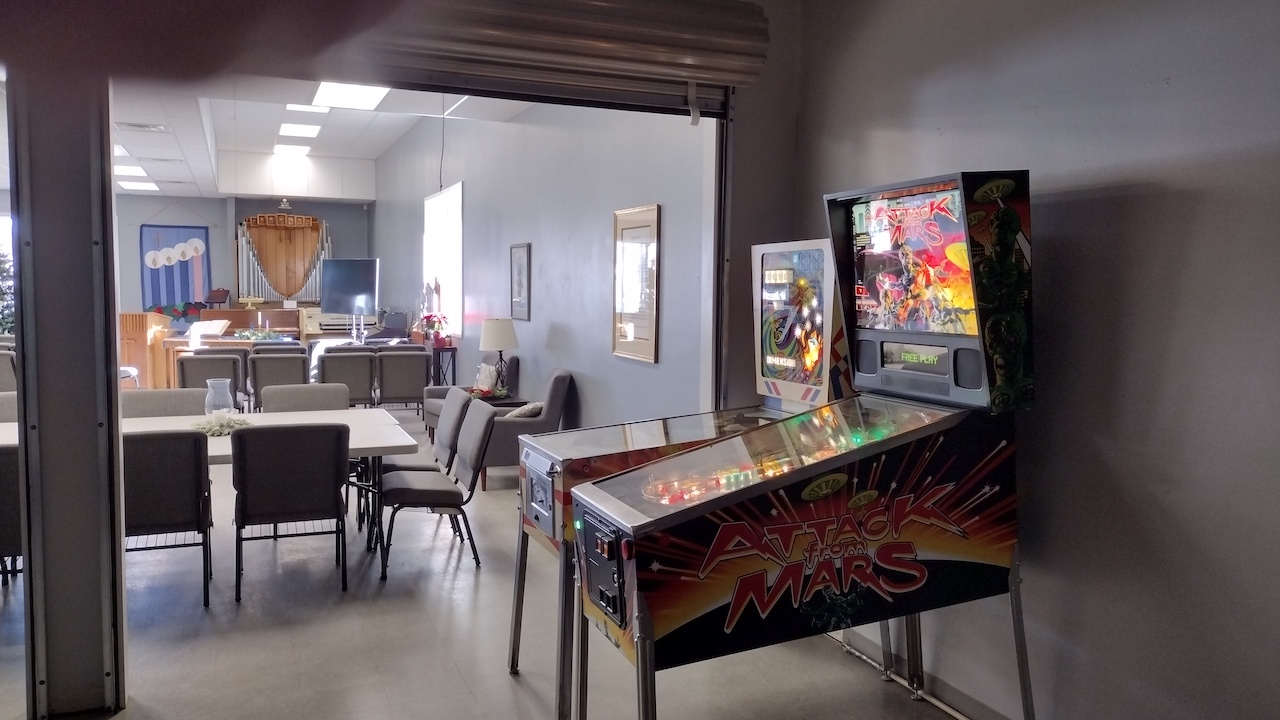
Pinball machines in the back room.

One of our members enjoys rebuilding or reconditioning old pinball machines. He places them in commercial spaces where they generate a bit of revenue. It’s a side gig for him, outside of his regular job. He was running out of space in his basement to store machines, so we said, “Sean, why don’t you put a couple of machines here?” So he did. We don’t know what we’re going to do with them, but there they are. What will God do with them?

Who knows what comes next? We’re in an experimental frame of mind. 

We do not need to hammer our church into a success story. God might plan for our church to die. If so, he hasn’t told us. 

Food supply is one way we have been entrusted to feed his sheep. Play rehearsals, line dancing, mah-jong, bridge, and pinballs might also be ways to feed His sheep.

We don’t know and we don’t need to know. 

We are calm. We are patient. We are methodical.

We are full of faith, hope, and love.

We’re just doing our thing. 

Could that ever add up to the voice of God in somebody’s busy, distracted, vexed, and bewildered life? 

Is that a prophetic ministry?

Who knows? Who knows?

But it’s not nothing. It’s something.

Blessings,

Larry F. Sommers

Your New Favorite Writer

La Grand Tour dans La Mauvaise Époque: Meditations provoked by traveling with grandchildren

Steinbeck and Charley by Luiyo, licensed under CC BY-SA 2.0.

Steinbeck traveled with a dog named Charley.

I travel with grandchildren named Elsie and Tristan. And their mother Katie. And their grandmother Joelle, to whom I have been married more than fifty-four years.

“Pantaloon – The Sixth Age Shifts into the Lean and Slippered Pantaloon” engraved by William Bromley. Public Domain.

. . . The sixth age shifts

Into the lean and slipper’d pantaloon,

With spectacles on nose and pouch on side;

His youthful hose, well sav’d, a world too wide

For his shrunk shank; and his big manly voice,

Turning again toward childish treble, pipes

And whistles in his sound. . . .

—William Shakespeare, “the Seven Ages of Man”

The Native Hue of Resolution

In all innocence, we decided to celebrate our Golden Wedding Anniversary in 2020 by going to Italy. We would take Katie and her kids along to help us celebrate. It would be fun, we thought.

“The Prince’s Cicerone.” Sir Walter Lawrence, 15 June 1905, Vanity Fair illustration by Leslie Matthew Ward (English, 1851-1922).

Young men from Britain or the Americas used to take long European sojourns as way of capping their formal education. This practice, known as “the Grand Tour,” had roots in the burgeoning world of the mid-17th century. It continued through the complacent era just before the outbreak of the First World War—a time now remembered as “La Belle Époque.”

“The primary value of the Grand Tour lay in its exposure to the cultural legacy of classical antiquity and the Renaissance, and to the aristocratic and fashionably polite society of the European continent. It also provided the only opportunity to view specific works of art, and possibly the only chance to hear certain music. A Grand Tour could last anywhere from several months to several years. It was commonly undertaken in the company of a cicerone, a knowledgeable guide or tutor,”

says Wikipedia.

Democracy in Action

But, this is America! This is the Twenty-first Century! Travel has been democratized. Even if we can’t go in high style, at least we can travel. Ignore the fact that we swelter in giant sardine cans hurtling through bumpy skies while we watch epic films on seven-inch screens, with prefabricated salads in our laps; at least we are going.

We will get there. We will be there. We will come back. Millions of us.

We hoped to expose Elsie and Tristan “to the cultural legacy of classical antiquity and the Renaissance, and to the aristocratic and fashionably polite society of the European continent.” We, ourselves, would be the cicerones.

What happened next, Dear Reader? Can you guess? . . . That’s right:

COVID.

Starting on March 13, 2020, all transglobal sardines’ wings were clipped. No Grand Tour could be scheduled.

But Resourceful is our middle name. We pivoted.

For the benefit of readers from afar: Door County is an idyllic peninsula in northern Wisconsin—a sort of stretched-out Martha’s Vineyard—that hosts thousands of visitors every summer. In late spring of 2020, Door County had not yet become alarmed about covid; it had hardly touched their peninsula. Business—that is, tourism—went on, with just minor precautions. 

We took the kids to Door County. We swam and dined and shopped and campfired to our hearts’ content. Tristan, now 8, and Elsie, still 10, enjoyed themselves immensely. We came home, illness-free, just as the pandemic was getting worse everywhere. 

A grizzled Alaskan enjoys a fresh shore lunch, untroubled by covid fears. “Grizzly Bear Alaska” by Shellie from Florida, USA is licensed under CC BY 2.0.

One year later, we tried again. But we still couldn’t schedule Italy, which by then was melting down with covid. So we went to Alaska instead. Alaska has plenty of fresh air. The grizzlies and moose at Denali National Park posed no threat at all, from a public health perspective. Local precautions were bearable. The good folks of Alaska were touchingly glad to see us. With all cruise ships lying idle in their home ports, we had America’s Last Frontier almost to ourselves. The kids—now 9 and 11-turning-12—really, really had a great time. 

Liberation

Britannic Majesty

However, since we as a family, unlike wealthy young men of old, could not stay in Europe for months on end, some bits were left uncovered. The British Isles, for example.

Tristan and Elsie, continents apart. Larry Sommers photo.

So this year, after a one-year hiatus, we took Katie, Elsie, and Tristan to Ireland, Scotland, and England—with a clever little layover in Reykjavik to see Iceland’s Golden Circle. It was wonderful. We saw Geysir (the original geyser), Gulfoss the rampaging waterfall, Thingvellir where the European and American plates come together. 

British military band prepares for the Changing of the Guard at Buckingham Palace. Larry Sommers photo.

In Ireland, one or more of us went to Blarney Castle, the Guinness Brewery, the Titanic Museum in Belfast, and the Giant’s Causeway. In Scotland, it was lovely old Edinburgh with its mighty castle, followed by a visit to Oban and the exciting islands of the Inner Hebrides. Then on to jolly old England: Derby in the Midlands, followed by several days in London—Buckingham Palace, the London Eye, Westminster Abbey, the Harry Potter studios, the Tower of London, HMS Belfast, the Churchill War Rooms. On our last day, we went to see Wicked on the stage of the Apollo Theatre. 

The London Eye never sleeps. Photo by Diego Delso, delso.photo, License CC-BY-SA.

The kids loved the whole trip—so far as we could tell. We had no way to know, since they were always two hundred yards ahead of us. Did I mention that now they’re 12 and almost 15? 

“It’s hard traveling with old people,” they confided to their mother. We were slowing them down, you see. Katie reminded them they would not be traveling at all if not for the old people. 

In former times, I would have added, “Put that in your pipe and smoke it!” But I’m reformed. No more promotion of tobacco products.

#

Neither Joelle nor I gained any weight while on vacation—a first! We ate copiously, but the travel was just so strenuous. We huffed and puffed along in the wake of individuals who had  not even bothered to arrive on Earth until after we retired. 

Suddenly, it’s fifteen years later. Our age has begun to dawn on us.

Nevertheless, we’ll probably do the whole thing again. There are still places to go, and tempus does indeed fugit.

Tempus shown in mid-fugitThe Sinnington sundial by Pauline E, licensed under CC-BY-SA-2.0

I’ll let you know how that works out.

Blessings,

Larry F. Sommers

Your New Favorite Writer

The Joy of Covid

Fooboo leapt into the window seat and set up a clamor. 

How much is that Fooboo in the window?

It was too early in the day for our neighbor dog to drag his master past our window, and Fooboo long ago became bored with the mailman’s daily sallies. 

I stood up from our dining table—which we use in the living room, as a breakfast/lunch/dinner nook.

I ambled to the window, and lo!, there stood Milo Bung, my old schoolmate. Milo was about to ring the bell at our side door—which we use instead of the front door. 

Milo’s melodious bing-bong triggered another spasm of barking, so I couldn’t hear any thoughts in my brain. I shooed the dog off the window seat and bade him be still. 

Then I cranked open the casement window. 

Which wore me out.

“Over here, Milo,” I croaked. 

He took his finger off the button and turned towards my casement window. 

“Oh, there you are!” He sidled over, scratching his elbows.

“Don’t come any closer,” I squeaked.

“Yeah, I heard you were under the weather,” Milo said.

Dread Disease

“Under the weather?” I said. “Under the weather? I have COVID!”

COVID-19. Alissa Eckert and Dan Higgins, Center for Disease Control. Public Domain.

Milo rolled his eyes.

“I do. I have it. We both tested positive,” I wheezed. “So it’s more than just under the weather, old pal. We’re victims of a major global pandemic.

“Yesterday’s news,” Milo said. He favored me with what I suppose he meant as a cheerful smile. “What you’ve got, at most, is a well-entrenched endemic.”

“Thanks for your support.”

“Well, you’ve got medicine, haven’t you?”

“Yes.” 

“And you’re getting better?”

“Thank God.” 

“And also, be sure to thank all those doctors and nurses, and the robber barons in Big Pharma, too,” said Milo, “working day and night on the taxpayer’s dime to develop vaccines. Had you not been immunized, you might have gotten sicker.”

My wife and I had just returned from a long trip. Somewhere along the Danube, we had been occupied by the virus that made our return home a miserable one. 

A Bullet Dodged

But Milo was right. It could have been worse.

I sighed. “When we were young, I never heard of such a thing as a global pandemic.” 

“Nor I,” said Milo, using his shirt tail to polish his bifocals. “Guess the first we heard the term was when Michael Crichton and Robin Cook started writing all those lurid medical thrillers. Death from Ebola and all them.”

Death from Ebola? It was not a title I recalled.

“Be that as it may. My point, Milo, is that once I learned a global pandemic was possible I assumed it would be cataclysmic—we’d all die.” 

“Well, amigo, a lot of us did die. Not you and me personally, of course, but a lot of—well, you know. People. Millions of people, all around the world.”

It was a sobering thought.

“So what are you going to do?” Milo asked.

“What do you mean, what am I going to do?”

“When you get out of quarantine?”

Post-Covid Challenges

“First thing, I’m going to the hardware store and buy a new set of hex keys.”

“An astounding act of celebration,” he declared.

“The bathroom faucet handle came loose, and I seem to be missing the Allen wrench the right size for that set screw. Must have lost it somewhere along the way.”

“How could you?”

I gave him a stony glare. “I’ve only had that set of wrenches for forty-five or fifty years.”

“Well, go ahead, then. Splurge.”

My hapless friend, a direct descendant of King Æthelred the Unready, stood pondering, head bowed. 

“And after I get the hex keys, I’ll say a little prayer for all those souls who caught covid before the world piled up four years of clinical experience.”

Milo Bung peered up at me through my window screen. “Guess we could all say that one.”

Blessings,

Larry F. Sommers

Your New Favorite Writer 

COVID Wednesdays

Each Wednesday of COVID, our grandchildren’s school releases them on their own recognizance, with the vague injunction to pursue “independent studies.” 

Pish, tosh. What do grade-school children know from independent studies? 

Ours—Elsie, 11, and Tristan, 8—fortunately have something available that’s better than independent studies. They have grandparents.

Their mom and dad both work Wednesdays, so Elsie and Tristan spend all day with us. 

They choose one of the world’s nation states in advance, and we come up with a lesson. We’ve done Egypt, Spain, Uruguay, Fiji—just to name  few. We start by bombarding our grandkids’ heads with random facts about the chosen nation. Then we cook some food alleged to be typical of the chosen nation. They participate in both the bombardment and the cooking . . .  at varying levels of excitement. 

Sometimes they abandon Mormor—the Swedish name for their grandmother, Jo—when she’s in the midst of an exciting recipe. They just run off and do something else. Turns out, it was exciting to her, but not so much to them. On other occasions, they stick throughout the process. 

Our kids are fickle and changeable. But, thanks to Mormor’s dogged persistence, we always end up with something original and tasty to eat. Often it’s a sweet dessert, and we detect no reluctance to consume it.

Afternoon is literature time. That part of the curriculum varies a great deal, too. I’ve gone radical by introducing poetic meters—the various kinds of rhythmic “feet,” iambic pentameter and such. Or sometimes we discuss what a piece means. Elsie and Tristan both like Robert Frost. And it turns out they’re capable of memorizing whole poems, if only they are challenged to do so.

On other occasions, the curriculum may be less formal. Last week we regaled one another with silly songs. Needless to say, their silly songs are sillier than my silly songs. Then we read a few Paul Bunyan stories, including one about the time Paul Bunyan tried to drive his logs down a Wisconsin river that ran around in a perfect circle. It took a while for Tristan to realize that such a thing is impossible—but he figured it out on his own. 

Much of my teaching is stuff and nonsense, of the basest sort; but I have a nagging fear that if not for Bapa—their non-Swedish name for me—they would miss out on such things entirely.

These days, children’s educational and recreational opportunities are meted out, trimmed, and balanced to a stupefying degree. We all know kids need exposure to the world of their grandparents, but we commonly neglect that need while we pursue other goals that are less vital. 

Should you have the opportunity to spend extra time with your grandchildren, rejoice. And use the time wisely. Don’t fritter it away in certified, approved, and educator-recommended lesson plans. This may be your one chance to give them something different.

Blessings,

Larry F. Sommers, Your New Favorite Author

Author of Price of Passage—A Tale of Immigration and Liberation.

Price of Passage

Norwegian Farmers and Fugitive Slaves in Pre-Civil War Illinois

(History is not what you thought!)