First Lady of the Air

She survived the Spanish Flu of 1918 but was left with a sinus condition that plagued her for the rest of her life. 

Her sinuses did not stop her, however, from becoming the first woman to make a nonstop solo flight across the Atlantic Ocean, an act for which Congress awarded her the Distinguished Flying Cross.

Lindbergh. Public Domain.
Earhart. Public Domain.

With her strong physical likeness to Charles Lindbergh, she became “Lady Lindy” to the headline writers of the Fourth Estate—or “Queen of the Air,” dubbed so by the United Press wire service. 

She and navigator Fred Noonan went missing over the Pacific Ocean in July 1937, prompting a search of unprecedented scale. But the search came up empty. 

Rumors of her fate still tease us, almost ninety years later.

Amelia’s Early Life

Amelia Mary Earhart was born in Acheson, Kansas, in 1897 and grew up there and in Des Moines, Iowa. She and her younger sister, Muriel, got an unconventional upbringing, as their mother had no desire to raise “nice little ladies.” 

Amelia—nicknamed “Meeley” or “Millie”—sought out adventure and achievement. A voracious reader drawn to science and mechanics, she took charge of her own education. When her family moved to Chicago, she rejected the high school closest to home and instead went to Hyde Park High School, which had the best science program. 

According to Wikipedia, “she kept a scrapbook of newspaper clippings about successful women in predominantly male-oriented fields, including film direction and production, law, advertising, management, and mechanical engineering.” 

She continually sought advancement in fields then dominated by men. After stints as a nurse’s aide, a pre-med student, a photographer, truck driver, and stenographer, she took seriously to flying. In 1921, after twelve hours of flight instruction from female aviator Neta Snook, Amelia cropped her hair short and bought a leather flying coat. Almost as soon as she took up flying, she drew up plans for an organization of female aviators. 

Neta Snook, the Kinner Airster, and a young Amelia. Public Domain.

Her life became a blur of flying, coupled with nonstop promotion of flight in general and flight by women in particular. She went ahead and started her dreamed-of female fliers’ group, which came to be known as The Ninety-nines and today has 6,500 members.

Amelia and Putnam at home.

She had a gift for promotion. Merely flying the Atlantic as a passenger in a plane flown by pilot Wilmer Stultz was enough to merit a ticker tape parade in Manhattan, followed by a reception with President Calvin Coolidge at the White House. Publisher George Putnam sponsored a promotional campaign which included publishing a book she authored, arranging a series of lecture tours, and using her likeness in various product advertisements. Putnam, her senior by a decade, proposed marriage six times and eventually became her husband.

In 1932, she made her own solo crossing of the Atlantic in a Lockheed Vega 5B. 

She continued to push for the acceptance of women in all aviation-related roles, from passengers to pilots and engineers. She flew in air races, served as an official of the National Aeronautic Association, and set a world altitude record of 18,415 feet at the controls of a Pitcairn PCA-2 autogyro.

In 1935 she joined Purdue University “as a visiting faculty member to counsel women on careers and as a technical advisor to its Department of Aeronautics.” In that same year she began to promote “one flight which I most wanted to attempt—a circumnavigation of the globe as near its waistline as could be.” 

Circumnavigation

It took a couple of years to get the project together. In 1936, with financing from Purdue, she acquired a custom-built Lockheed Electra 10E, a twin-engined monoplane, its fuselage modified to accommodate many additional fuel tanks. 

Earhart’s Lockheed Electra. Public Domain.

She chose Captain Harry Manning to accompany her on the round-the-world flight as navigator. Later, with reservations about Manning’s navigating skills, Amelia replaced him with Fred Noonan, a licensed ship’s captain and experienced marine and airline navigator. He had recently left the employ of Pan American Airlines, having laid out and pioneered most of Pan Am’s routes for flying boat service across the Pacific, as well as training the other navigators who would fly those routes regularly.

Amelia Earhart and Fred Noonan. Public Domain.

After her first attempt, flying east to west, failed due to an accident on the ground in Honolulu, Earhart had the plane repaired and then took off with Noonan, this time flying west to east. They flew from Miami and after a month-long series of hops across South America, Africa, the Indian subcontinent and Southeast Asia, arrived at Lae, New Guinea, on June 29, 1937.

They departed from Lae on July 2, bound for Howland Island in the mid-South Pacific, some 2,500 miles away—the longest leg of the journey. The flight was expected to take about twenty hours and would use up most of the plane’s 1,100 gallons of aviation gasoline, leaving little room for navigational error.

Earhart and Noonan’s planned route, mapped by SnowFire , illustration licensed under CC BY 4.0.
USCGC Itasca. Public Domain

Besides Noonan’s vaunted skill at celestial navigation using a nautical sextant, there was a provision for radio navigation, based on a homing signal from the U.S. Coast Guard Cutter Itasca, which was parked off Howland Island for that precise purpose. 

At the expected arrival time, the Itasca heard Earhart’s voice in a loud, clear signal indicating she was nearby, but two-way communication could not be established. She stated she could not find the radio homing signal.

O3U-3 Corsair biplane. Public Domain.

An hour after Amelia’s last message was received, Itasca began to search north and west of the island, assuming the plane had gone down in the ocean nearby. They found nothing. Over the next three days the U.S. Navy sent other assets to the search area, finally dispatching the battleship Colorado from Hawaii, where it had been in the middle of a summer training cruise for Naval ROTC students from Washington and California. The Colorado’s three O3U-3 biplanes flew search patterns around Howland Island. They also searched the Phoenix Islands south of Howland Island, focusing on Gardner Island (now called Nikumaroro). 

Nothing was found. 

The official search ended July 19, just five days short of Amelia’s fortieth birthday. After the Navy called off the search, her husband, George Putnam, ordered further searches with chartered boats. A year and a half after her last radio call, Amelia Earhart was declared legally dead. 

And So?

There are half a million theories on what went wrong. The most prominent ones are summarized at great length by Wikipedia. What it all boils down to is . . . nobody knows.

The most recent lead comes from Deep Sea Vision, a Charleston, South Carolina company that operates unmanned underwater vehicles. Early this year, their underwater drone captured a plane-like image of the right size on the sea floor about 16,000 feet underwater, in the ocean near Howland Island. But another expedition will be required to corroborate or invalidate the find. 

For now, pending new updates, she remains in that role, as apostrophized in song by Red River Dave McEnery: “Farewell, First Lady of the Air.”  

Blessings,

Larry F. Sommers

Your New Favorite Writer

Interim Report

“Reflections” is the name of this blog. It is also the name of Your New Favorite Writer’s “author newsletter.” 

In fact, the two are one. If you got here by surfing the Web and you found this site, you are reading my blog. If it arrived in your inbox, because you signed up, then you are reading my newsletter. It is the same content, only delivered by email, so you don’t have to search the Internet to find it. 

If you have not yet done so, please sign up for the newsletter version, using the “Share My Journey” box at right. You’ll be glad you did.

In the pages of the blog/newsletter, this search for the links between present and past ranges over a vast field of ruminations. But every post has something to do with present and past. I like to think of “Reflections” as “Miscellany with a purpose.” 

That purpose, simply put, is to offer us all, on a weekly basis, a fresh dash of historical perspective, from any source. 

But What About News?

Lion. Photo by Kevin Pluck, licensed under CC BY 2.0.

This being a newsletter and all, I really ought to share some news. Mostly what I share is random thoughts and woolgatherings. I do hope you enjoy them, but it’s necessary from time to time to toot my own horn—self-promotion being a solemn duty of the Literary Lion. That’s what I mean by “sharing news.” 

You may recall that in August 2022 I published—or rather, DX Varos Publishing, Inc., published—my first novel, a compelling work of historical fiction called Price of Passage: A Tale of Immigration and Liberation. Since then I’ve been living the life of a published author. 

It’s a life filled with glory in lieu of monetary rewards. I call it “living the dream.” 

A kink appeared in the dream last July when Dan Willis, the guiding genius behind DX Varos Publishing, died unexpectedly. Without Dan’s sacrificial levels of one-man input, the corporation is failing to thrive. I have been forced to reclaim my rights in Price of Passage, meaning DX Varos will no longer publish it. There is hope, however, that a new edition will be published.

And What of Izzy?

You may also recall that I wrote a middle-grades novel, Izzy Strikes Gold!, about a twelve-year-old boy in 1957. It won the hearts of my grandson’s fifth-grade classmates and teachers when I read it aloud to them over several weeks last year. I am proud to announce, if I have not already done so, that HenschelHAUS Publishing, Inc., of Milwaukee, will publish Izzy Strikes Gold! later this year. When the publication date is set and pre-orders can be taken, I’ll announce that here. 

It happens that HenschelHAUS is also interested in republishing Price of Passage, with a new cover and new subtitle. I think it’s okay to mention that here, although a contract has not yet been inked. 

Work in Progress

“So, New Favorite Author, what have you done for us lately?”

I’m working hammer and tongs on a new adult historical novel about two brothers who are at odds with each other when World War II separates them. It’s the most ambitious project I’ve tackled yet, and it’s going slowly. But I’m deeply wrapped up in it. When it is finished, it will have been worth the wait.

The reason the writing goes slowly is that my brain works slowly. That’s all there is to it. 

The advice of many authors is, “When writing your first draft, just write flat out. Get it down on paper as fast as you can. Don’t stop to fix anything, you can do that later.” 

That’s all right for them, but I’m me. 

Having written a couple of good novels, I know my process and how it works. Writing a first draft, I often follow my instincts down a blind alley. I paint myself into corners. I set up situations I cannot plot my way out of. As soon as I get a glimmer that I’m doing that, I need—absolutely need, Dear Reader—to go back to where I went wrong and find a new angle of attack. This is an essential part of the process. 

Usually what saves me is research. I learn something completely unexpected while researching to verify particulars of the plot. For example, does such-and-such work in 1937?

U.S.S. Colorado, 1932.
Amelia Earhart in 1937. Public Domain.

Amelia is still lost; but it excites me to find real facts of that kind that my story can tie into. It inspires me to invent new plot points. Nuggets of historical reality give me little pegs on which to hang a compelling story.

But working everything out, and narrating it in the right direction and at the right pace, takes a lot of time and effort. 

So stay tuned, Gentle Reader. My entire career as a Literary Lion is a work in progress. You can’t know how glad I am to have you along for the ride.

Blessings,

Larry F. Sommers

Your New Favorite Writer

Oracles

Your New Favorite Writer is but recently returned from a visit to the famed Oracle of Delphi. 

Temple of Apollo at Delphi. Photo by Annatsach, licensed under CC-BY-SA-4.0. 

Well, not the Oracle, exactly, but the place of the Oracle—the ruins of the Temple of Apollo at Delphi, Greece—which itself is often spoken of, in a modern linguistic convention, as “the Oracle of Delphi.”

Attic red-figure kylix from Vulci (Italy), 440-430 BC. Kodros Painter. Oracle of Delphi: King Aigeus in front of the Pythia. Antikensammlung Berlin, Altes Museum, F 2538. Photo by Zde, licensed under CC-BY-SA-4.0. 

The actual Oracle, however, was a high priestess, conventionally named Pythia but embodied by many generations of actual women who spoke forth from at least the eighth century B.C. (but perhaps much earlier) to the late fourth century A.D. 

Persons, representing themselves or their city-states, would come to Delphi—a place perched high on the slopes of Mount Parnassus, overlooking the Gulf of Corinth—with urgent questions bearing on their plans or hopes. 

On the seventh day of each non-winter month, the petitioners or “consultants,” in order of priority as assigned by priests or priestesses, would present their questions, and Pythia would present her answers. A long tradition says that Pythia did so in a trance-like state, influenced by toxic vapors seeping from a chasm in the ground underneath the Temple of Apollo.

The Oracle of Delphi Entranced, engraving by Heinrich Leutemann  (1824–1905). Public Domain.

Thus, the Oracle’s answers, or “oracles,” were ambiguous, easily misunderstood by the customers. Or maybe, Pythia’s utterances were pure gibberish, rearranged by the members of her subordinate priesthood into intelligible yet ambiguous formulations.

Lots of examples cited by ancient authorities such as Herodotus, Plutarch, and Diogenes Laërtius show that understanding and applying Pythia’s advice could be tricky.

#

Marmota monax. Photo by Cephas, licensed under CC-BY-SA-4.0. 

We have our own oracles.

For example, this demigod, Marmota monax. What are we to make of him?

Woodchucks, we have in plenty. There is only one Groundhog, one Lawgiver of February. 

He goes by many names: Punxsutawney Phil, Wiarton Willie, Jimmy the Groundhog, Dunkirk Dave, Staten Island Chuck, etc. But these are merely local avatars of the Universal Groundhog.

Wikipedia confides that the groundhog “is also referred to as a chuck, wood shock, groundpig, whistlepig, whistler, thickwood badger, Canada marmot, monax, moonack, weenusk, red monk, land beaver, and, among French Canadians in eastern Canada, siffleux.” 

But clearly, those terms refer to ordinary rodents.

An ordinary woodchuck preparing to chuck wood. Photo by Rodrigo.Argenton, licensed under CC-BY-SA-4.0. 

The Groundhog—the One and Only Groundhog—is said to control the weather. He controls it absolutely.

Stated baldly, the One Unitary Groundhog makes one unitary prediction, and we must all live with it for a whole season. 

“Which season is that?” 

The season of Winter-into-Spring, Dear Reader—a fraudulent season to begin with.

And how can we foretell the weather for Winter-into-Spring?

The Groundhog wakes up. Not at any old time, as a proper woodchuck would, but precisely on the second day of February. First thing in the morning.

When Groundie stumbles from his burrow, he waddles about for a while in a post-hibernial glaze. After coffee, he opens his eyes. If he sees his shadow, he goes back to bed. If he does not see his shadow, he stays up and does calisthenics. 

Punxsutawney Phil, Oracle, protected and cosseted by members of his priesthood. Photo by Anthony Quintano, licnsed under CC-BY-2.0. 

It’s that simple. A binary choice, ruled by a shadow. 

People say if the sun is shining, the Groundhog will have a shadow and can’t miss seeing it; but if the weather is overcast, there will be no shadow, hence nothing for the Groundhog to see. This may be reading too much science into the picture. The governing myth only says, “if he sees his shadow.” Parse that how you will.

Now, here’s the corker: If he sees his shadow and re-hibernates, there will be six more weeks of winter. Holy cow. 

But wait, there’s more: If he does NOT see his shadow and therefore stays out, then we shall have an early spring. 

Now, Fair Reader, we have breached the Innermost Cave, the Sanctum Sanctorum, the Mystery of Mysteries. For, in any place where anybody gives two hoots about the Groundhog, six more weeks of winter IS an early spring.

Do the math. February 2 + six weeks = March 16 most years, or March 15 in a leap year. That’s six or seven days before the Vernal Equinox, the “official” start of spring. But in most temperate climates, the real spring—meteorological, vegetative, phenological spring—does not come round until days or weeks after the Equinox. 

So, what can this rodentine Oracle be trying to tell us? In plain English, it’s not plain English. It’s mere gibberish, no more understandable than the virgin Pythia’s long-ago howls and whistles in ancient Delphi. 

Perhaps that’s why we, like a certain film character, are doomed to repeat the whole thing over and over until we get it right.

You may be forgiven, Neighbor, if you haul off and belt Ned Ryerson right in the kisser.

You have my earnest hope for brighter days, six weeks from now or sooner.

Blessings,

Larry F. Sommers

Your New Favorite Writer

The Past

Why does Your New Favorite Author live in the past?

You may have noticed, Fair Reader, that every one of these posts has something to do with the past. And every one ties the past in some way with the present. This is in keeping with our motto: “Seeking fresh meanings in our common past.” (See the top of this page.)

Have you not noticed my references to the future?

That can’t be it, because I haven’t made any. 

Is this because I have no interest in the future? Au contraire. I am eager to see how things will work out. But I am patient.

I don’t feel competent to comment on the future. It isn’t here yet. 

My ability to predict the next fifteen minutes has proven inadequate over the past seventy-eight years or so. How dare I venture a guess farther out?

I am content to wait until the future happens and then talk about it when it has become the past, as it always, eventually, does. Hindsight is better than foresight.

Confucius, the ancient Chinese sage, once said 君子欲訥於言而敏於行。It has been translated, “The superior man acts before he speaks, and afterwards speaks according to his action.” 

But why go into all that? Maybe the superior man acts first and speaks later so that he will know what he did before he comments on it. It turns out the superior man is not any better at telling the future than I am.

The public media are full of inspiring things that relate to the future. E.g., “Some men see things as they are and say, why; I dream things that never were and say, why not?”

With all due respect to the late Robert F. Kennedy, and to George Bernard Shaw before him—this is balderdash. 

Things that are dreamt of, or wished for, are unreal. Nothing is real until it happens.

Hope you feel comfortable joining me here sometimes. I’ll leave the light on for ya.

Blessings,

Larry F. Sommers

Your New Favorite Writer

Snow

All through autumn there was little to suggest winter was approaching. 

Now, it’s here.

After the blizzard.

On the west side of Madison, Wisconsin, we got close to a foot of snow January 9-10. Again, overnight January 10-11, we picked up three inches. On January 12-13, we hunkered down under a howling blizzard that dumped another foot of snow. 

Now the temperatures have dropped below zero.

If we have a mild December, Old Man Winter is apt to unleash his cold fury in January. This is my seventy-ninth winter. One gets to know these things.

Too Much is Enough Already

Some time ago, I lost sight of all the charms of snow. The gobs of white frosting smothering the cake of our landscape, the glitter of a million snow-diamonds in the moonlight, the squeak and crunch of ice-crust beneath your boots, the clean crispness of inhaled frost—all these things were lost on me.

I had shoveled too many tons of the stuff. Dug my car out of too many drifts. Dragged out the jumper cables once too often. Watched it all polluted with carbon granules and the effluvia of wandering dogs.

Before the blizzard.

My backyard has become a thing of beauty. One of the great things about snow is that you don’t have to mow it. 

I did have to unlimber the snow rake and pull a few tons off the roof to reduce the formation of ice dams that might cause leakage. Roof raking ought to be an Olympic sport. All the medals would be taken by beefy Norwegians.

My dog, the ever-adaptible Fooboo, has a high old time playing outdoors in the sub-zero sunshine. We think he is part husky. 

When I was his age, I played in the snow with great vigor. So did all my friends. There was no snow fort we could not build, none we could not assail. If we were feeling physical, we could wash our smaller siblings’ faces, unwillingly, in the snow. And boys bigger than we could do the same to us.

It’s All Downhill from Here

Every hill had sledding potential, but there was one, when I was nine or ten, that was par excellence—the Snake Path. It was not only a steep hill, it was a narrow path that took a tortuous drop through trees and brush, down to the old shale road that led to the river. 

In those days, sleds were steerable, but their steering was gradual. You had two steel runners under you. By pulling hard on the left or right end of a wood crossbar, you could warp the runners slightly to the side, sending you and your sled on a gentle curve down the hill. 

But the curves on the Snake Path were not gentle. They were sudden and heartbreaking. You had to yank the crossbar with all your might and sink a toe off the back runner to bend around the curve. Then you had to do it the other way, more or less instantly.

All this maneuvering was hard on your knit gloves or mittens and on the toes of your four-buckle galoshes. The sudden course changes threw cold snow in your face more or less all the time—but you were expected to take it. You had to run the bends without loss of momentum, so you broke the sound barrier while approaching the final obstacle—an earthen mound that made a perfect mogul or, if you will, a ski jump for sleds. 

Your reward for speed was to fly five or ten feet through space, landing with a big whomp on the old shale road. If, at that moment, you wrenched the crossbar violently and planted your right toe, you could turn ninety degrees and coast down the icy road almost a quarter mile to the litte bridge over the Stink Creek.

Then you would stand up, grab your sled, walk back to the top, and do it all again.

I haven’t had that kind of fun in almost seventy years, nor do I expect to, this side of Eternity. But that’s okay; I had the experience once upon a time. 

In my mind, I am always nine years old.

I hope you’re not much older, Gentle Reader.

Blessings,

Larry F. Sommers

Your New Favorite Writer

Harry T. Loper’s Difficult Day

Today I ran into a young friend who happens to be a staff member at the clinic where I had a medical appointment. My young friend said she wants to read my novel, Price of Passage, because she has developed a great interest in history. She wants to get the real story and is especially interested in African American history. She has recently been learning about Ida B. Wells.

I mentioned that she might want to look at my blog post on the Springfield, Illinois, riots of 1908. It’s not a part of our history to be proud of, but I think we should be aware of historical events that really happened, whether they make us proud or not. The Springfield riots led directly to the formation of the National Association for the Advancement of Colored People, a development in which Ida B. Wells had a hand. Those riots also caused the death of William Donnegan, a black Springfield shoemaker and Underground Railroad operative, who appears as a supporting character in my book.

All these reflections made me think I should repost the story, which appeared April 13, 2021, under the title, “Harry T. Loper’s Difficult Day.” So here it is.

Anarchy, Loper thought. 

Crowds of men, women too, ran through the afternoon streets of Springfield. Shouted. Shook fists. Spooked horses. Snarled teams and rigs. Loper had witnessed the Cincinnati riots in 1884. Now those bloody scenes flashed back across his mind.

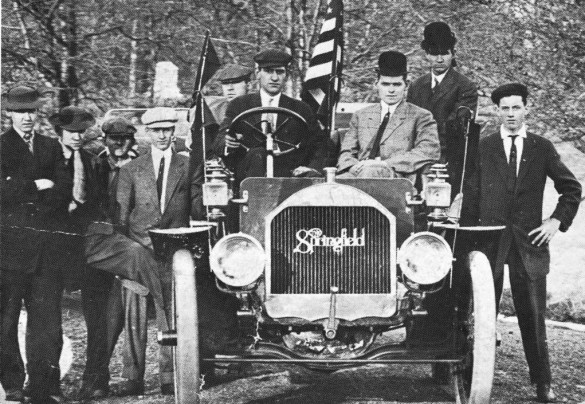
He frowned and crushed the horn bulb, steered his touring car through the lunatics, trying not to bump flesh. Loper’s 1906 Dorris was his pride and joy, but as a National Guard member and community leader, he knew his duty. He drove toward the county jail, the same place the mob was going, but on a different mission. 

Out of nowhere, six of Springfield’s new motorized fire engines came roaring down the street. Loper swerved, nearly killing some moron walking in the gutter. Bells clanging, the fire trucks raced northward, beyond Union Square Park—and the mob in the street followed them. Loper turned down an alley between Washington and Jefferson Streets and approached the jail from the back. 

“Took your time getting here,” said Sheriff Werner.

“There was a mob in the street, and by the way, the North End seems to be burning down.”

“Don’t worry about that fire. It’s a little invention of mine, to draw people away.” The sheriff barked back over his shoulder: “Come on, hustle!”

Two black men in prison stripes and handcuffs stumbled into the sunlight, surrounded by four armed lawmen. 

“Harry Loper,” said the sheriff, “meet Deputies Kramer, Hanrahan, and Rhodes, and Sergeant Yanzell of the city police. The famous desperadoes climbing in behind you are Joe James and George Richardson. They may hang for their crimes next week, but by God we’ll keep them safe tonight.” 

Loper turned in his seat to look at the prisoners. Both men stared bleakly at the floorboards. The Dorris was spacious, but two of the gun-wielding deputies had to stand on the running boards. Loper drove all six, prisoners and officers, five miles to Sherman, where they caught a train for Bloomington. 

He drove fast on the return trip, anxious to get back to his restaurant—even though a big supper rush seemed unlikely. Decent folk would not venture out this night, even for a Friday feed at Springfield’s finest eatery.

But that was the least of it. He turned into Fifth Street only to find his place beleaguered by an ugly mob. He parked in the street and leapt from the car. 

“There he is!” shouted someone as he ran in the door. “That’s Loper, the dirty nigger-lover!”

Loper made straight for his office and got the rifle he kept in case of robbers. He came out and stood in the doorway, brandishing the gun as broadly as he could. 

“You hauled the negro out of town,” shouted a voice, female this time. “Now we will haul you!” The crowd surged forward.

Loper ran for his life.

A fictionalized account of true events.

Loper postcard, interior.
Loper postcard, exterior.

Back in Business

My Grandma, Millie Marie Gunsten-not-yet-Sommers, lived in Low Point, Illinois, in 1908 and collected postcards. In her collection are two cards with no written message, no address, no stamps, no postmarks. They were never mailed. She must have been acquired them hot off the press. 

These cards were printed and distributed for an urgent purpose: To get Harry Loper back in business after the riot. But theywere no doubt kept by Grandma simply as mementoes of the riot.

I remember her, from the 1940s and ’50s, as a homely old woman in a shapeless dress, who wore big button hearing aids, smiled a lot, rocked me in her rocking chair when I couldn’t sleep, and gave me a spoonful of honey when I had a cough.

In 1908, she would have been about twenty, a shy and socially awkward telephone operator still living with her parents and younger siblings in a very small town. What would she have thought of the distressing and notorious events in nearby Springfield? Did the big riot stay in her memory? She had enough things to occupy her mind in the intervening years, with marriage to a profane and pugnacious railroad telegrapher, the raising of five children, the loss of two sons in World War II. She never mentioned the riot in my hearing, and I never asked her about it, since I had never even heard of it. Long before I came along, the Springfield Race Riot of 1908 had been buried in society’s willing forgetfulness. 

The Springfield Race Riot of 1908

But our haunted past has been resurrected. We now know that Springfield, Illinois—Abraham Lincoln’s home, the city from which he went to Washington to preside over a Union torn apart by slavery—was the site of one of the worst, and also most significant, race riots in the post-Reconstruction period.

On August 14, 1908, a young white woman, Mabel Hallam, charged George Richardson, a black construction worker, with raping her the night before. “I believe you are the man,” she said after hesitantly identifying him at the sheriff’s office in the Sangamon County Courthouse, “and you will have to prove that you are not.”

“Before God, I am innocent of this crime,” Richardson said. “I can explain her identification of me only by the theory that all coons look alike to her.”

An angry crowd formed outside the courthouse. Armed guards marched Richardson three blocks to the county jail and locked him up. Soon the mob re-formed at the jail.

Sheriff Charles Werner resisted using National Guard troops the governor placed at his disposal. He figured that getting the prisoner out of town would calm the mob. He telephoned Harry Loper to commandeer his car and arranged the diversionary tactic of a fake fire alarm. Perhaps as an afterthought, he added a second black prisoner to Loper’s cargo—one Joe James, languishing in jail for the July 4 murder of Clergy Ballard, a white mining engineer. 

Loper and motoring friends in 1910. Loper, in light-colored suit and black hat, sits in the passenger seat. Photo courtesy Sangamon County Historical Society.

But the mob would not be placated. Learning that Loper had driven the two men out of town, hundreds converged on his restaurant, utterly destroying it and Loper’s car. The restaurateur escaped through a rear basement entrance, but Louis Johnston, a white factory worker, was hit by a stray gunshot inside the restaurant and died.

Black Districts Pillaged

The mob then turned to the Levee, a black business district, and the Badlands, a nearby neighborhood where blacks lived in mostly run-down houses. Many African American residents fled to any available refuge, although some defended themselves with revolvers and shotguns, firing from upper stories of businesses in the Levee.

The white mob lynched two black businessmen—Scott Burton, a 59-year-old barber, and William K. H. Donnegan, an 84-year-old shoemaker. Both men were beaten, slashed, and hung, their bodies mutilated. 

In three days of rioting, at least thirty-five black-owned businesses were destroyed and riddled with bullets, and a four-square-block residential area was put to the torch. Local police, fire, and sheriff’s office responses were ineffective or nonexistent. Order was eventually restored by National Guard troops, deployed too late to stop the destruction and carnage. Accounts differ as to how many Springfield citizens, besides Burton and Donnegan, were killed or injured. At least several people, both black and white, died. Some estimates are higher.

Legal Penalties

Within a few days, a special grand jury “issued a total of 117 indictments and made eighty-five arrests for murder, burglary, larceny, incitement to riot, disorderly conduct, concealed weapons, and suspicion” (Something So Horrible: The Springfield Race Riot of 1908, by Carole Merritt [Springfield: Abraham Lincoln Presidential Library Foundation, 2008], p. 59). 

However, in the trials that followed, only one person faced serious punishment for participation in the riot—Roy Young, 15, who confessed to “shooting at negroes” and helping burn 15 or 16 houses and was sentenced to the state reformatory at Pontiac. Another rioter, Kate Howard, a boardinghouse owner known to have led rioters in the destruction of Loper’s café, was released on $10,000 bond and subsequently re-arrested in connection with the lynching of Scott Burton. “Before leaving for prison, Howard secretly took poison and died at the door of the county jail.”

Negro prisoner Joe James was convicted of the murder of Clergy Ballard and was hanged October 23, 1908. However, George Richardson, the man whose alleged rape of Mabel Hallam was the actual spark for the riot, was fully exonerated and released from jail two weeks after the riot, when his accuser admitted to the grand jury that she made the story up. According to Wikipedia, “He received no restitution or apology for his time away from work or harm to his name. He went on to work as a janitor, and lived until he was 76, when he died at St. John’s Hospital. His obituary did not mention the events of 1908.”

Catalyst for Founding of the NAACP

Richardson’s vindication would seem to be the only good thing to have come out of the Springfield riot. But it was not.

W.E.B. Du Bois

Wealthy white Republican Socialist William English Walling traveled to Springfield in the aftermath of the riot, visited hard-hit areas and spoke with survivors of the riot. He penned an article, “The Race War in the North,” for a New York weekly, The Independent.  Journalist and social activist Mary White Ovington read Walling’s article and wrote to him in response. They organized a January 1909 meeting in New York, attended also by Dr. Henry Moskowitz, which became the founding meeting of the National Association for the Advancement of Colored People (NAACP). Prominent black and white leaders such as W.E.B. Du Bois, Oswald Villard and his mother Frances Garrison Villard, Ray Baker, Mary Church Terrell, Archibald Grimké, and Ida B. Wells joined the initial organizational efforts. 

Thus the Springfield riot became the catalyst that led to the formation of the NAACP early the following year. 

#

Blessings,

Larry F. Sommers, Your New Favorite Author

Author of Price of Passage—A Tale of Immigration and Liberation.

Price of Passage

Norwegian Farmers and Fugitive Slaves in Pre-Civil War Illinois

(History is not what you thought!)

Nobel Nobles of Norway

After months spent acclimatizing on the lower slopes . . . and further months reddening my corpuscles at a lofty base camp . . . I am now poised for the final assault. Scaling the steep Volume III to its summit, Your New Favorite Writer will become one of five or six living human beings to have read Kristin Lavransdatter, the Norse epic by Sigrid Undset. I may even become the only person since the War to have read it in English translation.

This is no mean feat, Dear Reader. I have been working at it, on and off, for years. 

Once  achieved, it will be the obscurest feather in my literary cap. But it portends; for Kristin Lavransdatter is so pure in its essence, so majestic in concept, that the Swedish Academy awarded Ms. Undset—an inscrutable saga all by herself—the 1928 Nobel Prize for Literature. 

Sigrid Undset working at Bjerkebæk in Lillhammer, Norway. Photo by Alvilde Torp. Public Domain.

Perhaps this would be of little interest to you, Gentle Reader, were it not for your secret yearning to use Kristin Lavransdatter as esoteric chatter at cocktail parties. Yet the obstacles, till now, have been great.

Happily, I can give you the essentials, free of charge, thus sparing you the considerable pains I myself have endured in the conquest. Don’t mention it. Glad to do it.

#

Herewith, then, Kristin Lavransdatter:

Kristin Lavransdatter was a little girl living in the days when Norwegians were starting to take up bishops and, with some reluctance, leave off dragons. Those were also the days when your last name told who your father was. 

Lavrans Olivierssøn in bronze. No copyright.

Kristin’s father was named Lavrans, the Norsk equivalent of Lawrence or Laurence. Had he been Lavrans Olivierssøn, perhaps he would have been a great Shakesperian actor. However, Shakespeare had not been born yet, and Lavrans was actually Lavrans Bjørgulfssøn. He had to settle for being a wealthy Norwegian landowner. But I digress.

But bear in mind, it is Nobel prize material. Or it was, ninety-five years ago.

Kristin had a number of childhood adventures which firmed up in her mind the predicament of being a beautiful young maiden enmeshed in the aristocratic life of fourteenth-century Norway—which was mostly a succession of idylls in upland meadows, snowy forests, and scree-covered mountain slopes. As she grew into a gorgeous teenager, she was stupefyingly bored and thus fell in love with the raffish, error-prone Erlend Nikulaussøn. 

Actor Gard Skagestad as the raffish Erlend. 

Now, here is a curious point to ponder, Fair Reader: Kristin was the loveliest creature in all Gudbrandsdal, which is saying something; for those dales are filled with lovely Norwegian creatures. My point is, she could have had her choice among all sorts of wonderful husbands and good providers—many with great ancestral lands of their own. So who did she take up with but Erlend Nikulaussøn—a man acknowledged by all to be capable and charming, but then everybody also knew he couldn’t keep his head on straight.

It was the stuff of which good soap operas are made. Once Kristin and Erlend did the deed, of course she got pregnant, and her wise old father, Lavrans Bjørgulfssøn, swallowed his pride and gave her hand in marriage to this bounder, Erlend, from Trøndelag. 

The remaining two-and-a-half books explore in a charming, rustic way, every nook and cranny of the consequences flowing from that first-act mistake.

Somewhere in the second book author Undset lets slip that Erlend—tired of the routine tasks of a wealthy landholder married to a beautiful, beguiling, and willful woman—has been dabbling in politics. Medieval Norwegian politics, that is, of the kind that may cost a man his head if the legal king finds out about it. Well, that fact, of course, adds to Kristin’s trials. 

All through this endless parade of elephantine, Erlendesque blunders, Kristin keeps her cool. She scrupulously refrains from criticizing her husband on the principle that—well, I’m not quite sure what the principle is, but at any rate it prevents her giving him any good advice. Which is too bad, because he sure could use some.

You get the drift. I am sure you do, Dear Reader, since you are among the sharper knives in the drawer.

Kristin Lavransdatter exemplifies the best traditions of confused medieval nobles and gives us—what exactly does it give us? An enduring chronicle, shall we say, and let it go at that. 

If, in the course of finishing Volume III, I discover anything heart-stoppingly new and unexpected, I’ll be sure to let you know. 

In the meantime, should you wish to begin your own ascent into post-Viking Norsk literature, just email me, including your postal address. I’ll send you the first two volumes, like new except for the very occasional ketchup stain.

Blessings,

Larry F. Sommers

Your New Favorite Writer

Izzy Rounds Third, Headed for Home

To be filed under “Further Adventures of a Literary Lion”:

TA-DA!! Huzzah!! Thank you very much.

#

AND HOW DID THIS GREAT BLESSING COME TO PASS?

Here’s a recap:

When I retired from my retirement job in 2016 to devote myself to writing, I did not know exactly what I would write about. But I figured whatever touched the emotional core of my being would be a good place to start. 

That sent me back to my childhood. Specifically, to my grade-school years in Streator, Illinois, a prairie town of fewer than twenty thousand souls. The era was the 1950s. 

Yes, Gentle Reader, those 1950s. The famous Fifties. The Fabulous Fifties. Which were not always completely fabulous, in case you didn’t know.

But here’s the thing: Life, by itself, does not make good art. If I wrote a simple recollection, you would find nothing remarkable or interesting about it. Indeed, when I look back on my actual childhood, no meaning or theme can be divined. 

Yet it draws forth a strong emotion, a yearning to revisit those moments and find something . . . momentous. That’s why I write fiction. Perhaps I can touch the core truth of life by wrapping it in pretense.

So I made up a juvenile character, Izzy Mahler, a young boy in a small town in the 1950s, beset by bullying schoolmates, mystifying grownups, and a drive to reconcile conflicting events. Izzy’s experiences are my own, but rearranged in the hope they will add up to something.

I wrote a short story, “Nickel and Dime,” that links a six-year-old Izzy with two separate memories—being shaken down by bullies, and buying a candy novelty on credit. The tale had humor and nostalgia, and The Saturday Evening Post featured it on their website May 27, 2016.

Hoping to repeat this success, I wrote a seven-year-old Izzy into a romantic competition with an intriguing classmate, both kids hoping to win a bicycle. This was web-published as “The Liberation of Irma Ruger” on February 3, 2017.

And I hit the trifecta with a slightly deeper story, “The Lion’s Den,” about Izzy, still age seven, and his family tree. This piece won honorable mention in The Great American Fiction Contest and was published in its annual contest anthology.

There was more yet to say about Izzy. I thought there might be a coming-of-age novel buried somewhere in Izzy’s experience. I wanted to write it but didn’t quite know how.

MEANWHILE, my Scandinavian ancestors lured me to devise a fictional story featuring Norsk immigrants and fugitive slaves. This sweeping historical epic took five years to reach fruition and was published in August 2022 as Price of Passage: A Tale of Immigration and Liberation.

After most of the writing was done on Price of Passage, and while engaged in a two-year struggle to get it published, I doubled back and started to work on Izzy’s coming of age. 

This book would be a bit stiffer in content than the innocent childhood tales picked up by The Saturday Evening Post. It would focus on an older Izzy, in the momentous year when he was twelve. 

Alluring and enigmatic Irma Ruger plays a part in the story, and bullies from earlier Izzy stories also appear, as well as a couple of new bullies. This time around, Izzy is mired in a family drama with serious dimensions. But there is also humor and a huge dose of authentic Fifties nostalgia. 

You will enjoy the read, and so will your grandchildren. 

When I thought the book was finished, I did the same thing I had done when I thought Price of Passage was finished. I took it to Christine DeSmet. 

Christine DeSmet

In the most respectful and encouraging way, she took it apart—chapter by chapter, paragraph by paragraph, line by line—and helped me see what was working and what was not. We found enough needed improvements to make the book five hundred percent better than it had been. 

Nobody can do this like Christine. She has a gift and a calling.

The next step was to expose it to the target audience. Though written for ALL readers, Izzy Stirkes Gold! will be classified as a middle grade novel, merely so the booksellers know what shelf to put it on! It’s unlikely the book will appear on many bookstore shelves. Most of its sales will be online or direct from author to reader at book fairs and craft shows. But the need to categorize persists. 

In the publishing world, if your protagonist is twelve years old, you have written a middle grade novel. It’s that simple. Many such books provide enjoyment and edification to full-grown adults, but no matter; they are still middle grade books.

That experience alone was worth the whole effort. I found out what eager learners those kids are, and how they identified with a boy much like them but living in The World of Sixty-Five Years Ago. We had a fabulous time, and they affirmed for me that Izzy Strikes Gold! brings the reader some of the same longings and frustrations I knew as a boy.

By then I had begun a wide-ranging search for an agent or publisher to help me make the manuscript into a book. 

A few weeks ago, I began conversations with Kira Henschel, a very experienced publisher with a catalog of books by wonderful authors. 

As a result, I am now to be one of the wonderful authors in her catalog. This blessed event will occur about halfway through 2024. 

Don’t worry, Dear Reader; I’ll keep you informed. 

When the book comes out, do yourself and your grandkids a big favor: Buy it!

Blessings,

Larry F. Sommers

Your New Favorite Writer

A Child’s Christmas in Downstate Illinois, Part II

Reprising a post from four years ago, originally titled “A Child’s Christmas in Downstate Illinois.” This is the second of two parts. Hope you enjoy a bit of nostalgia. Next week, something new.

Waiting. Waiting. Waiting all year. Waiting in a little town on the prairie. 

Waiting through the commotion at Grandma and Grandpa LaFollette’s brown board house under the big elm on the Square. Waiting in bed at Grandma and Grandpa Sommers’ quiet house, with the lone blue light in its window, waiting with dreams of an electric train or a trap drum set, waiting for Santa Claus and his reindeer, if only they would—

It’s morning. Christmas morning!

I jump out of bed and dash into the living room. And there I find . . . NOT the amazing trap drum set from the Sears catalog. Not even a Lionel electric train, which I know for a fact Santa keeps plenty of on hand, and gives to lots of boys my age.

Something has gone terribly wrong. Under the tree, instead of a train on a loop of metal track, sits a big flat thing wrapped in red and green paper. I pick it up and rip off the paper, while the thing underneath makes clicking sounds. It’s a clear plastic box. A bunch of little metal balls inside it roll around and bump into things as I tilt it sideways.

“Look, Larry, it’s a pinball game,” says Mom, in her nightgown and robe. 

“Here,” says Dad, in his wrinkled pajamas. “You work it like this.” He takes it out of my hands, tilts it so all the little balls roll down to the corner, pulls back on a handle and lets it go. One of the balls shoots up and goes bouncing around between pegs and plastic fences until it comes back to the bottom. Wow.

“Here, let me try.” I reach up, take the thing back and start shooting metal balls. I’m so busy watching the balls bounce around that I almost, not quite, forget the trap drums. 

“Why the long face?” Grandpa hollers. With his pointy nose and his wire-rimmed glasses, he stares at me like a bird getting after a worm. “Y’oughta count yourself goddam lucky to have a nice game like that!”

“Maybe when you’re a little older,” Mom says, “Santa Claus will bring you an electric train.” She doesn’t mention the trap drum set. 

Girl and doll. Photo by Museums Victoria on Unsplash.

Although I have given them quite a few hours of free informational talks on it, I have never heard either Mom nor Dad actually speak the words “trap drum set.” Still, Mom just said “electric train.” So there is hope for the future.

Cynda gets her heart’s desire, a stupid doll named Betsy Wetsy. Mom brings a little glass of water to pour in its mouth, so my little sister can watch as the stupid thing pees its pants. Cynda is carried away with joy. She pours more and more water until not only the doll’s panties but also its dress, its hair, its chubby hands, and its sappy face are all dripping. 

“Now let’s put Betsy Wetsy away for a while,” Mom says, “until she dries out.” Cynda starts crying and carrying on as Mom takes the doll from her hands. Betsy Wetsy, to her, is what a trap drum set is to me. She has no right to complain. Hmph.

There are socks, bigger than we can wear, hung by Grandma’s fake fireplace with care. In them are oranges and nickels and candy canes and Mars bars and a few things like that. 

We dress, eat, pile into the car and drive down Main Street to the fun grandparents’ house. Grandpa and Grandpa Sommers will come along later.

A Flexible Flyer sled within the permanent collection of The Children’s Museum of Indianapolis. Creative Commons Attribution-Share Alike 3.0 Unported license.

The place is already humming when we get there. The bottom of the tree swims in a sea of presents. The biggest one is for me, and I grab it right away, because it is too big to be wrapped: an American Flyer sled, longer than I am tall. It has shiny wooden slats on two red metal runners, with a wood steering bar to make it turn.

Now, this is more like it. “Mom, where’s my coat? I’m going outside to try my sled.” 

“Wait a bit,” Dad says. “We’re about to open all the presents, and then we’ll eat. You can play with your sled in the afternoon.” 

More waiting. Sigh. I give the steering bar a twist or two. It doesn’t seem like it really works. The runners don’t hardly bend. “Dad, the runners don’t hardly bend.” 

“It’s just fine, son. You’ll see.” 

My cousin Steve is there, his eyes big and round behind his glasses. He doesn’t need to be jealous of my sled. I’ll let him ride it this afternoon. He has already done pretty well at his Grandma and Grandpa Stucki’s house. He got a cowboy hat and BB gun there. His little sister, Betsy, got, guess what—a Betsy Wetsy doll! Even though she’s only two.

From left: Aunt Linda, Cynda at 2, Steve at 6, Betsy at 1, Larry at 7. Christmas 1952 at Grandma LaFollette’s house.

Aunt Bertha and Uncle Harry—Mom’s aunt and uncle, everybody’s favorites—come in through the little wooden shed that stands outside the front door to keep the cold out. (Grandpa calls it “the vestibule.”) They have red-tipped noses and big smiles. They came later because they went to church for the Christmas morning service.

Grandma and Grandpa Sommers pull up in their big old Hudson. Grandpa’s wearing his suit and tie now, with his shoes shined and his hair slicked down. He’ll be on his best behavior—no yelling and cursing here. Grandma gives him the fish eye as they come in. 

We all sit down to open presents. The grownups sit in a big circle. Aunt Sue and Aunt Linda take the presents from the tree and hand them out, because they can read the tags. I can read, too, but not when it’s written in longhand.

It’s like a madhouse. Everybody unwraps presents, whooping and hollering, laughing, showing off, trying on new shirts and sweaters. I get some clothes that are nice, I guess. But my best presents are a coiled metal thing called a Slinky, and a tin Caterpillar bulldozer with rubber treads. It has a key on the side that you wind it up with.

Grownups in Grandma LaFollette’s dining room, Steve and Larry in foreground, Christmas 1952.

I have to wait to play with my new toys, because it’s time for dinner. We go down a step from the living room to the dining room. All the rooms in this house are one or two steps higher or lower than each other. I don’t know why, that’s just how it is.

Steve and Betsy, Cynda and I, Aunt Linda and Aunt Sue eat in the kitchen. The grownups sit at the big table in the dining room. There is turkey and mashed potatoes and gravy and sweet potatoes and stuffing and two different kinds of rice—Spanish, and glorified—and cranberry sauce. And three different pumpkin pies, each one a little different. Maybe I can try them all.

The kids’ table, Christmas 1952. Clockwise, from lower left: Steve, Aunt Sue, Aunt Linda, Cynda, Larry.

Aunt JoAnne comes into the kitchen with something called the wishbone. It was part of the turkey. I get to pull it with her. We each hold one end and pull to see where it breaks. Whoever gets the big end, their wish will come true. I hurry up and wish a wish. I close my eyes real tight to think.

“Oh, I know!” I shout. “I’ll wish for—”

“No, don’t tell!” Aunt JoAnne says. “If you tell your wish, then it won’t come true.”

Really? There are rules for wishes?  I didn’t know.

So I close my eyes again to remember my wish. Oh, yeah, that’s right. I can’t say what my wish is, but it’s not an electric train. Mom already said I might get an electric train next Christmas, so I don’t want to waste my wish on that. So I’m wishing for something else. Something that can make a loud noise.

I open my eyes. We pull the wishbone and it breaks on Aunt Jo’s side, so I win. “Hooray! Now I’ll get my train and my—oops.” 

I’ve waited long enough to play with my toys. When I get back to the living room, the uncles have set up the books from the Collier’s Encyclopedia to make stairs, and they have the Slinky walking down the steps. “This is just to show you how it’s done,” says Uncle Earl. 

Then he winds up my tin bulldozer and shows me how it can drive down the steps. This is so much fun that Uncle Dick does it next, and then Uncle Garrett, and then Richard Henderson—who isn’t even my uncle, yet. Next, they try to make it drive up the steps, but it won’t go. “Goddam grade’s too steep,” says Grandpa Sommers.

An earlier Christmas: 1950.

“We can’t give up now,” says Richard. He takes half the books out of the stack so it is shallower. Now the tractor goes up the steps just fine, but then  it turns and falls off the side.

“Maybe the damned thing needs a new driver,” Grandpa Sommers says. So finally it’s my turn to wind it up and aim it toward the book-stairs. It falls over when I start it, too.

Otto Graham. Bowman’s football card, 1954. Public domain.

By Sunday, when we go home, the Slinky has a bent coil and the Caterpillar tractor is dented, but we’ve all had a lot of fun playing with them. The sled works okay when you pull it with a rope, but when we get back to Streator, I know where a hill is, and that will be even more fun. 

We drive along between the fields of corn stubble on Sunday afternoon. Dad switches on the car radio. The Detroit Lions are playing the Cleveland Browns. “Bobby Layne versus Otto Graham,” Dad says. I don’t pay much attention to that because I’m dreaming about my electric train and trap drum set.

Detroit wins. “Guess Otto Graham will have to wait till next year,” Dad says.

Blessings and Merry Christmas, 

Larry F. Sommers, Your New Favorite Author

Larry F. Sommers

Author of Price of Passage—A Tale of Immigration and Liberation.

Price of Passage

Norwegian Farmers and Fugitive Slaves in Pre-Civil War Illinois

(History is not what you thought!)

A Long-ago Yuletide

Today I’m re-posting an entry from four years ago, originally titled “A Child’s Christmas in Downstate Illinois.” It’s a two-parter, the conclusion next week. Hope you enjoy a bit of nostalgia.

A vast reach of flatness, wrinkled only where streams of water flow. Small towns wedged among square fields of corn or, in winter, corn stubble. A place where calendars yield only 1950s, and people come in all varieties of regular. In this place I am always a boy, roaming bemused through a tall prairie of grownups. 

Chevrolet similar to ours.

In 1953 I am eight years old. It is Thursday night, December 24. It’s already dark when Dad comes home at five. Mom bundles us into the car. It’s a 1939 Chevrolet like the ones in black-and-white gangster films. Dad drives, because I’m too young. (But if I had an electric train, I could drive that. How great would that be?)

Teddy

I share the back seat with my teddy bear and my three-year-old sister, Cynda. Mom reaches over the seat and hands back a tuna sandwich on white bread. Cynda gets a sandwich too, but Teddy must be content to share mine. 

The miles unspool, a ribbon of two-lane highway painted by headlights. 

In a small town called Wenona there is a mountain, the only one I have ever seen. Dad says it’s only a hill of coal mine tailings. By day it is a pink cone that sticks up like a huge pimple on the skin of Illinois. By dark, we can see it only because someone has placed a five-pointed star of colored lights on its top for Christmas.

We zoom along at fifty miles per hour. (By the way, did you know there is no top speed limit on electric trains? Another advantage.) 

Cynda

We have eaten our sandwiches. Cynda has given up on crawling all over the back seat and has gone to sleep. I curl up with Teddy by the cold glass of the window and watch the night go by. Here and there a light gleams from a farmyard. Not much else out there.

Near Princeville, a wooden barricade like a sawhorse juts into the road to keep us from driving into a hole. It is marked by round pot flares, like black bowling balls with little orange flames flickering from their tops.

After two hours we arrive in Knoxville, a town of 2,000 souls, many of them our relatives. Dad drives past the old courthouse, makes two left turns, and parks in front of Grandma and Grandpa LaFollette’s one-story house. 

At the party

Inside, a party is already going on. Uncle Dick and Uncle Garrett kneel on the floor, unscrewing and replacing colored bulbs in a string of unlit lights. Richard Henderson, Aunt Jean’s skinny boyfriend, stands by, cracking jokes and handing them new bulbs. Suddenly the many-colored lights blink on. Everybody claps. 

The grownups stand around drinking from red glasses. 

“What’s in the glasses?” I ask.

 Dad takes a sip from his. “Mogen David and Coke,” he says. 

“Mogen David?”

“It’s wine,” Mom says. “Only for the grownups.”

Grandpa comes in from outside, holding a metal pitcher. He pours from the pitcher into the big brown heater that stands out from one wall of the living room. The stuff he pours in has a funny smell. I like the heater because you can look through a round window on its front and see orange and blue flames dancing inside.

By now, the uncles have draped the lights all around the skinny balsam that stands in the middle of the wall across from the heater. Mom and Grandma and Aunt Sue and Aunt Linda hang glass balls, bells, and tinsel on its branches. “That looks real nice,” Grandpa says.

Grandma has placed white fluffy cotton on the window sills. It’s supposed to be snow, and on it stand plastic reindeer and Santas. One is a red plastic Santa with a brown pack on his back. He is not in his sled but stands on a pair of green plastic skis, ready to deliver his gifts on foot. I like this Santa best, because of the skis. I can make believe the skis allow him to fly, like ski jumpers in the newsreels at the Earl Theater, even though he has no reindeer. I lift him off the cotton, fly him in circles through the air, and bring him in for a perfect ski landing. 

Grandma and Grandpa and all the aunts and uncles make a fuss over Cynda, because she now walks quite well. She stalks all around the room. “My, how she’s grown!” Big deal. I could walk years ago.

The other grandparents

After a long time, we get back in the car and drive Main Street to the other end of town. Even though all the Christmas fun happens at Grandma and Grandpa LaFollette’s, we are going to stay with Grandma and Grandpa Sommers. Their house is quiet, except when Grandpa shouts or curses about something. We have to stay with them because they have enough room for us. Uncle Stanley and Uncle Franklin died in the war. Uncle Ed and his family live in England; Aunt Mabel and her family are in California. We’re the only ones left who live close enough to spend Christmas with Grandma and Grandpa Sommers. 

It’s not so much fun at their house, and I’m afraid of Grandpa. But it is kind of nice to stay there on the night before Christmas. They have a tree, but not a lot of other decorations. Only, in the front window of the side room where Cynda and Teddy and I will sleep, Grandma has hung an electric candle with a single blue bulb. When we’re tucked into bed and the lights are turned off, the blue light from the candle glances off many points in the silvery wreath that surrounds it. It is pretty. 

I can imagine Santa and his reindeer, or maybe Santa on skis, just outside that window, just beyond the blue candle. I hope this year he’ll bring me an electric train, or else a trap drum set like the one in the Sears catalog. 

I want to stay awake long enough to see him arrive, but somehow I never quite make it. . . .

To be continued.

Blessings, 

Larry F. Sommers, Your New Favorite Author

Larry F. Sommers

Author of Price of Passage—A Tale of Immigration and Liberation.

Price of Passage

Norwegian Farmers and Fugitive Slaves in Pre-Civil War Illinois

(History is not what you thought!)