The Next Voice You Hear

A church can be the voice of God in our bewildered lives.

Movie poster. Fair use.

In 1950, when Your New Favorite Writer was only five years old, along came The Next Voice You Hear, a film in which God breaks into radio broadcasts, leading people to re-examine their lives. 

Its title came from a standard radio-era trope: A staff announcer’s preparation of the audience for an important message by saying, “The next voice you hear will be . . . .”

In this case, the movie implied, the next voice heard will be God, with a message for the world.

#

The Christian church has always struggled to embody the voice of God for people on Earth. 

In the High Middle Ages, people seemed to accept the notion that what the Holy Roman Catholic Church said, through priests and prelates, was God’s voice. If a pope said, “Go to Jerusalem and conquer it for Christianity,” that’s what people did. It was the voice of God.

Before long, people began to question that equation—mostly because, in the Reformation, “the Church” became two churches, then three. Then a thousand.

With a thousand churches saying different things, how could they all be the voice of God?

#

Today, we have a different problem. Church membership, attendance, and affiliation by any metric you may choose, have all declined—inexorably, year by year, decade over decade. 

In today’s society, it is inevitable that people will say, “Can any church speak for God?”

I am here to affirm, Dear Reader, that it can. See my statement above: “A church can be the voice of God in our bewildered lives.” 

I’m not talking about doctrine. It was once common to suppose that a church could be exactly right—fully orthodox—in its theology. In which case, of course, it spoke with the voice of God.

Few people buy into that kind of thinking anymore. 

Today, Christians are more likely to hew to an old biblical standard: “Ye shall know them by their fruits,” words spoken by Jesus in the Sermon on the Mount.

Permit me to amplify.

#

The church where I worship may serve as an example: Heritage Congregational Church of Madison, Wisconsin. 

Heritage was founded by a group of high-minded civic Christians in 1968. At that time approximately half of all Americans attended church, normally wearing their Sunday best. It was the classic 1950s church. Heritage had about three hundred members soon after it opened its doors. 

Almost immediately, erosion began. Over five and a half decades, our membership dwindled until we are now down to 51 members, theoretically. That translates to an active core group of about two dozen who show up regularly for Sunday morning services and other church events.

Most of us are old. We have three “young” families—mom and dad in their early fifties plus children in their late teens or early twenties. The rest of us are in our seventies and eighties. 

We are not getting any younger. By most reckonings, we ought to be what one old-time member used to call “tired roosters.”

I do not mean we never get tired. We do. 

I do not mean we are whirling dervishes of liturgical and evangelical activism. We are not. 

We are calm. We are patient. We are methodical.

We are full of faith, hope, and love.

#

We were not always that way. We got to be that way. God made us that way. 

Five years ago, we were a dying church. 

We struggled to maintain a huge building far in excess of our needs for worship or any other purpose. Just to keep snow and ice from demolishing the roof was a serious drain on our energies. We always worried about money, mostly money to keep the building going.

Then covid hit. We couldn’t even use this enormous building to gather on a Sunday morning and worship the Lord. We worshiped by Zoom while the building sat empty. That in itself was some kind of revelation, to use a biblical term.

We offered the building for sale. To our amazement, it was snapped up quickly by another congregation at a very fair price. 

Suddenly—SHAZAM!—we were awash in cash. We had no money worries for the first time in anyone’s memory. 

But now we had a different problem. Covid was over. Masks were becoming optional, then rare. Life was back to normal, sort of. And we had no place to meet in person. We deeply yearned to meet again with our loved brothers and sisters face-to-face. 

We rented a storefront in the conveniently-named Heritage Square strip mall. We chose the location because it was central and available. The echo of our church name was just a stroke of good fortune. 

Our storefront worship space.

We thought the storefront would be a temporary location. But you know, we like our new space. We’re in no hurry to move on. For the next few years at least, we can afford the rent. 

Free of the institutional concerns that used to tie us in knots, we have begun to relax. 

We concentrate now on simply holding good, restorative worship services in our new space. Our music director, Robert Eversman, has even built a small pipe organ into our little storefront, making it seem kind of churchy, if you know what I mean. He gets a good sound out of it, too.

There is a small kitchenette, adequate for staging our weekly after-worship coffee and refreshments—a key hallmark of our fellowship.

And some wonderful things have happened: 

The Madison Theater Guild, always hungry for rehearsal space, discovered us. We have hosted their rehearsals for three plays in the last year or so, and they’ll be rehearsing Arsenic and Old Lace at Heritage on weekday evenings early in 2025. We don’t charge any rent or facility use fee. We’re just glad there is something nice we can do for the community.

Some folks who enjoy line dancing use our space on Tuesday afternoons. There is a mah-jong club on Wednesday afternoons. A women’s bridge club may start using our space as well. It’s nice these groups can enjoy a cozy and comfortable space for the things they like to do.

Has all this activity increased our membership? No. But that’s no longer what we’re about.

The church is becoming relevant to our community. 

We collect items for a nearby food pantry, and one of our pastors delivers them there on a frequent basis. Some members volunteer there. It’s something we can do for our neighbors.
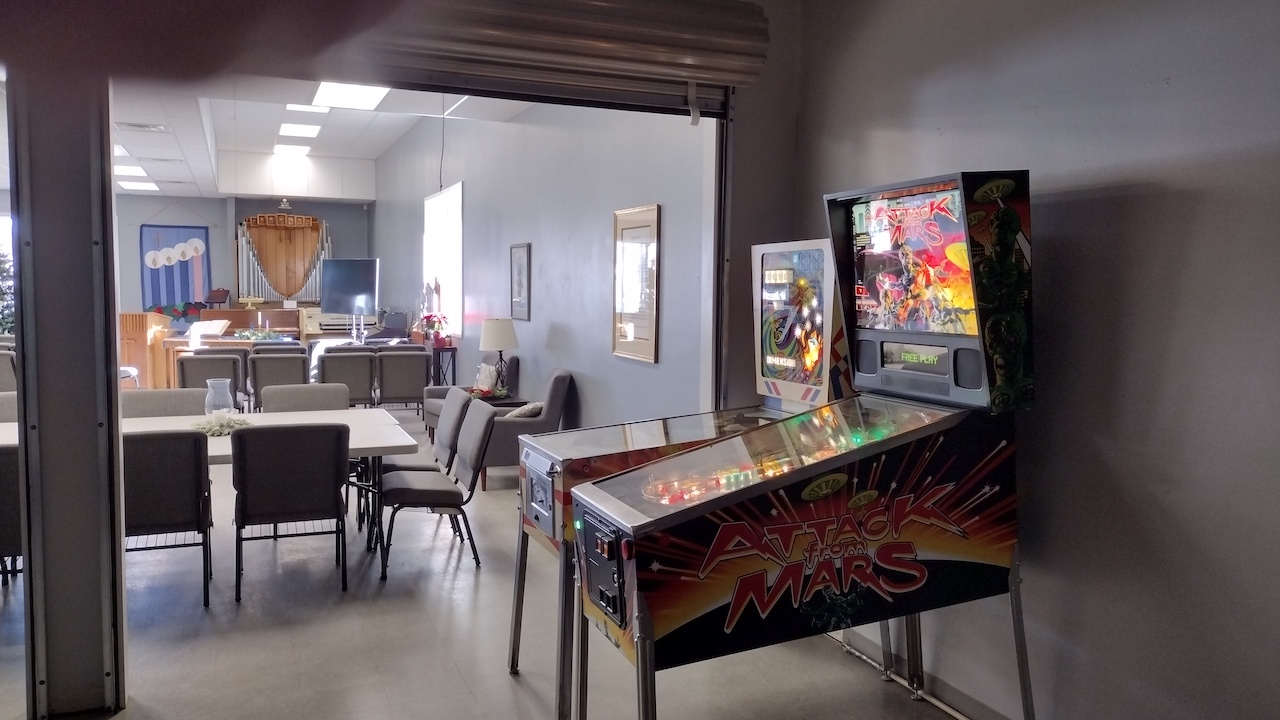
Pinball machines in the back room.

One of our members enjoys rebuilding or reconditioning old pinball machines. He places them in commercial spaces where they generate a bit of revenue. It’s a side gig for him, outside of his regular job. He was running out of space in his basement to store machines, so we said, “Sean, why don’t you put a couple of machines here?” So he did. We don’t know what we’re going to do with them, but there they are. What will God do with them?

Who knows what comes next? We’re in an experimental frame of mind. 

We do not need to hammer our church into a success story. God might plan for our church to die. If so, he hasn’t told us. 

Food supply is one way we have been entrusted to feed his sheep. Play rehearsals, line dancing, mah-jong, bridge, and pinballs might also be ways to feed His sheep.

We don’t know and we don’t need to know. 

We are calm. We are patient. We are methodical.

We are full of faith, hope, and love.

We’re just doing our thing. 

Could that ever add up to the voice of God in somebody’s busy, distracted, vexed, and bewildered life? 

Is that a prophetic ministry?

Who knows? Who knows?

But it’s not nothing. It’s something.

Blessings,

Larry F. Sommers

Your New Favorite Writer

Oh Izzy, Where Art Thou?

Emily Dickinson. Public Domain

You can be born in Amherst, live in Amherst, and die in Amherst. You can go to your grave unheralded. 

And then some interfering busybody will publish your poems, and you’ll be famous. Even rich, though only in absentia because by that time, you’ll be . . . elsewhere.

Dear Reader, I am no Emily Dickinson. I find it necessary to promote my own writings while I am still here. 

Not that it will make me famous or rich. But I would like somebody to read what I have written. 

This is especially true of a little book called Izzy Strikes Gold!, published in July 2024. My second novel. The one nearest my heart. 

If you wish to dismiss it, you may call it a middle-grade novel, because that means only pre-teen children should read it.

But here’s a news flash: I wrote it for everybody.

Izzy Mahler is a bright and inquisitive lad, age twelve, the class shrimp in a small Midwestern town. Not everything is going well in his life, but he’s accumulating friends—one by one, almost without being aware of it. And he has private knowledge of a hoard of shiny metal. That could be gold, and gold could help.

The story is set in the Sometimes-But-Not-Always Fabulous Fifties, which lends it a certain charm for those who remember the era, or a sense of wonder for those who have never been there. The kids who inhabit the Fifties are just like kids now—only in a gentler world.

Izzy Strikes Gold! is a charming, sometimes sad, but always honest look at growing up in America, then or now.

It is what we used to call a coming-of-age story.

This story is too good to be restricted to middle-schoolers. You can read it too.

Izzy Strikes Gold! is a book for anyone who was ever twelve years old, or ever will be. You can read it with your grandchildren.

It’s available on Amazon, but why not skip Jeff Bezos and give his share directly to my great Wisconsin publisher at https://henschelhausbooks.com/product/izzy-strikes-gold/. (My royalty will be the same in either case.)

I hope you enjoy the read. 

Blessings,

Larry F. Sommers

Your New Favorite Writer

Watch Out for That Deer!

An autumn buck. Photo by Laura College on Unsplash.

The events described below happened on Saturday, October 26. They were written down by the author the next day.

I hit a deer tonight, a large buck. 

He loomed like a ghost in the lights of a car passing on my left. 

I stood on the brake. 

The ghost buck missed the other car and appeared in my lane.

I struck him with blunt impact. Not a ghost after all.

He leapt, with agility, into the bushes and vanished in the dark. I sat, numb with surprise, in the slow lane on Highway 12.

The airbag did not deploy, nor was I injured. I drove onto the right shoulder, stopped, and triggered my flashing hazard lights.

I considered the deer, amazed he had taken that jolt and danced away. Was it mere adrenalin that propelled him, bounding off like a—well, like a healthy deer? Would he collapse, mortally injured, a hundred yards off the road? 

What about my car? How much damage was done? 

The driver’s-side door was stuck. I could not get out to inspect the front end.

I started to climb over the center hump, then reconsidered. It’s a small car and I’m an old man,  with cobalt-chromium knees and hips.

I called 9-1-1.

#

A host of angels descended. 

Within three minutes, a lone firefighter arrived, approached my passenger side, and asked through the window if I was okay. I said I wanted to find out how badly my car was injured but could not get out to check it. Was it drivable, I wanted to know.

“How old are you?” he asked.

“Seventy-nine,” I said.

“Wait a minute.” He went back to his truck.

In a minute he was back. He came around and pulled on the driver’s door. He gave a yank and it popped open with a crunch. I stepped out.

The left side of the front and the front of the left side were all crumpled. We went to the back and looked under the car for leaking gasoline or other fluids. There were none.

Emotion surged up—rage, indignation, fear? I stifled it as best I could. 

A whole crew arrived on a fire engine. They wore helmets and turnout coats. They gathered round and helped us look some more at the front end.

A Dane County Sheriff’s deputy arrived, quizzed me about the event, and asked if I was injured. 

“No, I’m just . . . chagrined.” 

He took down my name, looked at my driver’s license, made a couple of notes. 

“What kind of insurance you got?”

“We just changed it. It’s uh, what—Cincinnati.”

He nodded and made a note. “Cincinnati Insurance. Your car okay to drive?”

“Seems to be. These guys helped me check it out.”

“How far you got to go?”

“I live on the west side of Madison.”

He nodded. “Let’s make sure those headlights still work.”

I got back in, turned on the ignition, and turned on the headlights. They worked. 

A truck of paramedics arrived. The firemen in the turnout coats told them I was okay.

One paramedic, a grizzled man with close-cropped hair, stuck his head in my window. “You want us to check you over?”

“No,” I said, “I’m okay. No physical injuries.”

He nodded, said to the head fireman, “We’re outta here.” 

The deputy asked me to wait. He went to his car to fill out a crash report and get what he called “a crash number.”

By this time I was on the phone with Joelle. I was just explaining the situation to her when the deputy came back to my window. “Gotta go,” I said.

He handed me a piece of cardboard. “This is your crash report number. Your insurance company may want that.” 

I read it back to make sure I understood his digits and letters, scrawled in the dark in a squad car.

Then he left. By this time all the others had gone. 

I called home and told my wife I’d be home in half an hour.

“Drive carefully,” she said.

I always drive carefully. 

#

It troubled me, what that first firefighter had said. “Bound to happen, sooner or later.”

I hear people say that all the time. If you live in Wisconsin, it’s only a matter of time until you hit a deer, they say. I’ve always dismissed that in my mind as a lame excuse offered by sloppy drivers. 

Couldn’t happen to me.

Well, huh.

I still think it should be possible to avoid deer in all circumstances. But guess who failed to meet my standard? I can be a stickler.

I said a prayer for the buck and one for myself.

#

For the record: Damage to the car was about $6,000. The Cincinnati Insurance adjuster approved it for repair in an eyeblink.

The fate of the deer is unknown.

Blessings,

Larry F. Sommers

Your New Favorite Writer

A Momentous Occasion

In 1952 I spent the best part of the summer visiting my grandparents, Alvin and Berniece LaFollette, in the small village of Knoxville, Illinois.

1952 Chevy. Fair use.
Film poster: Red Skelton as The Fuller Brush Man (1948). Fair use.

Jean and Richard took me to the Galesburg Drive-in Theater, where we saw The Fuller Brush Man, starring Red Skelton. It was a cornball comedy about an aspiring yet inept door-to-door salesman. In my whole seven years, I had never seen anything so hilarious! Couldn’t wait to get home and tell Grandma and Grandpa the whole movie, from start to finish.

We took in other shows that summer, including Francis the Talking Mule, Ma and Pa Kettle, Bedtime for Bonzo, and Hold That Line, in which Huntz Hall of the Bowery Boys hurls a javelin through the dean’s window, shattering a priceless old vase; and does so again just as the dean finishes gluing the vase together. 

Film poster: Marjorie Main and Percy Kilbide as Ma and Pa Kettle (1949). Fair use.

Such films were wondrous good entertainment for a youngster innocent of any thought that he might be cramping anyone’s style, in the dark of a drive-in movie. Taking me along on dates with Aunt Jean was amiable and open-hearted of Richard—who in due time became my uncle.

The two lived a long life together, mostly in Houston, Texas. He was an engineer; she kept house and worked many years in the public schools. In retirement, they moved to Montgomery, fifty miles north of the city. Richard, a smart, capable, and funny man, died a few years ago. Jean still lives in Montgomery, surrounded by friends from her church and community. Three years ago she moved into a nice apartment or condo in a senior community.

Her ninetieth birthday approached. We knew it must be marked in some special way. With all but one of her brothers and sisters gone, she was now the matriarch of a nationwide family. 

Jean’s children, Kristin and Randy, planned a reception for Sunday, October 20, three days after her actual birthday. Cousins Renee, Sherri, and Darryl made arrangements to fly in from Virginia with their mother Lynda, Jean’s only surviving sibling.

At eighty-two, Lynda is just three years older than I. We played together as children. I led her across a fallen log that bridged the Stink Creek in the jungly river bottoms near my house. She slipped and fell in a slough of stagnant, black-scummed stink water. I pulled her out, led her up the hill, and drenched her down with cold water from our garden hose. That was seventy years ago, but nobody has forgotten.

Cousin Rick drove to Houston from his home in northern Illinois. Rick, Uncle Dick’s only child, has made something of himself in the world: He married a very smart woman, met the King of Sweden, and posed in his birthday suit for art students. He also earns pocket money by transporting corpses for a local undertaker. He has been urged to write a book.

Ronnie and Jimmy Seuntjens drove down from Las Vegas, New Mexico; their brother Brian flew in from some other Las Vegas up in Nevada. Returning to Montgomery,Texas, was bittersweet for the three Seuntjens boys. It was here their mother, my Aunt Sue, met her demise when a large truck crashed into the car she was riding in. Still, they could not miss the opportunity to honor Aunt Jean and mingle with cousins long unseen.

About 1944: Back row–Aunt JoAnne. Middle row–Mom, Grandpa LaFollette, Grandma LaFollette. Front row–Aunt Linda on Mom’s lap, Aunt Jean, Aunt Sue on Grandma’s lap. All gone now, but Lynda and Jean.

I flew down from Madison, Wisconsin, with my wife, Jo, and my sister, Cynda. We gathered with the other nine cousins in a wonderful resort called Sweetwater at Lake Conroe. Over snacks and beverages we caught up with one another’s doings, shared laughter and tears, and made trips to local eateries to dine with Aunt Jean and Aunt Lynda. 

Jean still drives around Montgomery, a small town. She uses a walker a bit at home, but seldom if ever does she use it in public. Her voice is wavery, but her eyes remain clear and bright.

Jo and I accompanied Aunt Jean on Sunday morning to the Montgomery United Methodist Church, where everyone gathered round to wish her well, for she is much loved. She remembered when the church’s present building was being constructed. “Richard watched every stick of it being put together,” she said. 

The gang’s all here: Two aunts, eleven cousins, and three spouses at the Montgomery Community Center.

On Sunday afternoon, all of us out-of-towners joined with many of Jean’s in-town friends for a tribute, at the Montgomery Community Center, on the occasion of her entering upon her ninety-first year of life. 

Aunt Lynda and Aunt Jean, the Honoree.

I told the story about going with her and Richard to see all those great movies when I was young. 

Rick brought along a book his father had made, with photos showing the removal of the old timber cabin from Grandma’s property and its relocation as a historic site on the other side of the town square. I explained all about that to anybody I could buttonhole and get to listen.

Jean’s grandchildren—Randy’s and Kris’s kids—were there for “Meemaw,” and they brought a couple of their own children as well.

When it was all over and all the group photos taken, we decamped to the Conroe Lake House, a swell restaurant recommended by Kris’s dughter Jordan. We all sat on the deck by the lake as the sun went down in a blaze of glory. We had small talk, beer, and some great fish and other entrees.

Dinner at the Conroe Lake House. Aunts Jean and Lynda at the far end.

Then it was truly all over, and we needed to leave early the next morning. As senior nephew, I drew the honor of driving Aunt Jean and Aunt Lynda back to Jean’s apartment. Both of them were tuckered out and needed sleep.

I helped them out of my rented van, and we stood there a few moments saying goodbye. We hugged and kissed. “This might be the last time we see each other,” Jean said. She gazed at me with those deep and penetrating eyes.

“Any time might be that,” I said. “You never can tell.”

“Love you,” she said. 

“And I love you. Be well, and I’ll see you back here in ten years.” 

They tottered in the door, clutching their styrofoam carryout boxes.

I got back in the van and strove to remember how the newfangled ignition works.

Blessings,

Larry F. Sommers

Your New Favorite Writer

Return of the Pod People

Do you recall my blessing you, a couple of weeks ago, with about 1,300 words on podcasting and its relevance to the practice of struggling authorship? 

Tom Bodett. I don’t think he looks like he sounds. What do you think? Image from Brattleboro Community TV, licensed under CC BY 3.0.

Maybe not enough was said.

In that post I mentioned that podcasters are the Arthur Godfreys of today. I could have gone on to call them latter-day Tom Bodetts, as well. But for once, I exercised restraint. (Please count that in my favor, come the Final Tabulation.)

Ben Patterson, Motel 6 ad for Roswell, New Mexico. Fair use.
First edition cover of The Body Snatchers, illustrated by John McDermott. Fair use.

But I digress. What I was going to say is that podcasting makes me think of pod people, as in, you know, Invasion of the Body Snatchers. Actually, the locus classicus of the species was just The Body Snatchers, a 1955 book by Jack Finney (one of Your New Favorite Writer’s favorite writers, by the way). When they made it into a movie in 1956, they added “Invasion of.” 

Kevin McCarthy prods a pod in the 1956 film Invasion of the Body Snatchers. Fair use.

Finney’s book was a sweet little story of spores or seeds or something that drift in from outer space, ripen into duplicate human beings inside large pods, and systematically replace the actual people they have emulated. Pretty soon the protagonist catches on, and then it’s a race to prevent all of Mill Valley, California, being replaced by a colony of soulless avatars. Once the premise is developed, Finney pretty much leaves off any pseudoscientific mumbo-jumbo and just tells the thrills and spills of the human resistance movement fighting off the invaders. The book has been criticized for its want of Heinleinian (Asimovian? Clarkeian?) authenticity, but once Jack Finney starts spinning a yarn, it’s hard not to get tangled in its web . . . or pod, or whatever.

Which brought to mind the fact that podcasting is one of those arcane disciplines that rely on the development of modern, computer-based technology in order to have any basis at all. That’s only one of the things that makes it daunting to yours truly—a Twenty-first Century Man with the technical know-how of the Tooth Fairy. 

I am firmly convinced, for example, that when my telephone dims its screen to 90 percent darkness without my commanding it to do so, it is exercising a purblind, autonomous, malicious will of its own. 

A Rube Goldberg machine: “Professor Butts and the Self-Operating Napkin (1931). Soup spoon (A) is raised to mouth, pulling string (B) and thereby jerking ladle (C), which throws cracker (D) past toucan (E). Toucan jumps after cracker and perch (F) tilts, upsetting seeds (G) into pail (H). Extra weight in pail pulls cord (I), which opens and ignites lighter (J), setting off skyrocket (K), which causes sickle (L) to cut string (M), allowing pendulum with attached napkin to swing back and forth, thereby wiping chin.” Public Domain.

And yet, Jack Finney stands as a shining example. A man with only a general liberal arts background, and some experience in the advertising business, he made a good living—as well as contributing to American mid-century culture—by writing stories that often fell under the science fiction rubric. He pulled it off by never letting pesky scientific details get in the way of a good story. His Time and Again stands as one of the great time-travel novels despite its resolute refusal to offer even a Rube Goldberg-style explanation of how time travel was supposed to have worked. He just massaged his protagonist’s psyche until he found himself in the 1890s.

Some chutzpah.

Stay tuned for further developments, but don’t stop the presses. Yet.

Blessings,

Larry F. Sommers

Your New Favorite Writer

Dwight

Smears of sticky color burn holes in the black sky, looping and whirling, riveting my five-year-old eyes. 

#

I barely remember Dwight. It dwells in a hazy time between active toddlerhood and full-fledged littleboyness.

Dwight. Photo by IvoShandor, licensed under CC BY-SA 3.0.

My father had finished his chemistry degree at Knox, plus a few teaching courses at Normal. He was teaching chemistry, physics, and driver training at Dwight Township High School.

Dwight was a very small town in North Central Illinois. About 2,800 people then.

Memories flee, circle, and evade. What I mostly can recall is a small, warm klatsch of teachers and townspeople.

#

We lived upstairs, above Rogers and Marie Cumming. 

Rogers Cumming—whom people called Roger Cummings, imagine that—was a music teacher and band master. Dapper and energetic, with a shiny bald dome, he was proably around thirty, only a little older than Dad.

Rogers’s wife, Marie, was a honey. She did not hold an official teaching position, as far as I know, but was very musical. She was also statuesque, blonde, and fair of face. She gave lessons to  young girls on baton-twirling, one of the social graces in mid-century, small-town Illinois. Occasionally she could be seen performing, herself, in the uniform of a drum majorette. She was a knockout! 

Louis Prima in 1947. Public Domain

Rogers and Marie had a Wurlitzer organ in their living room. Often, Marie, my sweetheart, sat at that organ and rolled out a rollicking version of my favorite song, “The Too-Fat Polka.” 

A year or two before, my favorite song had been “Bingo Bango Bongo, I Don’t Want to Leave the Congo,” a novelty song recorded in 1947 by Louis Prima and his band. 

But Marie and I were beyond all that. We were sophisticates.

. . . Good night, sweet princess,
And flights of angels sing thee to they rest.

Blessings,

Larry F. Sommers

Your New Favorite Author

The Pod People Are Coming!

You know how sometimes a light bulb goes on in your head? 

Light bulb. Image by Lidija296, licensed under Creative Commons Attribution-Share Alike 4.0.

You’ve been sweating over something for weeks or months, and all of a sudden you see it from a new angle. One thought breaks in and lights up a bevy of questions, the answers to which bounce off one another in ways you never suspected. It can be profound when that happens. 

It doesn’t happen to me much. But yesterday morning, it did.

It’s a bugaboo for writers. We are told to become a guest on somebody’s podcast, because podcasts are the best avenue to increased book sales. You must pitch podcasters with . . . well, with whatever it is you do, or what you have to contribute to the conversation, or . . . something.

Did I mention, Dear Reader, I was born in the twentieth century? The year 1945, to be precise. Almost eighty years ago. So what do I know from podcasting?

Tens of millions of people make podcasts and listen to podcasts, often with great regularity and brand loyalty. According to Pew Research—which, as you know, researches every social trend worth researching—large portions of a podcast’s audience will buy something, read something, or take an  action because they heard it on their favorite podcast.

#

Gutenberg. Public Domain.

But I don’t understand why someone would listen to podcasts in the first place. I am mostly a printed word guy. To me, Gutenberg invented the latest reliable technology. I watch very little TV, listen to very little radio, and take in nearly zero podcasts. 

Those things seem like giant time-wasters to me. You have to wait for someone to speak, or in the case of video, to act, before you can learn that which you could already have grasped by skimming a line or two of prose. And it’s inconvenient, sometimes even impossible, to go back and re-check something that was said a while back. Why would a person want to do this?

“Yes, but—” I hear you cry. “But you can ingest a podcast while doing something else—driving or jogging or washing dishes.” 

Maybe you can, but I am no multi-tasker. I have to pay attention to every single thing. I guess they call that a one-track mind. It leaves me no way to pay attention to something else.

That’s not absolute, Gentle Reader. I can, for example, talk with someone while driving a car. I won’t run over any pedestrians, but I’m almost certain to miss my turn-off. 

#

So why do I need to pay attention to podcasting at all? Because podcasters are powerful influencers. The folks who subscribe and listen to podcasts become attached to the voices they hear repeatedly. They invest great authority in their pronouncements. That’s what makes podcasting a valuable vehicle for promoting a book.

Still, I—antedeluvian creature I am—bridle at the idea of pursuing podcast appearances. It is unseemly. It is very now. Therefore I hate it.

But I was mulling over the authority listeners invest in the podcaster, and suddenly—Fair Reader, you might recognize that this is where you came in—A LIGHT BULB WENT ON above my head, just like we used to see in the funny papers.

When I was a boy, in the 1950s, there was a man in whom listeners invested great authority. So much authority, in fact, that you could buy time from him at an expensive rate . . . but if you paid, oh, ten times that rate, the great man himself would deliver your message, in his own voice.

His name was Arthur Godfrey.

Arthur Godfrey at a CBS microphone in 1938. Public Domain.

He was a creation of radio, and by his own audacity, he became king of the medium. While recovering from a near-fatal car crash in 1931, Godfrey spent a lot of time listening to and analyzing commercial radio broadcasts. He noted, according to Wikipedia, “that the stiff, formal style then used by announcers could not connect with the average radio listener. The announcers spoke in stentorian tones, as if giving a formal speech to a crowd and not communicating on a personal level. Godfrey vowed that when he returned to the airwaves, he would affect a relaxed, informal style as if he were talking to just one person.”

That’s just what he did. Jim Ramsburg says: “In their 1963 book, It Sounds Impossible, former CBS executives Sam Slate and Joe Cook describe Godfrey’s return. ‘. . . Listeners heard for the first time the casual, unhurried speech . . . the ruminating, hesitant pace . . . the purring growl that has since opened the doors to millions of American homes.’ ” 

Godfrey’s informality extended even to adlibbing and joking while delivering on-air commercial scripts that sponsors had paid good money for. Godfrey sometimes appeared to be mocking the very product he was selling. But sales zoomed, and canny sponsors realized that having your commercial butchered by “the Old Redhead” was better than having it read meticulously by an ordinary announcer. 

He hit his stride on April 30, 1945, when CBS gave him a half-hour coast-to-coast slot at 9:15 a.m., Monday through Friday, under the title Arthur Godfrey Time. Eventually it expanded to ninety minutes. 

The Old Redhead delivered long, unscripted monologues; interviewed celebrities; introduced and sometimes interrupted or joined in with musical selections by his own in-house orchestra and regular vocalists. It was all spontaneous and informal. 

He got beyond the scripted sound of commercials by inserting adlibbed comments. I recall his reading a commercial for Bufferin that was filled with Madison Avenue catch-phrases. He stopped ten seconds in, paused, and said, “So forth and so on. To tell you the truth, folks, I don’t know what’s in this stuff, but I’ve used it myself and it works.”

He was the ultimate pitchman because it never seemed he was pitching—he was simply commenting, in a folksy, down-to-earth way, on the passing scene. According to Ramsburg, he realized that radio was a personal medium and he spoke directly to the individual listener.

People listened to Arthur Godfrey every day. They knew him, they trusted him, and they were loyal.

Aren’t these the same reasons podcasters are said to be so influential? 

#

So when the light bulb went off over my head, it said: “Podcasters are the Arthur Godfreys of today.” Even an old wreck like me can understand that.

Few podcasters enjoy as big an audience as Godfrey commanded. That’s just as well, because anyone whose book is not yet on the New York Times Best Sellers list is unlikely to get a foot in the door of those giant podcasts.

The media scene today is fragmented. Many podcasters have only a few followers, or a few hundred, or a few thousand. That’s where I ought to start. 

And the first thing to do is to pick a few likely candidates and listen to their podcasts. When pitching somebody, it never hurts to know what they’re all about.

You can help me, Dear Reader. Do you subscribe, or listen regularly, to any podcasts that seem related to the theme of this blog—“Seeking new meanings in our common past”? If so, drop me a line at larryfsommers@gmail.com, or just add a comment to this post.  

Help me function in the present century.

Blessings,

Larry F. Sommers

Your New Favorite Writer

This Old House

The historic part of Grandma’s old house. Knoxville, Illinois.

I spent golden days of childhood at Grandma and Grandpa LaFollette’s house in Knoxville, Illinois. 

A bit of that old house has been saved as a historic site, but the place I knew in childhood is long gone. I don’t even have a photo of it. Only in memory is it preserved entire.

Let me try tell you why it was special.

#

It stood on a large lot fronting the town square in Knoxville, a town of about two thousand souls. Across the square, on the north side, stood the Old Courthouse, a two-story, white-pillared structure built in 1839. Beside the courthouse, a small brick building housed the village library. Between courthouse and library stood—and still stands—a brick wall, on which the names of local World War II servicemen stand in relief on twin bronze plaques. My father, who survived the war, and his brothers Stanley and Franklin, who did not, are listed there.

The lot my grandparents owned on the south side of the square, next to the Klink Mortuary, was dominated by a huge elm, said to be the largest in Knox County. That tree had a diameter of five or six feet, its trunk surrounded by a circular brick wall and its limbs overspreading the entire lot. The house stood on the left front corner of the lot, near the great tree.

A low porch ran across the front of the house. Wooden railings. A wooden porch swing suspended on chains from the porch ceiling. 

The front door opened into the living room, a large, square space. It was still a large room, even in winter, when a tall kerosene space heater on a metal pad occupied the center of the floor, its blue and yellow flames spreading warmth and cheer. There was room enough for a Christmas tree plus the whole family—twenty or thirty people with all the aunts and uncles and cousins—ripping the wraps off presents, experimenting with Slinkies and toy tractors and those little plastic woodpeckers made in Japan, the ones that climb the wall on rotating suction cups.

Some of the gang at Christmas, 1950. Uncle Dick and Aunt Jane stand in one of the doors to the girls’ room.

A long bedroom ran down the west wide of the living room. That was shared by the youngest of my aunts—Jean, Sue, and Linda—who still lived at home. The bedroom had two doors that opened to the living room, one at each end.

Behind the living room—on its south side—was a smaller dining room. You had to step down to enter it from the living room, a clue that the house had been built bit by bit, extra rooms added according to the dictates of convenience and necessity. 

In the dining room, Christmas 1952. Your New Favorite Author is in foreground, center.

Attached to the east side of the dining room, one step up again, were two additional bedrooms. The far one was Grandma and Grandpa’s bedroom; the other was a spare, a guest room. You had to go through the one room to get to the other. These two rooms could be made very dark, even on a sunny day, because Grandma never took down the blackout shades after the war was over. 

Behind the dining room, to its south, and on the lower level with it, was the kitchen, a small room with refrigerator, range, sink, and pantry on the south wall and just enough room left over for a kitchen table and chairs. 

The end of the kitchen had a door that led outside, to a sort of patio under a roof held up by a gnarled corner-post. Beyond the patio was the back yard, where stood an old iron hand pump— although in my earliest memories, the kitchen already had running water.

You may have noticed I mentioned no bathroom. The house originally had no indoor plumbing. An outhouse must have stood on the back of the lot, but I don’t remember it. One of my earliest memories is of watching a bulldozer dig out the earth right behind the kitchen. That hole was then roofed over and given walls and a floor. Water lines were installed. 

It was a fairly large, high-ceilinged space, with laundry tubs, a toilet, a shower, and an all-important gas-fired space heater. That became the house’s bathroom. In any weather, winter or summer, day or night, if you needed the bathroom you left the kitchen, walked to the rear of the roofed-over patio, then scampered under the sky to the bathroom door, which opened on a short flight of wooden stairs down into the bathroom.

Under those stairs were shelves, where Grandma stored Ball jars of home-canned pickles, tomatoes, jellies and jams.

The house’s only heat, besides that small heater in the bathroom, came from the kitchen stove, plus the large kerosene space heater in the living room, which was installed in the fall and taken out again in spring. You might surmise that peripheral areas—the bedrooms, for instance—would be cool or downright cold. Your surmise would be right. But that’s what blankets and quilts are for.

Another feature of the bedrooms, besides warm covers, was the continued presence of chamber pots under the beds, even after the outhouse was replaced by a “modern” plumbed bathroom. The residents of the house were accustomed to using “thunder mugs” in the middle of the night. And besides, trekking outdoors to the cellar bathroom at midnight in cold weather, barefoot or shod in slippers, was beyond the call of duty.

The lot was large enough, and the house small enough, that there was plenty of room for picnic suppers on warm summer evenings. We would dine at tables spread under the towering canopy of the big green elm, then chase lightning bugs in the dark and imprison them in peanut butter jars with air-holes punched in the lid.

On Saturday nights the town band performed in the old-fashioned bandstand in the park, just across the street from Grandma’s house. The program was always the same—Sousa marches—and it was always thrilling.

#

After Grandpa died, Grandma had to sell the property. Thy buyer wanted a clean lot, unencumbered by the rambling, ramshackle old house that had outlived its time. Grandma found a man who was willing to tear down the house in exchange for the materials he could salvage. 

It was a good deal, but when the man ripped the clapboard siding off the kitchen, he found square-hewn oak timbers, with mud chinking between them. All destuction halted while the members of the local historical society assessed the situation. It turned out that my grandparents’ house had been built upon the first log cabin erected by a white man in Knox County—John Sanburn’s trading post from the 1830s.

It was jacked up, placed on rollers, and moved to the north side of the square, in the empty space beside the Old Courthouse. There it was restored to something like its original condition, and ever since then (1957) it has been a historical exhibit for curious tourists.

I used to eat Thanksgiving dinner at the children’s table in that cabin, back when it was my grandma’s kitchen.

The children’s table in Grandma’s kitchen, 1952.

If you venture through Knoxville, Illinois, on a day when the Sanborn cabin is open for viewing, you can see something of what life on the prairie in the 1830s and 1840s must have been like. But there is no corresponding way for you to visualize what life was like in the middle of the twentieth century in my grandparents’ old house.

I only am escaped alone to tell thee.

Blessings,

Larry F. Sommers

Your New Favorite Writer

Changeover

It’s headed back to the 80s now, but we had a cold snap a couple of days ago. Daytime highs in the 60s, down to the low 40s at night.

That was First Notice. This happens almost every year in late August or early September. 

A cheeky squirrel. Photo by Charles J. Sharp, licensed under CC-BY-SA-4.0.

Sparrows and starlings have begun to flock. Twenty or so turkeys marched down our block this morning. More than half were this year’s poults. 

Thousands of squirrels have jacked up their metabolisms. They’re getting cheeky. One ran right up to me this afternoon as I sat in my lawn chair reading. When he belatedly saw me for what I am, he retreated only a few feet and made a narrow circle around me.

This is no time for a squirrel to be faint of heart. The harvest is upon us.

Our raspberries—slim pickins back in June and July—now look like making a bumper crop of luscious red fruit in the September cycle. That’s assuming the weather holds. We could have highs in the 80s for a couple more weeks, maybe even three or four. And we’ll keep getting berries until there’s a hard frost at night. That could be sometime in October, if we’re lucky.

Football, to be kicked. Photo (cropped) by AleXXw, licensed under CC-BY-SA-3.0-AT.

What we’re experiencing now, by the way, is not Indian Summer. That comes later, in the fall, if there should happen to be a warm spell after the frost comes. Right now, we’re still in summer. 

But summer’s lease, as the Bard of Avon reminds us, hath all too short a date.

Those football guys are kicking their oblate spheroids again, so it’s only a matter of time before the hammer comes down for good.

Make sure you’ve got a good warm coat.

Blessings,

Larry F. Sommers

Your New Favorite Writer

Railroad Days

Travel
Edna St. Vincent Millay, circa 1920. Public Domain.

The railroad track is miles away, 

    And the day is loud with voices speaking, 

Yet there isn’t a train goes by all day 

    But I hear its whistle shrieking.

All night there isn’t a train goes by, 

     Though the night is still for sleep and dreaming, 

But I see its cinders red on the sky, 

    And hear its engine steaming.

My heart is warm with the friends I make, 

    And better friends I’ll not be knowing; 

Yet there isn’t a train I wouldn’t take, 

    No matter where it’s going.

—Edna St. Vincent Millay (1892 – 1950)

#

Trains roll through my years. . . .

1948

A black shiny engine flies along the Burlington main line, just across Cherry Street, pluming white smoke behind it, dazzling in December sun, nothing but delight and awe. 

Steam locomotive. Fair use.

At night, the rummmmmble-bang! of freight cars in the hump yard lulls me to sleep. I peer into Teddy’s beady black eye and conjure underground works and scrapyards, machinery grinding to the rhythm of switch engines. 

1952

I am seven. Mommy dresses me nice and puts me in a coach car, hands a dollar bill to the steward—brown-skinned, white-coated, rotund—to keep me safe. 

When you ride the train, the conductor, a white man in a dark blue coat, takes your ticket, punches it, puts it in his pocket, swaying in rhythm with the coach, and snaps a white slip into a slot above your seat. The slip shows where you are going, and you’d better get off there. 

Teddy and I make this epic journey all by myself, with pride. I learn the side-to-side sway of railcars, the clack-clack-clack as wheels run over jointed tracks.The conductor opens the loud door at the back of the car and walks through, calling “Chillicothe, next stop! Chillicothe.” Galesburg is after Chillicothe. It’s time to pay attention.

The brown man has watched me kindly for a hundred miles. He makes sure I get off at Broad Street in Galesburg, where Grandma waits in her big gray Hudson.

1958

North Shore cars. Don Ross photo, fair use.

On a certain Friday, I go with Mom and my little sister, Cynda, and we all ride the Chicago North Shore and Milwaukee Railroad from its station on 27th Avenue in Kenosha, to meet Dad in Waukegan. The inter-urban car runs from overhead electric wires, like a trolley, packed with commuting men. They dangle from straps one-handed, the Sun-Times, folded with cunning for an efficient read, held in their free hands.

The North Shore Line is on its last legs, its stations and cars dirty and unkempt. People still ride it because the fare is less than for the Chicago and Northwestern, which parallels its route a few miles closer to the lakeshore.

1962

From Galesburg, we ride the Knox College Special to Chicago for Thanksgiving. We get off at Union Station—all color and bustle, shops and kiosks that sell everything known to man—and I slog two long city blocks at night to the Northwestern Station, for the North Shore Line is defunct, to catch my train to Kenosha. Chicago’s wintry wind, “the Hawk,” etches canyons in me as I struggle down Canal Street, lugging a suitcase, clad in a wool overcoat.

1966

Home on leave, I travel to my next Air force duty station at Monterey, California, by train rather than air. The Union Pacific’s City of San Francisco leaves from Union Station and heads west for two days. We stop briefly at Green River, Wyoming, under a scorching sun. At two a.m., we roll through Reno, “The Biggest Little City in the World,” its all-night neons flashing like competing rainbows as we slide by the main drag, swallowed up on the other side by dark desert.

Always: the side-to-side sway and the clack-clack-clack as the wheels rack up the miles. 

Before too long some folk singer will ride down the Mississippi Valley on the IC, noodling up a train-ride song, “The City of New Orleans,” for his fellow artists to record.

1960-something

We’re at the end of an era. We all sort of know it, because the service is not what it ought to be. To tell you the truth, it’s a lot nicer to ride airplanes, where you can sit in comfort while a pretty stewardess brings a great meal on a tray, with bright stainless cutlery, crystal glasses, china cups, and hotel-grade coffee. Airline service being so good, we may as well forget about trains.

#

But the memories . . . Ah, the memories. 

Those, you don’t forget so easily.

Blessings,

Larry F. Sommers

Your New Favorite Writer